Appreciate and appreciation are closely related words, but they serve different grammatical purposes. People use them to express gratitude, recognize someone’s efforts, and acknowledge the value of something. Understanding the difference also helps you use common expressions such as “I really appreciate it,” “I appreciate you,” and “Thank you, I appreciate it” naturally in conversations, text messages, and professional emails.
The phrase “I really appreciate it” expresses strong gratitude for an action, favor, or gesture, while “I appreciate you” recognizes the person behind that kindness. Both phrases sound natural in everyday English, but the context determines which one communicates your meaning more clearly. You should also understand the difference between “really appreciate” and “really appreciated,” especially when writing about present gratitude or past events.
This guide explains the meaning of appreciate, the difference between appreciate and appreciation, common appreciation phrases, correct grammar, useful synonyms, and practical examples you can use in real conversations.
What Does “Appreciate” Mean?
Appreciate is a verb that means to feel grateful for something, recognize its value, or understand the importance of a situation. People use it to thank others, acknowledge their efforts, and show that they recognize the value of a helpful action. The exact meaning depends on the sentence and context.
For example, when you say, “I appreciate your help,” you express gratitude. When you say, “I appreciate the importance of this decision,” you mean that you understand why the decision matters.
The Three Main Meanings of Appreciate
The word appreciate has three common meanings in everyday English.
1. To feel grateful
This meaning appears frequently in conversations, emails, and thank-you messages.
Examples:
- I appreciate your help with the project.
- We really appreciate your support.
- She appreciates everything her friends do for her.
- I appreciate you taking the time to explain this.
In these sentences, appreciate communicates gratitude for someone’s actions, time, kindness, or support.
2. To recognize the value of something
Appreciate can also mean recognizing the quality, importance, or worth of something.
Examples:
- I appreciate the beauty of this painting.
- He appreciates good music.
- She has learned to appreciate the value of teamwork.
- We appreciate the effort that went into this presentation.
This meaning does not always involve saying thank you. You can appreciate a painting, a skill, an opportunity, or an experience without receiving it from another person.
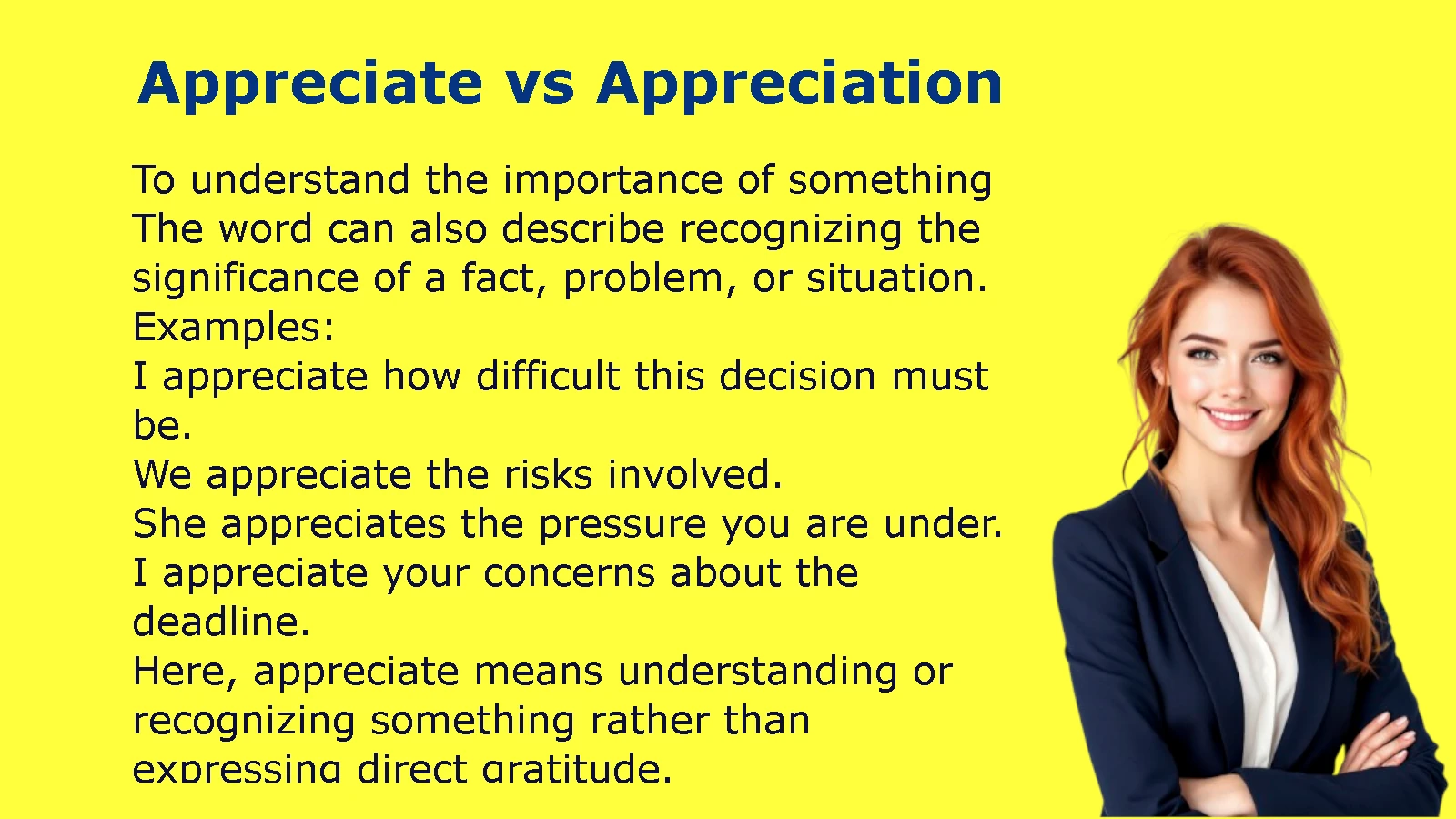
3. To understand the importance of something
The word can also describe recognizing the significance of a fact, problem, or situation.
Examples:
- I appreciate how difficult this decision must be.
- We appreciate the risks involved.
- She appreciates the pressure you are under.
- I appreciate your concerns about the deadline.
Here, appreciate means understanding or recognizing something rather than expressing direct gratitude.
Appreciate as a Verb: Meaning and Examples
Appreciate is a verb, so it describes an action, feeling, or state of understanding. You can use it with a noun, a pronoun, or a verb ending in -ing.
| Sentence | Grammatical structure | Meaning |
| I appreciate your help. | Appreciate + noun phrase | I am grateful for your help. |
| I appreciate it. | Appreciate + pronoun | I am grateful for that action or gesture. |
| I appreciate you. | Appreciate + person | I value you or feel grateful for you. |
| I appreciate your listening. | Appreciate + gerund phrase | I am grateful that you listened. |
| I appreciate how hard you work. | Appreciate + clause | I recognize the effort you make. |
A useful grammar rule is that appreciate usually takes a direct object. You appreciate something, someone, an action, or a situation.
For example, say, “I appreciate your advice,” rather than “I appreciate for your advice.”
You can also say, “I would appreciate your help,” when making a polite request. In this construction, appreciate refers to the gratitude you would feel if someone helped you.
Appreciation vs Appreciate: What’s the Difference?
Appreciate is a verb, while appreciation is a noun. Appreciate describes feeling grateful, recognizing value, or understanding importance. Appreciation names the feeling, recognition, or understanding itself. Both words can express gratitude, but they appear in different sentence structures and cannot always replace one another.
Appreciate vs Appreciation in Grammar
The easiest way to distinguish these words is to look at their grammatical roles.
- Appreciate: A verb that describes what someone feels, recognizes, or understands.
- Appreciation: A noun that names the feeling of gratitude or recognition.
Compare these examples:
- Appreciate: I appreciate your patience.
- Appreciation: I have great appreciation for your patience.
Both sentences communicate gratitude, but the structure changes. In the first sentence, appreciate is the main verb. In the second, appreciation is a noun used after the phrase “have great.”
Other examples include:
- We appreciate your contribution.
- We would like to express our appreciation for your contribution.
- She appreciates his honesty.
- She showed her appreciation for his honesty.
- I appreciate your kindness.
- I have a deep appreciation for your kindness.
Quick rule: Use appreciate when describing what someone does or feels. Use appreciation when referring to gratitude or recognition as a thing.
Appreciate vs Appreciation Examples
The following table shows how the two words work in different contexts.
| Context | Using appreciate | Using appreciation |
| Workplace | I appreciate your feedback. | I have appreciation for your feedback. |
| Personal | I appreciate your friendship. | I feel deep appreciation for your friendship. |
| Customer service | We appreciate your business. | We express our appreciation for your business. |
| Education | I appreciate your explanation. | I want to show my appreciation for your explanation. |
| General recognition | They appreciate her talent. | They have great appreciation for her talent. |
Some sentences sound more natural than others. For instance, “I appreciate your feedback” is more direct and conversational than “I have appreciation for your feedback.”
In formal writing, “We would like to express our appreciation” often fits reports, announcements, speeches, and official messages.
Common Mistakes When Using Appreciate and Appreciation
Writers sometimes confuse the two words because they share the same basic idea.
Here are common mistakes and their corrections:
| Incorrect sentence | Correct sentence | Explanation |
| I am appreciate your help. | I appreciate your help. | Appreciate is a verb and does not need “am” here. |
| I appreciate for your support. | I appreciate your support. | Appreciate takes a direct object without “for.” |
| I have appreciate your kindness. | I appreciate your kindness. | The present-tense verb does not follow “have” in this structure. |
| I want to appreciate for your help. | I want to thank you for your help. | The original construction is unnatural; use a natural expression of thanks. |
| Thank you for your appreciate. | Thank you for your appreciation. | The noun form is required after “your.” |
You can also use “I am grateful for your help” or “I am thankful for your support.” These expressions follow different grammatical patterns but communicate a similar message.
What Does “I Really Appreciate It” Mean?
“I really appreciate it” means “I am very grateful for what you did.” The phrase expresses sincere thanks for a favor, gift, act of kindness, helpful suggestion, or other positive gesture. The word really adds emphasis, making the message warmer or stronger than a simple “I appreciate it.”
For example, if a coworker stays late to help you finish a report, you might say, “I really appreciate it.” You acknowledge both the assistance and the effort behind it.
Meaning of “I Really Appreciate It”
The phrase contains three parts:
- I: The person expressing gratitude.
- Really: An adverb that adds emphasis.
- Appreciate it: An expression of gratitude for an action, favor, or situation.
The pronoun it refers to something already understood from the conversation.
For example:
“Thanks for picking up my package.”
“No problem!”
“I really appreciate it.”
In this exchange, it refers to picking up the package. You do not need to repeat the entire action because the context makes the meaning clear.
The phrase works well in both casual and professional settings. You can use it when someone gives you advice, shares useful information, helps you solve a problem, or makes an extra effort on your behalf.
Examples of “I Really Appreciate It” in Everyday Conversations
Here are original examples showing how the phrase fits different situations.
When a friend helps you
“Thanks for helping me move this weekend. I really appreciate it.”
When a colleague assists with a deadline
“Thank you for reviewing the presentation so quickly. I really appreciate it.”
When someone gives you advice
“Your advice helped me see the problem differently. I really appreciate it.”
When a person makes time for you
“Thanks for taking the time to meet with me today. I really appreciate it.”
When someone offers unexpected help
“You didn’t have to do that, but I really appreciate it.”
Each example expresses gratitude without sounding overly formal. The phrase is especially useful when you want to acknowledge a specific action while keeping your message short.
“I Appreciate It” vs. “I Really Appreciate It”
Both expressions are grammatically correct. The difference is emphasis rather than basic meaning.
| Expression | Meaning | Tone | Best situation |
| I appreciate it. | I am grateful. | Neutral and sincere | Everyday thanks |
| I really appreciate it. | I am very grateful. | Warmer and more emphatic | Meaningful help or extra effort |
| I truly appreciate it. | I sincerely feel grateful. | Personal and sincere | A thoughtful gesture |
| I greatly appreciate it. | I am very grateful. | More formal | Workplace or official communication |
| I appreciate it so much. | I feel a great deal of gratitude. | Warm and expressive | Friends, family, or personal messages |
Consider two situations.
If a colleague sends you a file you requested, “Thanks, I appreciate it” is perfectly suitable.
If that colleague spends an hour correcting errors and helping you meet a deadline, “I really appreciate it” acknowledges the extra effort more clearly.
Practical tip: Use really when you want to add emphasis, not simply to make every thank-you sound stronger. A specific explanation of what you value can sometimes communicate more than another intensifier.
For example, “I really appreciate you taking the time to explain the process” tells the recipient exactly what mattered to you.
What Does “I Appreciate You” Mean?
“I appreciate you” means that you value someone, feel grateful for them, or recognize the positive role they play in your life. Unlike “I appreciate it,” which usually refers to an action or thing, “I appreciate you” focuses on the person. It can communicate warmth, respect, gratitude, and recognition.
For example, you might tell a friend, “I appreciate you always checking in on me.” The message recognizes the person and the consistent support they provide.
Meaning of “I Appreciate You”
When you say “I appreciate you,” you express gratitude toward a person rather than only thanking them for one particular action.
The phrase can communicate several related ideas:
- Gratitude: You are thankful that someone helps or supports you.
- Recognition: You notice the effort or kindness they bring to your life.
- Respect: You value their character, skills, or contribution.
- Affection: You want someone to know they matter to you.
The exact meaning depends on your relationship and the conversation.
A manager might say, “I appreciate you taking responsibility for this project,” to recognize an employee’s contribution. A friend might say, “I appreciate you being there for me,” to acknowledge emotional support.
The phrase is personal, but it is not automatically romantic. Friends, family members, coworkers, and partners can all use it naturally.
“I Appreciate You” vs. “I Appreciate It”
The difference is the object of appreciation.
| Phrase | What you appreciate | Example |
| I appreciate you. | The person | I appreciate you and everything you do. |
| I appreciate it. | An action or gesture | I appreciate it when you help me. |
| I appreciate your help. | A specific contribution | I appreciate your help with the report. |
| I appreciate having you around. | The person’s presence | I appreciate having you around during difficult times. |
Use “I appreciate you” when you want to recognize the person as a whole. Use “I appreciate it” when your main focus is a specific favor or action.
You can combine the two ideas:
“I appreciate you taking the time to help me.”
This sentence expresses gratitude toward the person while identifying the action you value.
What Does “I Really Appreciate You” Mean?
“I really appreciate you” is a stronger, warmer expression of gratitude toward a person. It tells someone that you value their presence, kindness, support, or ongoing contribution. The phrase often feels more personal than thanking someone for a single favor.
Examples:
- I really appreciate you always checking in on me.
- I really appreciate you being honest with me.
- I really appreciate you making time for our family.
- I really appreciate you supporting the team through this busy period.
- I really appreciate you listening without judging me.
Notice how these examples connect appreciation to a person’s ongoing behavior or presence.
The phrase can be especially meaningful when someone has helped you repeatedly. Instead of thanking them for one isolated action, you acknowledge the broader role they play.
For example, after a friend has supported you through several difficult weeks, you might say, “I really appreciate you being there for me.” This communicates more than a simple thank-you because it recognizes their continued care.
When Should You Say “I Appreciate You”?
Use this phrase when you want to make your gratitude more personal.
With friends and family
“I appreciate you always making time for me, even when you’re busy.”
This recognizes an ongoing pattern of kindness rather than one event.
With a romantic partner
“I appreciate you listening to me and helping me feel understood.”
The phrase can express affection and respect without relying on dramatic or overly sentimental language.
At work
“I appreciate you taking the lead on this project.”
This acknowledges a colleague’s contribution while keeping the message professional.
With a mentor or teacher
“I appreciate you sharing your experience and helping me improve.”
This recognizes the person’s guidance and effort.
One useful distinction is that “I appreciate you” sounds more personal than “I appreciate your work.” The first focuses on the individual, while the second focuses on a specific contribution. Choose the version that best matches what you want to recognize.
“Thank You, I Appreciate It”: Meaning and Grammar
“Thank you, I appreciate it” is a natural expression that combines a direct thank-you with an additional statement of gratitude. The first part acknowledges the other person’s action, while the second reinforces that you value the help or gesture. It works in everyday conversations, professional messages, and many formal situations.
Is “Thank You, I Appreciate It” Grammatically Correct?
Yes. Both parts are grammatically correct, but punctuation matters.
The expression contains two independent clauses:
- Thank you.
- I appreciate it.
In standard writing, joining two independent clauses with only a comma creates a comma splice. Therefore, the most polished written versions use a period, semicolon, or coordinating conjunction.
Recommended forms include:
- Thank you. I appreciate it.
- Thank you; I appreciate it.
- Thank you, and I appreciate it.
- Thank you—I appreciate it.
In informal messages, people commonly write “Thank you, I appreciate it” with a comma. Readers will generally understand the intended meaning, but a period is a safer choice in formal writing.
Compare these examples:
Casual text: “Thanks, I appreciate it!”
Professional email: “Thank you for your assistance. I appreciate your support.”
Formal correspondence: “Thank you for your time and consideration. I sincerely appreciate your assistance.”
The best version depends on the level of formality and the relationship between the people communicating.
“Thank You, I Appreciate It” vs. “Thank You, I Really Appreciate It”
Both expressions communicate gratitude, but the second adds emphasis.
| Expression | Tone | Suitable context |
| Thank you. I appreciate it. | Polite and sincere | Everyday thanks |
| Thank you. I really appreciate it. | Warmer and more emphatic | Extra help or meaningful support |
| Thank you so much. | Friendly and enthusiastic | Gifts, favors, or kind gestures |
| Thank you for your assistance. I appreciate it. | Professional | Work emails and formal requests |
| Thanks a lot. I really appreciate it. | Casual and warm | Friends and familiar colleagues |
For example, if someone answers a quick question, “Thank you, I appreciate it” is enough.
If someone rearranges their schedule to help you, “Thank you. I really appreciate it” more clearly recognizes the effort.
You do not need to use both so much and really every time. “Thank you so much; I really appreciate it” is natural, but shorter wording often sounds more direct.
When to Use “Thank You, I Appreciate It”
This expression is useful whenever you want to acknowledge help without writing a long message.
In professional emails
“Thank you for sending the revised document. I appreciate it.”
In everyday conversations
“Thanks for grabbing my coffee. I appreciate it.”
When someone offers support
“Thank you for offering to help. I really appreciate it.”
After receiving feedback
“Thank you for sharing your thoughts. I appreciate your feedback.”
When someone gives you their time
“Thank you for meeting with me today. I appreciate your time.”
To make your message more meaningful, identify what you appreciate. For instance, “I appreciate you reviewing the draft before the meeting” gives the recipient clearer recognition than a generic thank-you.
“I Appreciate It” Synonyms and Alternative Expressions
The best synonym for “I appreciate it” depends on the context, the relationship, and how strongly you want to express gratitude. “I’m grateful” works in personal and formal situations, while “That means a lot to me” sounds more emotional. Professional messages often benefit from specific wording that identifies the help or contribution you value.
Formal Alternatives to “I Appreciate It”
Use these alternatives in professional correspondence, formal requests, and situations that require a respectful tone.
“I am grateful for your assistance.”
Example: “I am grateful for your assistance in preparing the report.”
This works well when you want to sound polished and direct.
“I sincerely appreciate your support.”
Example: “I sincerely appreciate your support throughout this process.”
This is suitable for professional relationships and important contributions.
“Thank you for your time and consideration.”
Example: “Thank you for reviewing my application. I appreciate your time and consideration.”
This expression is especially useful in applications, business correspondence, and formal requests.
“Your help is greatly appreciated.”
Example: “Your help is greatly appreciated as we work toward the deadline.”
This uses the passive voice and emphasizes the value of the help rather than the person expressing gratitude.
“I am thankful for your contribution.”
Example: “I am thankful for your contribution to the team’s success.”
This is a clear way to recognize someone’s work.
Casual Alternatives to “I Appreciate It”
In everyday conversations, simple phrases often sound more natural than formal expressions.
- “Thanks a lot.” Use it to thank someone for a helpful action.
- “That means a lot to me.” Use it when the person’s action has personal significance.
- “You’re a lifesaver.” Use it informally when someone helps you avoid a problem.
- “I owe you one.” Use it when someone does you a favor and you want to suggest returning it later.
- “Thanks for having my back.” Use it when someone supports or defends you.
- “That’s really kind of you.” Use it to recognize a thoughtful gesture.
- “I can’t thank you enough.” Use it when you feel especially grateful.
For example, if a friend drives you to the airport early in the morning, you might say, “You’re a lifesaver. Thanks for doing that.”
If someone offers encouragement during a difficult period, “That means a lot to me” may communicate more warmth than “I appreciate it.”
Professional Alternatives for Emails and Work Messages
Professional gratitude often sounds strongest when it identifies a specific contribution.
| Alternative | Example sentence | Best use |
| Thank you for your help. | Thank you for your help with the client presentation. | General workplace assistance |
| I appreciate your time. | I appreciate your time discussing the proposal. | Meetings and consultations |
| Thank you for your feedback. | Thank you for your feedback on the draft. | Reviews and collaboration |
| I value your input. | I value your input as we finalize the plan. | Team decisions |
| Your support has been very helpful. | Your support has been very helpful during the transition. | Ongoing assistance |
| I am grateful for your guidance. | I am grateful for your guidance throughout the project. | Mentoring and leadership |
Avoid repeating the same thank-you phrase several times in one email. Instead, write one clear expression of gratitude and then move to the next point.
For example:
“Thank you for reviewing the proposal. Your feedback helped me clarify the budget section, and I appreciate the time you spent on it.”
This sounds specific and sincere because it explains what the recipient’s contribution accomplished.
Alternatives to “I Appreciate You”
When your gratitude focuses on a person, choose an expression that reflects the relationship.
For friends
- I’m grateful to have you in my life.
- Thanks for always being there for me.
- I value our friendship.
- I’m glad I can count on you.
For family members
- I’m thankful for everything you do.
- I don’t take your support for granted.
- I’m grateful for all your help.
- I value everything you’ve taught me.
romantic partners
- You mean a lot to me.
- I’m grateful for your love and support.
- I value everything we share.
- I’m thankful to have you by my side.
coworkers and colleagues
- I value your contribution to the team.
- I appreciate your dedication.
- Thank you for being so dependable.
- Your work makes a real difference.
Choose a phrase that reflects your actual meaning. “I value your contribution” recognizes professional work, while “I’m grateful to have you in my life” communicates a more personal connection.
Which Appreciation Phrase Should You Use?
Use this comparison table to choose an expression based on your situation.
| Expression | Best use | Tone |
| I appreciate it. | Acknowledging a favor | Neutral and sincere |
| I really appreciate it. | Emphasizing gratitude | Warm |
| I appreciate you. | Recognizing a person | Personal |
| Thank you. I appreciate it. | Everyday gratitude | Polite |
| I am grateful for your help. | Formal or professional thanks | Respectful |
| That means a lot to me. | Responding to a meaningful gesture | Emotional |
| I value your input. | Recognizing someone’s opinion | Professional |
| I owe you one. | Responding to a favor | Casual |
| Your support is greatly appreciated. | Formal acknowledgment | Professional |
The main principle is simple: match the expression to the person and the situation. You do not need formal language for every thank-you, and you do not need emotional wording for every professional exchange.
“Really Appreciated” vs. “Really Appreciate”
“Really appreciate” expresses gratitude in the present, while “really appreciated” usually expresses gratitude for something in the past or describes something that people value. The correct choice depends on the sentence’s subject, tense, and intended meaning. Both forms are correct when used in the right grammatical structure.
When to Use “Really Appreciate”
Use really appreciate when expressing current gratitude or recognizing something you value now.
Examples:
- I really appreciate your feedback.
- We really appreciate your patience.
- I really appreciate everything you’ve done.
- I really appreciate you taking the time to explain this.
- I would really appreciate your help with this task.
The last example uses would appreciate as a polite way to make a request.
For instance, in a workplace email, you could write:
“Could you send me the updated figures by Thursday? I would really appreciate your help.”
This construction communicates a request politely without sounding demanding.
When to Use “Really Appreciated”
Use really appreciated when talking about gratitude you felt in the past or when describing something that receives appreciation.
Past-tense example:
“I really appreciated your help yesterday.”
The word appreciated refers to gratitude connected to a completed event.
Passive-voice example:
“Your efforts are really appreciated.”
Here, the sentence emphasizes the efforts and the gratitude they receive. The verb phrase are appreciated uses the present tense of be with the past participle appreciated.
Other examples include:
- I really appreciated your advice during the meeting.
- Her kindness was greatly appreciated.
- The extra time you gave us was really appreciated.
- Your continued support is much appreciated.
Remember that appreciated does not always mean past gratitude. In a passive sentence such as “Your work is appreciated,” the sentence can describe how people value the work now.
“I Really Appreciate It” vs. “I Really Appreciated It”
These expressions differ mainly in their time reference.
| Expression | Typical meaning | Example |
| I really appreciate it. | I feel grateful now. | I really appreciate your help with this project. |
| I really appreciated it. | I felt grateful for a past action. | I really appreciated your help yesterday. |
| I would really appreciate it. | A polite request for help | I would really appreciate it if you could review the file. |
| It would be really appreciated. | A polite, passive request or acknowledgment | It would be really appreciated if you could respond by Friday. |
| Your help is really appreciated. | People value your help now. | Your help is really appreciated by the team. |
Compare these two situations:
- Your coworker is helping you right now: “I really appreciate your help.”
- Your coworker helped you last week: “I really appreciated your help last week.”
You can also use the present perfect when the earlier help remains relevant:
“I’ve really appreciated your support throughout this project.”
This form connects past support with your experience up to the present.
Common Grammar Mistakes With Appreciate
Use the following examples to avoid tense and sentence-structure errors.
| Incorrect or awkward | Better version | Why |
| I really appreciated your help tomorrow. | I would really appreciate your help tomorrow. | The request refers to the future. |
| I really appreciate your help yesterday. | I really appreciated your help yesterday. | The past-time reference calls for past tense in this context. |
| Your help really appreciate. | I really appreciate your help. | The sentence needs a subject and a correctly formed verb. |
| I am really appreciate it. | I really appreciate it. | “Am” does not belong in this active construction. |
| I really appreciated it now. | I really appreciate it now. | Present gratitude normally takes the present tense. |
Some sentences may be grammatically possible in unusual contexts, but the alternatives above are more natural for ordinary communication.
How to Use Appreciate Naturally in Sentences
Using appreciate naturally involves more than choosing the correct tense. You should also identify what you value, choose an appropriate level of formality, and consider whether you are thanking someone for one action or recognizing their broader contribution.
Appreciate Someone’s Help or Support
When someone helps you, follow appreciate with a noun phrase or a gerund phrase.
Examples:
- I appreciate your help with the assignment.
- We appreciate your support during the transition.
- I really appreciate you helping me prepare for the interview.
- I appreciate everyone who contributed to the event.
- Thank you for your patience. I appreciate your understanding.
You can also acknowledge the result of someone’s assistance.
Instead of writing, “I appreciate your help,” you could say, “I appreciate your help in resolving the issue before the deadline.”
The second sentence tells the recipient why their contribution mattered. That extra detail can make your message feel more personal without making it much longer.
Appreciate Someone’s Time or Effort
Time and effort are common reasons to express appreciation, particularly in professional settings.
Examples:
- I appreciate you taking the time to meet with me.
- We appreciate the effort you put into the presentation.
- Thank you for reviewing the report. I appreciate your attention to detail.
- I appreciate your flexibility with the schedule.
- We really appreciate the extra work you did to meet the deadline.
When writing to a client, manager, or colleague, specificity matters. “I appreciate your time” is polite, but “I appreciate you making time for this discussion during a busy week” recognizes the effort more clearly.
Appreciate Something Beyond a Favor
Appreciate is not limited to thanking people for practical help. You can also use it to recognize opportunities, ideas, qualities, and experiences.
Appreciating feedback
“I appreciate your honest feedback because it helped me improve the proposal.”
Appreciating an opportunity
“I appreciate the opportunity to work with your team.”
Appreciating a person’s perspective
“I appreciate your point of view, even though I see the situation differently.”
Appreciating a quality
“I appreciate her patience and willingness to explain complicated ideas.”
Appreciating an experience
“I’ve learned to appreciate the value of taking a break from work.”
These examples show that appreciation can communicate gratitude, understanding, and recognition. The surrounding words make the intended meaning clear.
Appreciate in Formal vs. Informal English
The word appreciate works in both formal and informal English, but the wording around it can change the tone.
| Situation | Natural expression |
| Texting a friend | Thanks, I really appreciate it! |
| Thanking a family member | I appreciate everything you do for me. |
| Emailing a coworker | I appreciate your help with the report. |
| Writing to a manager | I appreciate your guidance on this project. |
| Contacting a client | We appreciate your time and consideration. |
| Thanking a mentor | I sincerely appreciate your advice and support. |
You generally do not need to make the phrase complicated to sound professional. Clear, specific wording often works better than expressions packed with formal adjectives.
For instance, “I appreciate your help resolving the scheduling issue” is direct and professional. “I wish to convey my deepest appreciation for your invaluable assistance” may sound unnecessarily elaborate in a routine email.
A Practical Example: Choosing the Right Phrase
Imagine that a colleague helps you prepare for an important presentation. You want to thank them in a message.
Option one: A simple acknowledgment
“Thanks, I appreciate it.”
This works when the help was small or the conversation is casual.
Option two: A more specific expression
“Thank you for reviewing my slides. I really appreciate your feedback.”
This recognizes the particular action and adds warmth.
Option three: Recognition of the person
“I really appreciate you taking the time to help me prepare. Your advice made the presentation much clearer.”
This expresses gratitude, recognizes the person’s effort, and explains the impact.
The third option often works well when someone has made a meaningful contribution. It does not rely on stronger adjectives alone; it explains what you value and why.
Key Takeaways: Choosing the Right Appreciation Phrase
Understanding the difference between appreciate, appreciation, and common gratitude phrases helps you communicate more naturally in personal and professional situations.
Keep these rules in mind:
- Appreciate is a verb: “I appreciate your help.”
- Appreciation is a noun: “I want to express my appreciation.”
- I really appreciate it expresses strong gratitude for an action, favor, or gesture.
- I appreciate you recognizes a person and the value they bring to your life or work.
- Thank you. I appreciate it. is a clear, grammatically sound way to combine thanks with additional gratitude.
- Really appreciate usually expresses present gratitude, while really appreciated often refers to past gratitude or appears in passive constructions.
- Synonyms should match the situation: “That means a lot to me” sounds personal, while “I appreciate your assistance” fits professional communication.
When you want your gratitude to sound sincere, choose a phrase that fits the relationship and identifies what you value. A short, specific thank-you often communicates more than an elaborate sentence.
Try using one of these expressions in your next email or conversation. Instead of relying on a generic thank-you, mention the person’s help, time, advice, or support so they understand exactly what you appreciate.
Frequently Asked Questions
What Is the Difference Between “Appreciate” and “Appreciation”?
Appreciate is a verb that describes feeling grateful or recognizing value. Appreciation is a noun that names the feeling or recognition. For example, “I appreciate your help” uses a verb, while “I want to show my appreciation” uses a noun.
What Does “I Really Appreciate It” Mean?
“I really appreciate it” means that you feel very grateful for something someone has done. The phrase often acknowledges a favor, helpful action, thoughtful gesture, or effort. For example, “Thank you for picking me up. I really appreciate it.”
What Does “I Appreciate You” Mean?
“I appreciate you” means that you value someone or feel grateful for their presence, kindness, support, or contribution. It focuses on the person rather than only one action. The phrase can be used with friends, family members, partners, and coworkers.
Is “Thank You, I Appreciate It” Grammatically Correct?
The wording is natural, but formal writing should avoid joining two independent clauses with only a comma. Write “Thank you. I appreciate it” or “Thank you; I appreciate it” for a grammatically sound alternative. In casual messages, the comma-separated version is common.
What Is Another Way to Say “I Appreciate It”?
Alternatives include “I’m grateful,” “That means a lot to me,” “Thank you for your help,” and “I value your support.” Choose based on the context. “That means a lot to me” sounds personal, while “I appreciate your assistance” fits professional communication.
Should I Say “Really Appreciated” or “Really Appreciate”?
Use “really appreciate” for present gratitude, as in “I really appreciate your help.” Use “really appreciated” for gratitude about a past event, as in “I really appreciated your help yesterday.” However, “Your work is really appreciated” can describe appreciation in the present.