Afterward or afterwards is a common spelling and usage question that can come up when you’re writing a sentence about something happening later. Both forms refer to a time that follows an event or action, but their usage can vary depending on American and British English. If you’ve wondered whether you should write “afterward” or “afterwards,” the answer is simpler than it may seem.
The afterward or afterwards question refers to two adverbs that have the same basic meaning: later, subsequently, or after something has happened. Afterward is especially common in American English, while afterwards is more common in British English and other varieties of English. Neither form is inherently incorrect, but your choice may depend on the variety of English you’re using.
In this guide, you’ll learn whether to use “afterward” or “afterwards,” the difference between the two forms, which spelling is preferred in American and British English, and how to use each word correctly in a sentence. You’ll also see clear examples to help you understand when afterward and afterwards sound natural.
By the end, you’ll know exactly whether “afterward” or “afterwards” is correct and how to choose the right form for your writing.
Afterward vs. Afterwards: Quick Answer
The short answer is simple: both “afterward” and “afterwards” are correct.
| Word | Correct? | Meaning | Typical preference |
| afterward | Yes | Later; after something | More common in US English |
| afterwards | Yes | Later; after something | Especially common in UK English |
| after word | No, when meaning “later” | — | Incorrect form |
| afterword | Yes, but different word | A concluding section of a book | Different meaning |
Cambridge defines afterward as an adverb meaning “after the time mentioned” and labels it US. Its entry for afterwards labels that form mainly UK and notes that US English usually uses afterward. Cambridge Dictionary
That distinction gives you an easy rule:
Use “afterward” for general US English. Use “afterwards” when following British English conventions.
However, don’t treat the British form as an error in American writing. Afterwards is also an established form in US English. Cambridge Dictionary
What Does Afterward Mean?
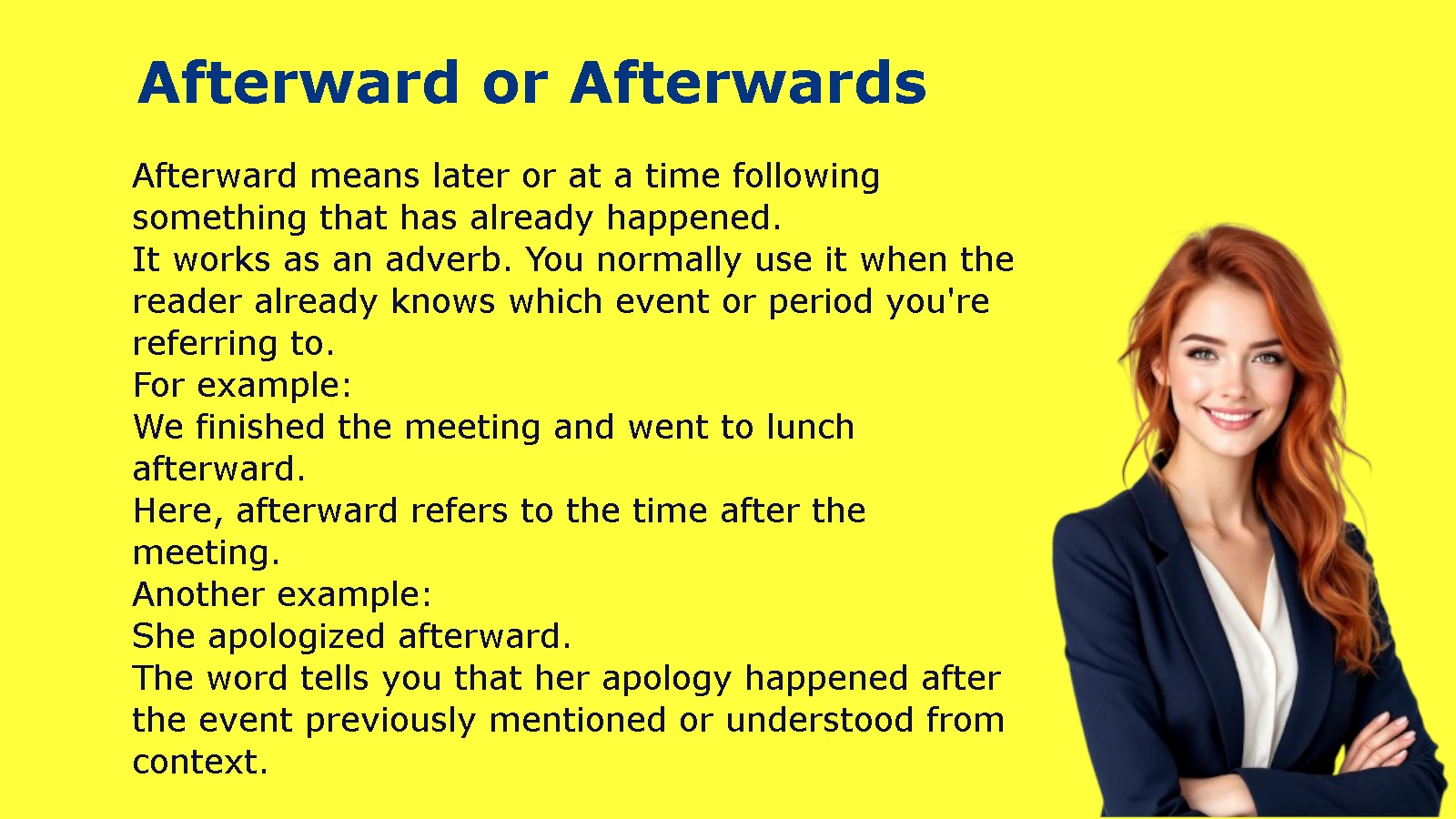
Afterward means later or at a time following something that has already happened.
It works as an adverb. You normally use it when the reader already knows which event or period you’re referring to.
For example:
We finished the meeting and went to lunch afterward.
Here, afterward refers to the time after the meeting.
Another example:
She apologized afterward.
The word tells you that her apology happened after the event previously mentioned or understood from context.
Cambridge gives the same basic definition: afterward refers to what happens “after the time mentioned.” Cambridge Dictionary
Examples of Afterward
- We talked about the problem afterward.
- He called me afterward.
- She felt better afterward.
- They went home afterward.
- I’ll explain everything afterward.
- The team celebrated afterward.
- We realized our mistake shortly afterward.
- She moved to another city soon afterward.
Notice how afterward usually points backward to an event that provides the time reference.
What Does Afterwards Mean?
Afterwards has essentially the same meaning as afterward: later or after something else has happened.
The important difference isn’t meaning. It’s usage preference by region.
For example:
We had dinner and went for a walk afterwards.
The sentence means the same thing as:
We had dinner and went for a walk afterward.
Cambridge describes afterwards as an adverb meaning “after the time mentioned” and marks it as mainly UK usage. Cambridge Dictionary
Examples of Afterwards
- We went home afterwards.
- She called me afterwards.
- They discussed the issue afterwards.
- He regretted his decision afterwards.
- We grabbed coffee afterwards.
- She apologized afterwards.
- The two friends talked about it afterwards.
- They left shortly afterwards.
In each example, afterwards indicates a later point following an event.
Afterward vs. Afterwards: What’s the Difference?
The most important fact is this:
There is no meaningful difference in definition between “afterward” and “afterwards.”
Both words function as adverbs. Both refer to a later time. Both can describe something that happens after a previously mentioned event.
The distinction mainly comes down to regional English.
| Feature | Afterward | Afterwards |
| Part of speech | Adverb | Adverb |
| Basic meaning | Later | Later |
| Refers to | A later time | A later time |
| American English | Preferred form | Also used |
| British English | Used | Especially common |
| Meaning changes? | No | No |
| Grammatically correct? | Yes | Yes |
Cambridge’s American English entry uses afterward as the main form and lists afterwards as an alternative. Its British-oriented entry does the reverse in terms of regional preference. Cambridge Dictionary
So you don’t need to memorize two different definitions.
You only need to remember the style difference.
Is Afterward or Afterwards More Common in American English?
For American English, afterward is generally the better default.
If you’re writing an article, school assignment, business email, website, report, or other material for a US audience, afterward will fit naturally:
We discussed the results afterward.
The researchers conducted a follow-up interview afterward.
She realized what had happened shortly afterward.
Cambridge’s US dictionary explicitly labels afterward as a US form and notes afterwards as another form. Cambridge Dictionary
That doesn’t mean Americans never write afterwards. They do. The word is recognized in American English, and major dictionaries include it. Cambridge Dictionary
The practical rule is simply:
If you need a default for US English, choose “afterward.”
Is Afterwards More Common in British English?
Yes. Afterwards is especially common in British English.
Cambridge labels afterwards as mainly UK and gives examples such as:
We had tea, and afterwards we sat in the garden.
It also identifies afterward as the usual US form. Cambridge Dictionary
That makes afterwards a natural choice in British writing:
- We went to the pub afterwards.
- She called me afterwards.
- They discussed the decision afterwards.
- He apologized shortly afterwards.
Still, British English speakers understand afterward perfectly well. The shorter form isn’t a grammatical error in Britain.
Likewise, American readers won’t be confused by afterwards. It simply has a stronger British association.
Afterward or Afterwards in American and British English
Regional preference becomes much easier to understand when you see the two forms side by side.
American English
American English generally favors afterward:
We went out for dinner afterward.
She called me shortly afterward.
They discussed the results afterward.
He realized his mistake soon afterward.
British English
British English commonly favors afterwards:
We went out for dinner afterwards.
She called me shortly afterwards.
They discussed the results afterwards.
He realized his mistake soon afterwards.
The meaning doesn’t change. Only the preferred form does.
The Easy Regional Rule
Think of it this way:
US English → afterward
UK English → afterwards
This isn’t an absolute rule. It’s a useful style preference, not a strict grammar law.
Afterward or Afterwards in a Sentence
Both words can appear naturally in the same types of sentences.
Examples With Afterward
- We went home afterward.
- I spoke with my manager afterward.
- The doctor called me afterward.
- They discussed the meeting afterward.
- She felt embarrassed afterward.
- We learned what had happened afterward.
Examples With Afterwards
- We went home afterwards.
- I spoke with my manager afterwards.
- The doctor called me afterwards.
- They discussed the meeting afterwards.
- She felt embarrassed afterwards.
- We learned what had happened afterwards.
The sentences communicate the same basic idea.
Beginning, Middle, and End of a Sentence
You can place afterward in different positions:
Afterward, we went home.
We afterward discussed the results.
We went home afterward.
The first and last positions tend to sound more natural in everyday English.
The same applies to afterwards:
Afterwards, we went home.
We went home afterwards.
The exact placement depends on rhythm, emphasis, and sentence structure.
Afterward vs. Afterwards: Sentence Comparison
One of the easiest ways to understand the difference is to compare sentences where only the final -s changes.
| American-style example | British-style example |
| We went home afterward. | We went home afterwards. |
| She called me afterward. | She called me afterwards. |
| We talked about it afterward. | We talked about it afterwards. |
| They celebrated afterward. | They celebrated afterwards. |
| He apologized afterward. | He apologized afterwards. |
| We met again shortly afterward. | We met again shortly afterwards. |
There is no change in the event being described.
The difference is stylistic and regional.
When Should You Use Afterward?
Use afterward when you’re writing in American English or when you simply want the more typical US form.
It’s particularly useful when your audience includes:
- American readers
- US customers
- American students
- US businesses
- American publications
- General international readers who expect US English
For example:
The company announced the changes and explained the reasons afterward.
That’s completely natural in American English.
More Examples
We can discuss the details afterward.
She went home afterward.
The team held a short meeting afterward.
He didn’t understand the consequences until afterward.
Shortly afterward, the situation changed.
That last construction is especially common.
When Should You Use Afterwards?
Use afterwards when you’re writing primarily in British English or when you want your word choice to match British usage.
For example:
We went to the restaurant afterwards.
She spoke to the manager afterwards.
They discussed the decision afterwards.
Shortly afterwards, the company announced another change.
Again, there’s no grammatical problem with the word.
The choice simply reflects the variety of English you’re using.
Afterward vs. Afterwards: Common Mistake
The biggest mistake is assuming that one of these forms must be wrong.
That’s not the case.
Is Afterward Wrong?
No.
Afterward is a standard English adverb. It is particularly associated with American English. Cambridge lists it as a US form and defines it as meaning “after the time mentioned.” Cambridge Dictionary
Is Afterwards Wrong?
No.
Afterwards is also a standard English adverb. It is particularly common in British English. Cambridge identifies it as mainly UK while also recognizing its use in American English. Cambridge Dictionary
Can You Use Them Interchangeably?
In most contexts, yes.
Compare:
We went shopping afterward.
We went shopping afterwards.
The meaning stays the same.
The important consideration is consistency with your chosen variety of English.
If the rest of your article follows US spelling and vocabulary, afterward will usually fit better. If the article follows British conventions, afterwards may sound more natural.
Afterward vs. Later
Although afterward and later can sometimes replace each other, they aren’t perfect synonyms in every situation.
Afterward usually connects a later event directly to something previously mentioned.
We finished dinner and went for a walk afterward.
Here, afterward clearly means after dinner.
Later has a broader meaning.
I’ll call you later.
That sentence doesn’t necessarily identify a specific event that comes first. It simply places the call at a future time.
Cambridge distinguishes afterwards from later in a similar way. Later can refer to a later time without necessarily describing something that directly follows the first event. Cambridge Dictionary
Compare the Two
| Word | Typical meaning | Example |
| afterward | After a particular event | We ate dinner and left afterward. |
| later | At some later time | I’ll call you later. |
| afterwards | After a particular event | We ate dinner and left afterwards. |
This distinction matters when you want to make the time relationship clear.
Afterward vs. After
After and afterward overlap in meaning, but they don’t always play the same grammatical role.
After can function as a preposition, conjunction, or adverb. For example:
We left after dinner.
Here, after introduces the noun phrase dinner.
It can also introduce a clause:
We left after the meeting ended.
And it can function as an adverb:
We met again soon after.
Afterward, on the other hand, functions as an adverb meaning that something happened at a later time.
We had dinner and went home afterward.
Cambridge’s grammar guidance explains that after can work as a preposition or conjunction, while afterwards commonly serves as an adverb. Cambridge Dictionary
Compare These Sentences
We talked after the meeting.
We talked afterward.
The first sentence tells you what event provides the time reference. The second relies on context to identify that event.
Afterward vs. Afterwards vs. Afterword
This distinction deserves special attention because afterword looks very similar to afterward and afterwards.
The three words aren’t interchangeable.
| Word | Meaning | Example |
| afterward | Later | We talked afterward. |
| afterwards | Later | We talked afterwards. |
| afterword | A concluding section of a book | The author included an afterword. |
An afterword is a piece of writing that appears at the end of a book or another work.
For example:
The author added an afterword explaining how the novel came together.
You wouldn’t write:
We talked afterword.
That’s incorrect if you mean later.
A Simple Memory Trick
Think:
- afterward = when
- afterwards = when
- afterword = what you read
The final part of afterword refers to a word or written section, not a later point in time.
Is Afterward One Word?
Yes. Afterward is written as one word.
Correct:
We talked afterward.
Incorrect when you mean “later”:
We talked after word.
The two-word form after word could theoretically occur when the words have their literal meanings in a particular sentence, but it isn’t the spelling of the adverb afterward.
For the meaning “later,” always use:
afterward
Is Afterwards One Word?
Yes. Afterwards is also written as one word.
Correct:
We talked afterwards.
Not:
We talked after words.
The spelling contains after + wards, not after + words.
This small difference can cause confusion because the words look similar when spoken quickly. In writing, however, the distinction is clear.
Common Phrases With Afterward and Afterwards
Both forms appear in several common time expressions.
Shortly Afterward / Shortly Afterwards
Both are correct:
The announcement came shortly afterward.
The announcement came shortly afterwards.
Shortly afterward is especially natural in US English, while shortly afterwards fits British English well.
Soon Afterward / Soon Afterwards
Again, both are correct:
They moved away soon afterward.
They moved away soon afterwards.
The phrase means that the second event happened relatively soon after the first.
Immediately Afterward / Immediately Afterwards
Both forms work:
He called immediately afterward.
He called immediately afterwards.
The word immediately emphasizes that very little time passed between the two events.
Other Natural Combinations
You may also see:
- right afterward
- right afterwards
- soon afterward
- soon afterwards
- shortly afterward
- shortly afterwards
- immediately afterward
- immediately afterwards
- a few minutes afterward
- a few minutes afterwards
The regional preference remains the same.
Afterward or Afterwards in Formal Writing
Both forms are acceptable in formal writing.
The important issue isn’t whether one sounds “more formal.” Instead, choose the form that matches your English variety and style guide.
Academic Writing
US academic writing can comfortably use:
The researchers collected additional data afterward.
British academic writing can use:
The researchers collected additional data afterwards.
Neither sentence is inherently more scholarly.
Business Writing
For an American business audience:
We can review the contract afterward.
For a British audience:
We can review the contract afterwards.
Again, the difference is regional rather than formal versus informal.
Professional Reports
Consistency matters more than choosing one form as universally superior.
If a report uses US English throughout, afterward is the natural default. If it follows British English conventions, afterwards is a good fit.
Afterward or Afterwards: A Practical Case Study
Imagine an American company publishes this sentence on its website:
Customers will receive a confirmation email shortly afterwards.
The sentence isn’t grammatically wrong. American readers will understand it immediately.
However, if the company’s editorial policy follows US English and generally prefers American forms, the editor might change it to:
Customers will receive a confirmation email shortly afterward.
Now imagine a British publication using:
Customers will receive a confirmation email shortly afterward.
Again, there’s nothing fundamentally wrong with the sentence. Yet afterwards may fit the publication’s British style more naturally:
Customers will receive a confirmation email shortly afterwards.
The Lesson
The correction isn’t about right versus wrong.
It’s about matching the intended variety of English.
That distinction prevents unnecessary “corrections” that turn a regional preference into a fake grammar rule.
Afterward vs. Afterwards: Facts to Remember
If you only remember a few points, remember these:
- Afterward is correct.
- Afterwards is correct.
- Both words mean later or after something else has happened.
- Both function as adverbs.
- Afterward is generally preferred in US English.
- Afterwards is especially common in UK English.
- Afterwards also appears in American English.
- Afterword is a different word with a different meaning.
- After word isn’t the normal spelling when you mean “later.”
- For a US audience, afterward is usually the safest default.
Afterward or Afterwards: Which One Should You Use?
For US English, use afterward as your default.
For British English, afterwards is often the more natural choice.
That’s the cleanest answer.
| If you’re writing for… | Best default |
| United States | afterward |
| United Kingdom | afterwards |
| A general US-English website | afterward |
| A British publication | afterwards |
| Formal US writing | afterward |
| Formal British writing | afterwards |
Don’t worry about treating the other form as an error. Major dictionaries recognize both forms. The difference is primarily one of regional usage and preference. Cambridge Dictionary
FAQs About Afterward or Afterwards
Is afterward or afterwards correct?
Both are correct. Afterward and afterwards both mean “later” or “after something else has happened.” Afterward is generally preferred in American English, while afterwards is especially common in British English. Cambridge Dictionary
Is afterward correct in American English?
Yes. Afterward is a standard American English form. Cambridge labels it as US usage and defines it as meaning “after the time mentioned.” Cambridge Dictionary
Is afterwards correct in American English?
Yes. Afterwards is also used in American English, although afterward is generally the usual US form. Cambridge Dictionary
Is afterwards British or American?
Afterwards is especially associated with British English. Cambridge labels it “mainly UK” and notes that US English usually uses afterward. Cambridge Dictionary
Is afterward British or American?
Afterward is especially associated with American English, although British English speakers also understand and use it. Cambridge identifies it as a US form and lists afterwards as the mainly UK alternative. Cambridge Dictionary
Do afterward and afterwards mean the same thing?
Yes. In normal usage, they have the same meaning. Both refer to a later time following something previously mentioned.
Which is more common, afterward or afterwards?
It depends on the variety of English. Afterward is generally preferred in American English, while afterwards is especially common in British English. Cambridge Dictionary
Can I use afterward and afterwards interchangeably?
In most sentences, yes. You can usually replace one with the other without changing the meaning. However, choose the form that fits your target variety of English.
Is “after word” correct?
Not when you mean “later.” The correct adverb is afterward or afterwards.
What is the difference between afterward and afterword?
Afterward means “later.” Afterword refers to a concluding section of a book or other written work.
For example:
We spoke afterward.
But:
The author wrote an afterword.
Is afterward more correct than afterwards?
No. Afterward isn’t inherently more correct. It is simply the preferred form in American English. Afterwards is a standard form as well and is especially common in British English.
Should I use afterward in an American English article?
Yes. If you’re deliberately writing in US English, afterward is usually the better default because it matches the prevailing American preference. Cambridge Dictionary
Conclusion: Afterward and Afterwards Are Both Correct
The afterward vs. afterwards question has a straightforward answer: both spellings are correct.
They mean the same thing. Both function as adverbs that describe something happening at a later time.
The real distinction comes from regional usage.
Afterward is generally preferred in American English, while afterwards is especially common in British English. Cambridge explicitly reflects this distinction by identifying afterward as a US form and afterwards as mainly UK. Cambridge Dictionary
So if you’re writing for an American audience, choose:
afterward
If you’re writing for a British audience, choose:
afterwards
Neither one is a misspelling. Just match the form to your audience and keep your usage consistent.
And don’t confuse either word with afterword, which means something entirely different.