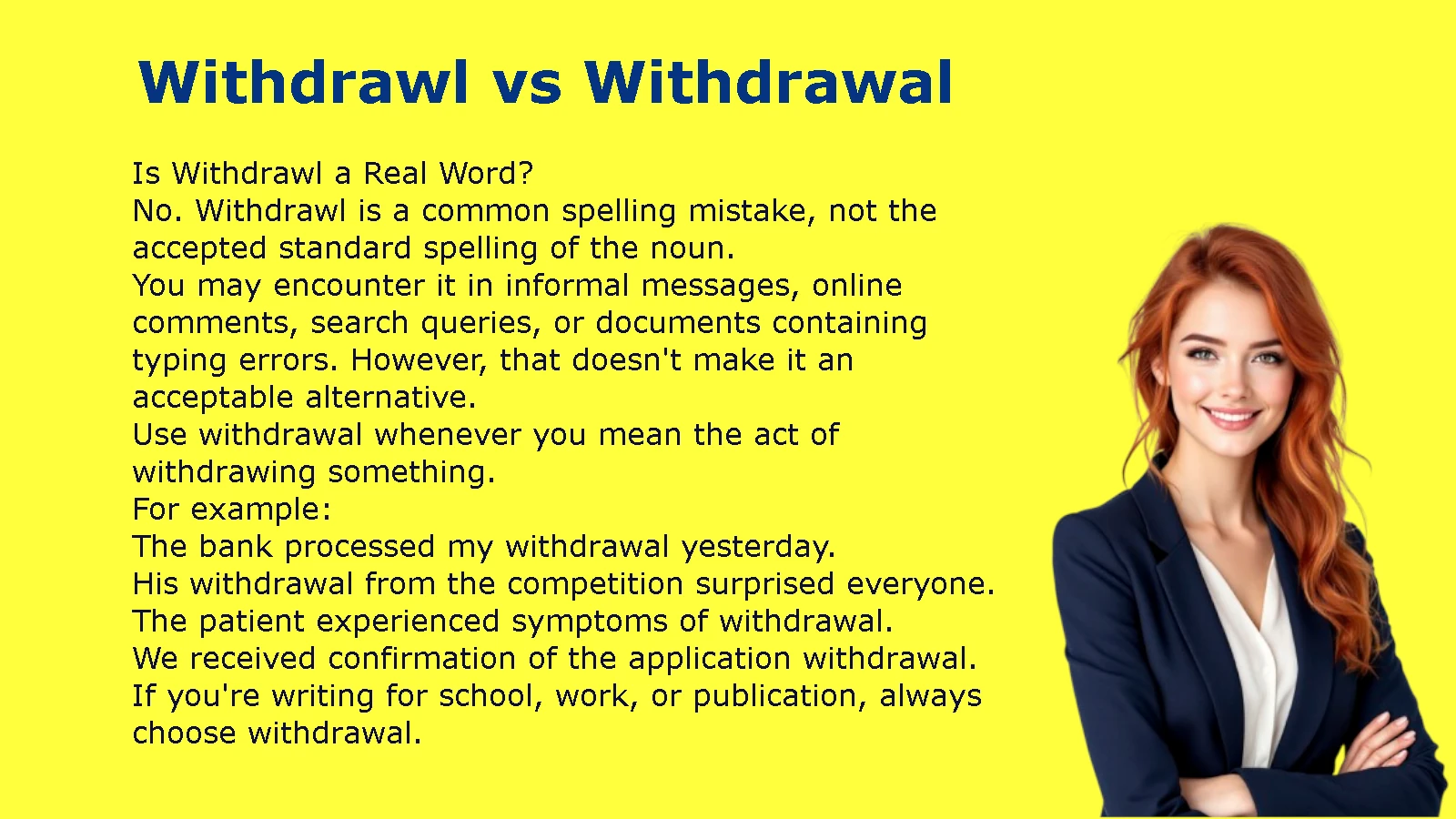
Withdrawl vs withdrawal is a common spelling question, but only withdrawal is the correct standard spelling. Withdrawl is a misspelling of withdrawal. The correct word is a noun that describes the act of taking something back, removing something, or stopping participation in an activity. The verb form is withdraw, while withdrew and withdrawn are its past-tense forms.
You can use withdrawal when discussing banking transactions, drug withdrawal, school enrollment, or application cancellations. However, you should use withdraw when describing the action itself. Understanding the difference between withdraw, withdrawal, withdrew, and withdrawn will help you choose the right form in everyday writing.
| Question | Answer |
| Is it withdrawl or withdrawal? | Withdrawal is the correct spelling. |
| What does withdrawal mean? | It means the act of taking something back, removing it, or stopping participation. |
| What is the difference between withdraw and withdrawal? | Withdraw is a verb; withdrawal is a noun. |
| Is it withdraw or withdrawal money? | Use withdraw money because withdraw describes the action. |
| Is it withdrew or withdrawn? | Withdrew is the simple past tense; withdrawn is the past participle. |
Withdrawl vs Withdrawal: Which Spelling Is Correct?
Withdrawal is the correct spelling in standard English. The spelling withdrawl is incorrect and should not appear in formal writing, academic work, business documents, or professional communication.
The confusion often occurs because people recognize the verb withdraw but aren’t sure how to form its noun. English spelling doesn’t always make these changes obvious. In this case, the noun takes the ending -al, producing withdrawal rather than withdrawl.
Compare these examples:
- Correct: I requested a withdrawal from my savings account.
- Incorrect: I requested a withdrawl from my savings account.
- Correct: She decided to withdraw from the course.
- Incorrect: She decided to withdrawal from the course.
The distinction is straightforward: withdrawal names an action or process, while withdraw describes performing that action.
Why Is Withdrawal the Correct Spelling?
The word withdrawal comes from the verb withdraw combined with the noun-forming suffix -al.
This suffix appears in many English nouns that describe an action, process, or result. For example:
| Verb | Noun |
| Arrive | Arrival |
| Approve | Approval |
| Refuse | Refusal |
| Renew | Renewal |
| Withdraw | Withdrawal |
Notice that withdrawal retains the complete base word withdraw and adds -al. The final letters of the verb don’t disappear.
This pattern explains why withdrawl is incorrect. It leaves out the a that belongs in the noun ending.
Is Withdrawl a Real Word?
No. Withdrawl is a common spelling mistake, not the accepted standard spelling of the noun.
You may encounter it in informal messages, online comments, search queries, or documents containing typing errors. However, that doesn’t make it an acceptable alternative.
Use withdrawal whenever you mean the act of withdrawing something.
For example:
- The bank processed my withdrawal yesterday.
- His withdrawal from the competition surprised everyone.
- The patient experienced symptoms of withdrawal.
- We received confirmation of the application withdrawal.
If you’re writing for school, work, or publication, always choose withdrawal.
Withdrawl vs Withdrawal: Spelling Comparison
| Word | Correct? | Explanation |
| Withdrawal | Yes | Standard English noun |
| Withdrawl | No | Misspelling of withdrawal |
| Withdraw | Yes | Present-tense verb |
| Withdrew | Yes | Simple past-tense verb |
| Withdrawn | Yes | Past participle |
| Withdrawals | Yes | Plural form of withdrawal |
Remember: The correct noun contains the letters a and l at the end: withdrawal.
What Does Withdraw Mean?
Withdraw is a verb that means to take something away, remove something, pull back, or stop participating in an activity.
Its exact meaning depends on the situation. You might withdraw money from a bank, withdraw an application, withdraw from a school course, or withdraw from a conversation.
The word can describe both physical and nonphysical actions.
For example:
- I need to withdraw some cash before the trip.
- The athlete decided to withdraw from the tournament.
- The company may withdraw its offer.
- He chose to withdraw from the discussion.
In each sentence, withdraw describes an action.
What Does Withdrawal Mean?
Withdrawal is a noun that describes the act or process of withdrawing.
It can refer to removing money, leaving an activity, taking back a statement, or experiencing physical or psychological effects after reducing or stopping a substance.
Here are some examples:
- The bank approved her withdrawal.
- His withdrawal from the program became official on Monday.
- The team announced the withdrawal of its original proposal.
- Some substances can cause withdrawal symptoms when a person stops using them.
Unlike withdraw, which tells you what someone does, withdrawal names the action, event, or process.
Withdraw vs Withdrawal: Main Differences
The most important difference between these words is their grammatical function.
| Feature | Withdraw | Withdrawal |
| Part of speech | Verb | Noun |
| Meaning | To remove or take something back | The act or process of removing or taking something back |
| Example | I will withdraw the money. | I made a cash withdrawal. |
| Common use | Describes an action | Names an action or event |
| Plural form | Not applicable | Withdrawals |
Consider these sentences:
- I plan to withdraw from the competition.
- My withdrawal from the competition surprised my coach.
The first sentence describes what you plan to do. The second identifies the event itself.
Withdraw and Withdrawal in Different Contexts
Both words appear in several everyday situations, but their grammatical roles stay the same.
| Context | Correct verb usage | Correct noun usage |
| Banking | Withdraw money | Make a withdrawal |
| School | Withdraw from a course | Request a withdrawal |
| Employment | Withdraw an application | Application withdrawal |
| Competition | Withdraw from the event | Tournament withdrawal |
| Addiction | Withdraw from a substance | Drug withdrawal |
| Business | Withdraw an offer | Withdrawal of an offer |
The context changes the meaning, but it doesn’t change the spelling or grammatical function.
Withdraw vs Withdrawal vs Withdrawn
Withdraw is the base verb. Withdrawal is its noun form, while withdrawn is the past participle of the verb. Choosing the right one depends on the sentence structure and the time of the action.
Withdraw: The Base Verb
Use withdraw to describe an action in the present or future, or after certain helping verbs.
Examples:
- I want to withdraw my application.
- They may withdraw their support.
- You can withdraw cash from this ATM.
- We decided to withdraw from the event.
- The school allows students to withdraw from selected courses.
The word also appears after modal verbs such as can, could, may, might, should, and will.
For example:
- She might withdraw her complaint.
- You should withdraw your request if it is no longer necessary.
Withdrawal: The Noun
Use withdrawal when you need a noun to identify the action or process.
Examples:
- The withdrawal of the offer disappointed the applicants.
- My bank charged a fee for the cash withdrawal.
- The university approved his course withdrawal.
- Drug withdrawal can involve several physical symptoms.
You can often recognize the noun because it follows an article, adjective, or possessive word.
For example:
- A withdrawal
- The withdrawal
- A sudden withdrawal
- Her withdrawal
- Several withdrawals
Withdrawn: The Past Participle
Withdrawn is the past participle of withdraw. It usually appears with a helping verb such as has, have, had, or was.
Examples:
- She has withdrawn her application.
- The company had withdrawn its offer.
- The money was withdrawn yesterday.
- Several students have withdrawn from the program.
The word can also function as an adjective describing someone who is quiet, reserved, or less socially involved.
For example:
- He became more withdrawn after moving to a new city.
- The normally outgoing child seemed withdrawn during the meeting.
Withdraw vs Withdrawal vs Withdrawn: Comparison Table
| Word | Part of speech | Meaning | Example |
| Withdraw | Verb | To remove or take back | I will withdraw my request. |
| Withdrawal | Noun | The act of withdrawing | Her withdrawal was unexpected. |
| Withdrawn | Past participle | Removed or taken back | The offer has been withdrawn. |
| Withdrawn | Adjective | Quiet or socially reserved | He seems withdrawn today. |
Quick rule: Use withdraw for the action, withdrawal for the noun, and withdrawn when forming perfect tenses or describing a completed removal.
Withdrew vs Withdrawn: What’s the Difference?
Withdrew and withdrawn are both correct forms of the verb withdraw, but they have different grammatical uses.
Withdrawn is the past participle. It usually appears with helping verbs such as has, have, and had.
When to Use Withdrew
Use withdrew when describing a completed past action without a helping verb.
Examples:
- She withdrew her application last week.
- I withdrew $200 from the ATM.
- The player withdrew from the competition.
- The company withdrew its proposal after the meeting.
- He withdrew from the conversation without explaining why.
In each example, withdrew tells you that the action happened in the past.
When to Use Withdrawn
Use withdrawn with a helping verb to form a perfect tense or passive construction.
Examples:
- She has withdrawn her application.
- They had withdrawn their support before the announcement.
- The money was withdrawn from the account.
- The proposal has been withdrawn.
- Several participants have withdrawn from the event.
The helping verb gives the sentence its tense or voice.
Withdrew vs Withdrawn: Common Mistakes
Writers sometimes use these two forms interchangeably, but they aren’t interchangeable in standard grammar.
| Incorrect sentence | Correct sentence |
| She has withdrew her application. | She has withdrawn her application. |
| He withdrawn from the race yesterday. | He withdrew from the race yesterday. |
| I have withdrew the money. | I have withdrawn the money. |
| The company had withdrew its offer. | The company had withdrawn its offer. |
A simple way to remember the difference is to look for a helping verb.
- Without a helping verb: She withdrew.
- With has, have, or had: She has withdrawn.
A Simple Example of All Three Forms
Consider this short example:
I decided to withdraw from the course last month. My withdrawal was approved, and the school confirmed that I had officially withdrawn.
This paragraph uses all three forms correctly:
- Withdraw: The base verb describes the action.
- Withdrawal: The noun identifies the process.
- Withdrawn: The past participle appears with had.
Withdraw or Withdrawal From Drugs?
When discussing substance use, both withdraw and withdrawal are correct, but they have different grammatical roles.
Use withdraw to describe stopping or reducing the use of a substance. Use withdrawal to describe the symptoms or process that may follow.
For example:
- He decided to withdraw from the substance-use program.
- The patient experienced withdrawal symptoms after stopping the substance.
The second sentence uses the noun to name the process.
What Does Drug Withdrawal Mean?
Drug withdrawal refers to physical and psychological symptoms that can occur when someone who has developed dependence on a substance reduces or stops using it.
The symptoms vary depending on the substance, the person’s health, the amount used, and the duration of use.
Possible symptoms include:
- Anxiety or restlessness
- Sweating
- Nausea or vomiting
- Sleep difficulties
- Tremors
- Changes in mood
- Muscle aches
- Cravings
Not everyone experiences the same symptoms. Some withdrawal processes can also involve serious medical risks.
For example, withdrawal from alcohol or certain sedative medications can cause dangerous complications. Anyone who may be physically dependent on these substances should seek medical guidance before stopping. A healthcare professional can help determine whether supervised treatment is needed.
Withdraw or Withdrawal: Which Is Correct in Addiction?
Choose the word according to the sentence.
| Intended meaning | Correct expression | Example |
| Stop using a substance | Withdraw | He plans to withdraw from substance use with professional support. |
| Describe the symptoms | Withdrawal | Alcohol withdrawal can require medical supervision. |
| Discuss multiple withdrawal experiences | Withdrawals | The discussion covered withdrawals associated with different substances. |
| Describe someone who stopped using a substance | Has withdrawn | She has withdrawn from the substance under medical care. |
The plural withdrawals can refer to separate withdrawal experiences or different types of withdrawal. However, the uncountable use of withdrawal is common when discussing the general process.
Withdraws or Withdrawals: Which Form Is Correct?
These words look similar, but they have different grammatical functions.
Withdraws is a verb form used with singular third-person subjects, such as he, she, or it.
Withdrawals is the plural form of the noun withdrawal.
Examples:
- He withdraws from social activities when he feels overwhelmed.
- The report discusses several types of substance withdrawals.
- She withdraws her support whenever the conditions change.
- The clinic provides information about different withdrawal symptoms.
The subject and meaning determine which word you need.
Withdrawl vs Withdrawal in Banking
In banking, withdrawal is the correct noun for the act of taking money out of a bank account. Withdraw is the verb that describes taking that money out.
For example:
- I need to withdraw $100 from my account.
- I made a withdrawal of $100 yesterday.
Both sentences are correct because each word has a different grammatical role.
Withdraw Money or Withdrawal Money?
The correct expression is withdraw money, not withdrawal money.
This is because withdraw is the verb that takes money as its object.
Correct examples:
- I want to withdraw money from my savings account.
- Can I withdraw cash from this ATM?
- She needs to withdraw money before traveling.
- They plan to withdraw funds from the business account.
Use withdrawal when the sentence needs a noun.
Correct examples:
- The bank processed my withdrawal.
- There is a daily cash withdrawal limit.
- The ATM rejected the withdrawal request.
- The account shows three cash withdrawals this month.
What Is a Bank Withdrawal?
A bank withdrawal is a transaction in which money leaves a bank account because the account holder takes it out.
People commonly withdraw money through:
- ATMs
- Bank branches
- Debit card cash transactions
- Eligible online or mobile banking services
- Other approved banking channels
Banks may set daily withdrawal limits, charge certain transaction fees, or require additional verification depending on the account and transaction type.
A withdrawal reduces the available balance in the account. For example, if your account contains $1,000 and you withdraw $150, the balance becomes $850, assuming no other transactions or fees.
Withdrawal vs Withdrawals in Banking
Use the singular withdrawal for one transaction and the plural withdrawals for more than one.
| Form | When to use it | Example |
| Withdrawal | One transaction | I made a withdrawal today. |
| Withdrawals | Multiple transactions | The statement lists four withdrawals. |
| Withdraw | The action | I need to withdraw some cash. |
| Withdraws | Action by a singular third-person subject | He withdraws money every Friday. |
| Withdrew | Past action | She withdrew $300 yesterday. |
| Withdrawn | Past participle | The funds have been withdrawn. |
Remember: You withdraw money, but you make a withdrawal.
Withdraw or Withdrawal From School?
When discussing education, withdraw means to leave a course, class, or academic program. Withdrawal is the noun that describes the process or formal decision.
For example:
- I want to withdraw from my mathematics course.
- My course withdrawal was approved by the university.
Both expressions are correct.
What Does Withdrawal From School Mean?
Withdrawal from school generally means that a student formally stops attending a school, course, or academic program.
The exact meaning depends on the institution and the type of enrollment.
A student might withdraw because of:
- Personal or family circumstances
- Financial difficulties
- Health concerns
- A change in academic plans
- Employment commitments
- A decision to attend another institution
- Difficulty managing the course workload
Some schools distinguish between withdrawing from one course and withdrawing from an entire program.
For example, a university student might withdraw from one class while remaining enrolled in the rest of their courses.
Withdraw From a Course vs Course Withdrawal
Use withdraw from a course when describing the action.
Use course withdrawal when referring to the formal process or event.
Examples:
- She decided to withdraw from the course before the deadline.
- The registrar approved her course withdrawal.
- Students must complete a form to withdraw from a class.
- The university recorded the withdrawal on his academic transcript.
Schools may have different deadlines, refund rules, and transcript policies. Students should check their institution’s requirements before submitting a withdrawal request.
Withdraw vs Drop Out: Are They the Same?
Not exactly. Both expressions describe leaving an educational activity, but they can suggest different situations.
Withdraw often refers to a formal process. A student may complete an official form and follow the institution’s procedures.
Drop out usually means leaving a school or program before completing it. The phrase can describe a broader decision and doesn’t necessarily imply a formal administrative process.
| Expression | Meaning | Example |
| Withdraw from a course | Formally leave a course | She withdrew from biology. |
| Course withdrawal | The formal act or process | His course withdrawal was approved. |
| Drop out | Leave a school or program before completion | He dropped out of college. |
For official academic documents, withdraw and withdrawal are often more precise when describing a formal enrollment change.
Withdraw or Withdrawal From an Application?
When discussing applications, withdraw means to take back or remove an application that has already been submitted. Withdrawal refers to the act or process of doing so.
For example:
- I want to withdraw my job application.
- The company confirmed the withdrawal of my application.
The correct word depends on whether you need a verb or a noun.
What Does It Mean to Withdraw an Application?
To withdraw an application means to formally stop asking an organization to consider it.
This can happen in several situations:
- A job applicant accepts another offer.
- A student decides not to attend a university.
- A person no longer wants to pursue a visa or permit application.
- A business changes its plans and withdraws a submitted proposal.
- An applicant discovers that they no longer meet the requirements.
For example:
After accepting another job offer, Maria decided to withdraw her application from the second company.
The sentence uses withdraw because Maria performs the action.
What Does Application Withdrawal Mean?
Application withdrawal is the noun phrase used to describe the act of taking back an application.
Examples:
- Your application withdrawal has been confirmed.
- The admissions office received a request for application withdrawal.
- The company processed the candidate’s withdrawal.
- The applicant submitted a formal withdrawal request.
Withdraw Application vs Withdrawal of Application
Both phrases are correct, but they fit different sentence structures.
| Expression | Grammatical role | Example |
| Withdraw an application | Verb phrase | I want to withdraw my application. |
| Application withdrawal | Noun phrase | The application withdrawal was approved. |
| Withdrawal of an application | Noun phrase | The withdrawal of the application was confirmed. |
| Application has been withdrawn | Passive construction | Her application has been withdrawn. |
A useful rule is to use withdraw an application when someone performs the action and withdrawal of an application when you refer to the action as an event or process.
Withdraw: Verb Forms and Word Family
Understanding the different forms of withdraw will help you avoid mistakes in everyday writing.
The verb is irregular, so its past-tense form doesn’t follow the usual pattern of adding -ed.
All Forms of Withdraw
| Verb form | Word | Example |
| Base form | Withdraw | I plan to withdraw my request. |
| Third-person singular | Withdraws | She withdraws her offer. |
| Present participle | Withdrawing | They are withdrawing from the event. |
| Simple past | Withdrew | He withdrew his application. |
| Past participle | Withdrawn | The application has been withdrawn. |
Notice that withdrew and withdrawn are different. You shouldn’t use one in place of the other.
Is Withdraw a Regular or Irregular Verb?
Withdraw is an irregular verb.
Regular verbs generally form their simple past tense and past participle by adding -ed. For example:
- Walk → Walked → Walked
- Open → Opened → Opened
- Accept → Accepted → Accepted
However, withdraw changes its form:
– Withdraw → Withdrew → Withdrawn
This is why expressions such as withdrawed are incorrect in standard English.
Correct examples:
- I withdrew the money yesterday.
- She has withdrawn her application.
- They are withdrawing from the agreement.
Singular and Plural Forms of Withdrawal
Withdrawal is a countable noun when it refers to a specific act or transaction. Its plural form is withdrawals.
| Form | Usage | Example |
| Withdrawal | Singular noun | One withdrawal appeared on my statement. |
| Withdrawals | Plural noun | Three withdrawals appeared on my statement. |
The plural form follows the regular spelling rule: add -s to the singular noun.
Examples:
- The bank recorded a large withdrawal.
- The bank recorded several withdrawals.
- Her withdrawal from the program was unexpected.
- Multiple student withdrawals affected the class size.
The verb form withdraws is different from the noun form withdrawals.
Compare:
- She withdraws money every month. (Verb)
- She makes several withdrawals every month. (Noun)
Common Withdraw Word-Family Mistakes
| Incorrect | Correct | Reason |
| Withdrawl | Withdrawal | Incorrect noun spelling |
| Withdrawed | Withdrew | Incorrect simple past |
| Has withdrew | Has withdrawn | Past participle required |
| Withdrawal money | Withdraw money | Verb required |
| He withdrawal from school | He withdrew from school | Verb required |
| Several withdraw | Several withdrawals | Plural noun required |
These errors often happen when writers confuse the verb and noun forms.
Synonyms of Withdraw and Withdrawal
The words withdraw and withdrawal have several synonyms. However, not every alternative works in every situation. The best choice depends on the meaning you want to communicate.
Synonyms of Withdraw
| Synonym | Meaning | Example |
| Remove | Take something away | Please remove your name from the list. |
| Retract | Take back a statement or claim | He retracted his earlier statement. |
| Recall | Ask for something to be returned | The company recalled its offer. |
| Revoke | Officially cancel something | The authority revoked the permit. |
| Pull out | Stop participating | The team decided to pull out of the tournament. |
| Retreat | Move back or away | The soldiers retreated from the area. |
| Resign | Leave a position voluntarily | She resigned from her role. |
| Discontinue | Stop an activity or process | The company discontinued the service. |
These synonyms have different shades of meaning. For example, retract often applies to statements, while revoke usually refers to permission, authority, or an official decision.
Synonyms of Withdrawal
| Synonym | Meaning | Example |
| Removal | The act of taking something away | The removal of the offer was unexpected. |
| Retraction | The act of taking back a statement | The newspaper published a retraction. |
| Cancellation | The act of ending an arrangement | The cancellation was confirmed. |
| Departure | The act of leaving | Her departure surprised the team. |
| Retreat | A move away from a position | The retreat happened quickly. |
| Discontinuation | The act of stopping something | The discontinuation affected customers. |
| Pullout | The act of leaving an activity or agreement | The company’s pullout changed the plans. |
Choose synonyms carefully. A bank withdrawal, a withdrawal from school, and a withdrawal from an agreement don’t always have the same meaning. The context determines which alternative sounds natural.
How to Remember the Correct Spelling of Withdrawal
The easiest way to remember the correct spelling is to connect the noun with its base verb.
Withdraw + al = Withdrawal
The word keeps the complete spelling of withdraw and adds -al.
Try these simple reminders:
- Remember the a before the final l.
- Connect withdrawal with arrival and approval, which also use the -al ending.
- Use withdraw when describing an action.
- Use withdrawal when naming the action or process.
- Check whether the sentence needs a verb or a noun before choosing a form.
You can also remember the distinction through these short examples:
- I withdraw money.
- I make a withdrawal.
- I withdrew money yesterday.
- I have withdrawn money before.
Reading the four sentences together makes the difference easier to recognize.
Common Examples of Withdraw and Withdrawal in Sentences
The following examples show how to use the words correctly in everyday situations.
Examples With Withdraw
- I need to withdraw cash before going shopping.
- She plans to withdraw her application tomorrow.
- The player decided to withdraw from the tournament.
- You can withdraw your consent at any time, subject to applicable rules.
- He chose to withdraw from the conversation.
- The company may withdraw its proposal.
- Students can withdraw from the course before the deadline.
- They decided to withdraw their support.
With Withdrawal
- The bank processed my withdrawal this morning.
- Her withdrawal from the competition surprised the audience.
- The university approved his course withdrawal.
- The company announced the withdrawal of its offer.
- The patient received information about possible withdrawal symptoms.
- The application withdrawal was confirmed by email.
- Several cash withdrawals appeared on the statement.
- His social withdrawal concerned his family.
Examples With Withdrew
- She withdrew her application after accepting another offer.
- I withdrew money from the ATM.
- The team withdrew from the competition.
- The company withdrew its original proposal.
- He withdrew from the discussion.
Examples With Withdrawn
- She has withdrawn her application.
- The company had withdrawn its offer before the announcement.
- The funds were withdrawn from the account.
- Several students have withdrawn from the program.
- The proposal has been withdrawn.
Frequently Asked Questions About Withdrawl vs Withdrawal
Is It Withdrawl or Withdrawal?
Withdrawal is the correct spelling. Withdrawl is a misspelling and isn’t accepted as the standard form in modern English. Use withdrawal when referring to the act or process of taking something back, removing it, or stopping participation.
What Is the Difference Between Withdraw and Withdrawal?
Withdraw is a verb that describes the action of taking something away or stopping participation. Withdrawal is a noun that names the action or process. For example, you withdraw money from a bank, but you make a bank withdrawal.
Is It Withdraw or Withdrawal Money?
The correct phrase is withdraw money. The word withdraw is a verb, so it can take money as its object. For example, “I need to withdraw money from my account.” Use withdrawal when referring to the transaction itself, as in “I made a cash withdrawal.”
Is It Withdrew or Withdrawn?
Withdrew is the simple past tense of withdraw, while withdrawn is the past participle. Use withdrew for a completed past action, such as “She withdrew her application.” Use withdrawn with a helping verb, as in “She has withdrawn her application.”
Is Withdraws or Withdrawals Correct?
Both are correct, but they have different grammatical functions. Withdraws is the third-person singular verb form, as in “He withdraws money every week.” Withdrawals is the plural noun, as in “The statement lists several withdrawals.”
What Does Withdrawal Mean in Addiction?
In addiction-related contexts, withdrawal describes symptoms that may occur when someone who has developed dependence on a substance reduces or stops using it. Symptoms vary by substance and individual. Some forms of withdrawal can be medically dangerous, so professional guidance is important before stopping certain substances.
What Is the Plural of Withdrawal?
The plural of withdrawal is withdrawals. Add -s to the singular noun. For example, “The bank recorded two withdrawals today.” Remember that withdraws is a verb, not the plural form of the noun.
Can I Use Withdrawal as a Verb?
No. Withdrawal is a noun, not a verb. Use withdraw when describing the action. For example, write “I want to withdraw from the course,” not “I want to withdrawal from the course.”
Final Takeaway: Withdrawl vs Withdrawal
The correct spelling is withdrawal, not withdrawl. Although the two forms look similar, only withdrawal is the accepted standard spelling.
The most important distinction is grammatical:
- Withdraw is the verb: I will withdraw my application.
- Withdrawal is the noun: My application withdrawal was approved.
- Withdrew is the simple past: She withdrew her application.
- Withdrawn is the past participle: She has withdrawn her application.
- Withdrawals is the plural noun: The bank recorded several withdrawals.
Whether you’re writing about banking, school enrollment, job applications, or drug withdrawal, these rules remain the same. Remember the spelling withdrawal, and choose the form that fits the sentence.













