What vs which is a common English grammar comparison that explains when to use each word in questions and sentences. What generally asks for open-ended information, while which usually asks someone to select or identify something from a known or limited group. However, both words can function as interrogative pronouns, determiners, and relative pronouns, depending on the sentence structure.
Understanding the difference between what and which helps you form clearer questions, choose the correct words, and avoid common grammar mistakes. The distinction also applies to expressions such as what or which country, what or which time, and relative pronoun constructions involving which, what, and that.
This guide covers their meanings, grammar rules, sentence examples, related pronouns, and practical exercises to help you use them correctly.
| Question | Answer |
| What is the main difference between what and which? | What asks for general or open-ended information, while which usually identifies a choice from an identifiable group. |
| Should I use what or which for a country? | Use what country for an open-ended question and which country when selecting from known options. |
| Is it what time or which time? | What time is the standard expression for asking about a clock time. |
| Can what and which be relative pronouns? | Yes. Which introduces ordinary relative clauses, while what can introduce free relative clauses. |
| What is the difference between which and that? | Which commonly introduces nonrestrictive relative clauses, while that commonly introduces restrictive clauses in American English. |
What Is the Difference Between What and Which?
What and which are interrogative words that help people request information. Their main difference involves the type of answer expected. What generally introduces an open-ended question, while which usually asks someone to identify an option from a particular group.
For example:
- What is your favorite movie?
- Which movie do you want to watch, the comedy or the thriller?
The first question allows almost any movie as an answer. The second presents specific alternatives.
However, this distinction is not an absolute rule. You can use which without explicitly listing the available options if the context makes the choices clear.
What Meaning and Examples
What is an interrogative pronoun or determiner used to ask about information, identity, descriptions, characteristics, and possibilities.
It usually appears when the speaker does not have a specific set of choices in mind. The person answering can provide almost any suitable response.
For example:
- What is your name?
- What do you do for a living?
- What kind of books do you enjoy?
- What happened during the meeting?
- What are your plans for the weekend?
- What makes this product different?
In each example, the question requests information without restricting the answer to a predetermined list.
What as an interrogative pronoun
An interrogative pronoun replaces a noun and works independently in a sentence.
Examples:
- What happened outside?
- What do you need?
- What belongs to you?
- What makes you happy?
Here, what represents the information or object the speaker wants to identify.
What as an interrogative determiner
An interrogative determiner appears before a noun to ask about its identity or characteristics.
Examples:
- What color do you prefer?
- What subject are you studying?
- What time does the store open?
- What movie did you watch?
In these sentences, what modifies a noun rather than replacing it.
Which Meaning and Examples
Which is an interrogative pronoun or determiner used to ask someone to identify a particular person or thing from an identifiable group.
The choices may be explicitly mentioned, previously discussed, or understood from the situation.
For example:
- Which dress should I wear?
- Which student answered the question?
- Which of these books belongs to you?
- Which route is faster?
- Which restaurant would you recommend?
The speaker expects the other person to identify a suitable option from a relevant group.
Which as an interrogative pronoun
Which can replace a noun when the speaker wants someone to identify a particular item.
Examples:
- Which is yours?
- Which do you prefer?
- Which belongs to your brother?
- Which should we choose?
Which as an interrogative determiner
Which also appears before a noun to identify something from an established or understood selection.
Examples:
- Which phone do you use?
- Which country would you visit?
- Which employee completed the assignment?
- Which answer is correct?
Notice that which does not always require two choices. A group can contain two, ten, or hundreds of possibilities. The important point is that the selection is identifiable within the context.
What vs Which: Quick Comparison Table
The following table highlights the main grammatical and practical differences.
| Feature | What | Which |
| Main purpose | Requests information | Requests identification or selection |
| Typical choices | Open-ended | Identifiable or limited |
| Grammatical function | Pronoun or determiner | Pronoun or determiner |
| Common use | General questions | Specific choices |
| Example | What food do you enjoy? | Which food should we order? |
| Expected response | A broad range of answers | An identifiable option |
| Context | Often unrestricted | Usually a known group |
Compare these examples:
- What language do you speak? (The speaker does not know which languages you speak.)
- Which language do you speak at home, English or Spanish? (The speaker presents specific alternatives.)
The difference becomes clearer when you consider the speaker’s expectations rather than simply counting the available choices.
Can What and Which Be Used Interchangeably?
Yes, what and which can sometimes appear in similar questions. However, they may communicate different expectations.
Consider these examples:
- What book are you reading?
- Which book are you reading?
Both sentences are grammatically correct. The first asks for general information about the book. The second suggests that the speaker has a particular selection or group of books in mind.
Another example:
- What subject do you like?
- Which subject do you like?
The first question allows an unrestricted answer. The second may suggest a known set of school subjects.
Use the following guidelines:
- Choose what when you want general information.
- Choose which when you want someone to identify a particular option.
- Consider the surrounding conversation before selecting either word.
- Remember that both words can introduce questions about people, places, objects, and ideas.
How to Use What and Which in Questions
What and which both introduce direct and indirect questions. The correct choice depends on whether you want general information or an answer connected to an identifiable selection.
They can appear before nouns, independently as pronouns, and within longer question structures.
How to Use What in a Question
Use what when you want someone to provide information without choosing from a particular group.
It commonly introduces questions about identity, descriptions, activities, preferences, and events.
Examples:
| Question | Purpose |
| What is your favorite sport? | Asking about a preference |
| What happened yesterday? | Asking about an event |
| What do you need? | Asking about a requirement |
| What is your profession? | Asking about someone’s occupation |
| What makes you nervous? | Asking about a feeling or cause |
| What are you studying? | Asking about an activity |
What also appears in indirect questions.
For example:
- I don’t know what she wants.
- Can you tell me what happened?
- He asked what time the meeting started.
- We discussed what caused the problem.
Notice the word order in indirect questions. They generally follow statement structure rather than direct-question inversion.
Correct: Can you tell me what she wants?
Incorrect: Can you tell me what does she want?
How to Use Which in a Question
Use which when you want someone to identify an option from an identifiable group.
You can use it before a noun or independently.
Which + noun
Examples:
- Which dress matches these shoes?
- Which employee is responsible for this project?
- Which country has the strongest economy?
- Which route takes less time?
- Which chapter should I read first?
Which of + determiner or pronoun
Examples:
- Which of these answers is correct?
- Which of the students won the competition?
- Which of them lives nearby?
- Which of your friends knows about the event?
The expression which of is especially useful when the speaker wants someone to select from an established group.
One important grammar point: use a plural noun or plural pronoun after the relevant group expression, but the verb agrees with the subject represented by which.
For example:
- Which of these books is yours?
- Which of the students are absent?
The verb depends on the intended meaning and whether the question identifies one item or asks about multiple people or things.
What or Which Country: Which Is Correct?
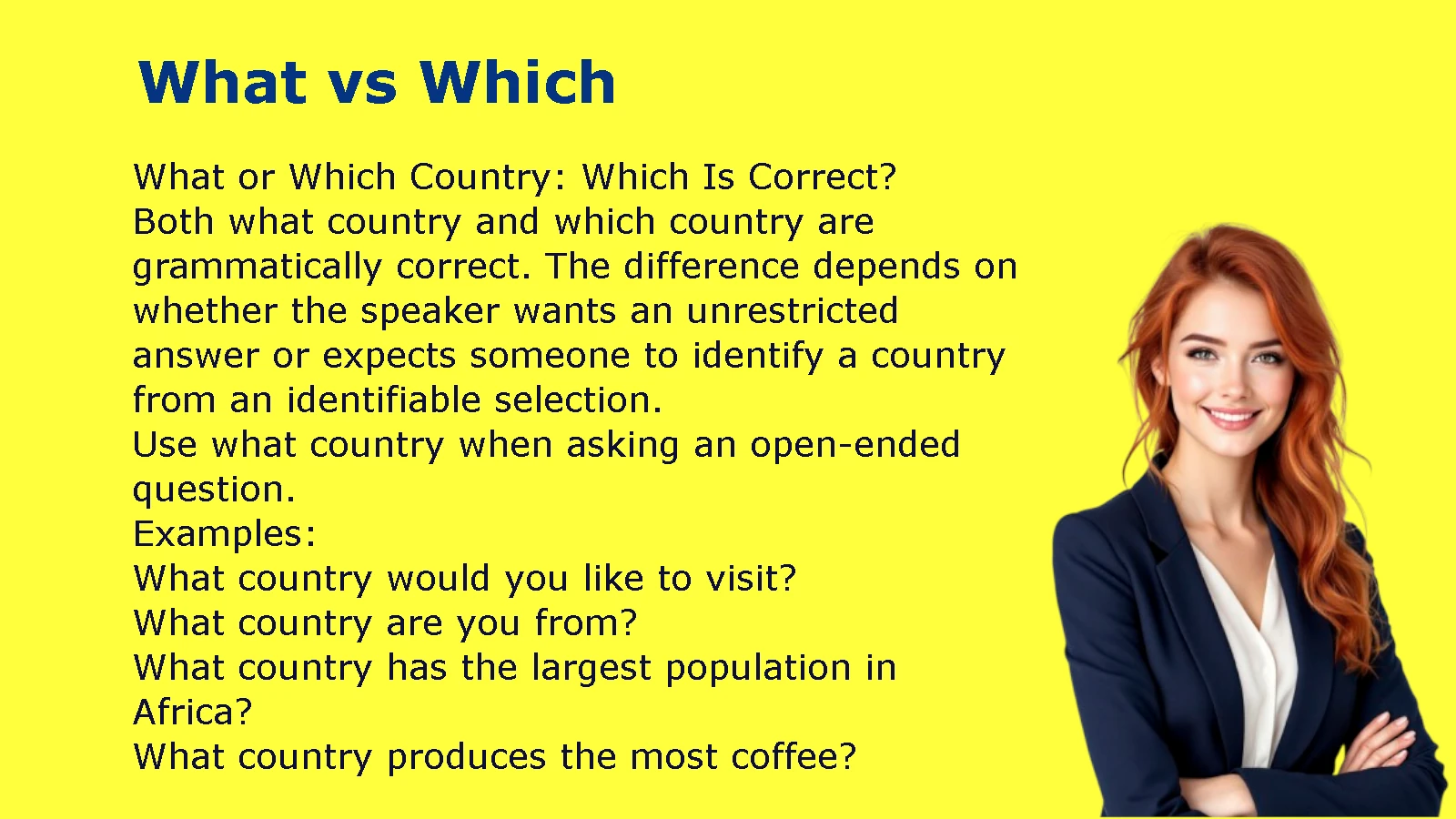
Both what country and which country are grammatically correct. The difference depends on whether the speaker wants an unrestricted answer or expects someone to identify a country from an identifiable selection.
Use what country when asking an open-ended question.
Examples:
- What country would you like to visit?
- What country are you from?
- What country has the largest population in Africa?
- What country produces the most coffee?
Use which country when the question involves a particular selection or known group.
Examples:
- Which country would you choose, Canada or Australia?
- Which country is larger, Germany or France?
- Which country in this list has the highest population?
- Which country should we visit first on our European trip?
What country vs which country comparison
| Sentence | Correct choice | Reason |
| ___ country would you like to explore? | What | Open-ended travel preference |
| ___ country is larger, Brazil or Argentina? | Which | Two identifiable alternatives |
| ___ country are you originally from? | What | General identity question |
| ___ country in this list has the lowest tax rate? | Which | Selection from a known list |
| ___ country would you move to if you could live anywhere? | What | Unrestricted possibilities |
A useful distinction is that a country does not automatically require which just because countries form a recognizable group.
For example, “What country would you like to visit?” is perfectly natural even though the world has a finite number of countries.
The speaker’s intended scope matters more than the theoretical size of the group.
What or Which Time: Which Should You Use?
What time is the standard expression for asking about a clock time. Which time is appropriate when someone must select between specific appointments, schedules, or time options.
Examples using what time:
- What time does your flight leave?
- What time should we meet?
- What time does the office close?
- What time did you arrive home?
- What time does the movie begin?
These questions request a particular clock time without presenting a selection.
Examples using which time:
- Which time works better for you, 9 a.m. or 11 a.m.?
- Which time should I book for your appointment?
- Which time slot would you prefer?
- Which time is available from the three options?
What time vs which time comparison
| Expression | Correct usage | Example |
| What time | Asking for a clock time | What time is the train arriving? |
| Which time | Selecting a specific time option | Which time should I reserve? |
| What time | Asking about a schedule | What time does your class start? |
| Which time | Comparing appointments | Which time suits your schedule better? |
Practical tip: When asking someone about the time of an event, use what time. When asking someone to select between appointment slots, use which time.
Common Mistakes When Using What and Which
English learners sometimes treat these words as interchangeable in every situation. This can make a question sound unnatural or change its intended meaning.
Here are common mistakes and their corrections.
| Incorrect or less natural usage | Better expression | Explanation |
| Which time does the train arrive? | What time does the train arrive? | Asking for a clock time |
| What of these options is correct? | Which of these options is correct? | Selecting from a known group |
| Which is your name? | What is your name? | Asking for someone’s identity |
| What one do you prefer? | Which one do you prefer? | Selecting from identifiable options |
| Which country are you from? | What country are you from? | The open-ended version is more natural |
Some sentences may be grammatically possible but less natural in everyday English. Context can also make a less common construction appropriate.
To avoid mistakes, ask yourself:
- Am I requesting general information?
- Am I selecting from a known group?
- Has the conversation already established the available choices?
- Does the question ask for a clock time or a choice between appointments?
These simple checks will help you select the appropriate word.
What and Which as Relative Pronouns
What and which can also introduce relative constructions, but they do not perform exactly the same grammatical function.
Which commonly introduces relative clauses that provide information about an antecedent. What can introduce a free relative clause, where the word itself represents the thing being discussed.
Understanding this distinction helps prevent sentence construction errors.
Difference Between What and Which as Relative Pronouns
A relative pronoun introduces a clause that connects additional information to another part of a sentence.
Which normally refers to an antecedent, meaning a noun or noun phrase mentioned earlier.
Example:
“The laptop which I purchased last month works perfectly.”
Here:
- Antecedent: the laptop
- Relative pronoun: which
- Relative clause: which I purchased last month
The relative clause identifies or describes the laptop.
In contrast, what can introduce a free relative construction without an expressed antecedent.
Example:
“I understood what you explained.”
Here, what means “the thing that you explained.” The word already contains the meaning of the thing being discussed.
Compare the following:
| Feature | Which | What |
| Construction | Ordinary relative clause | Free relative clause |
| Antecedent | Usually expressed | Not separately expressed |
| Main function | Refers back to a noun or clause | Represents the thing being discussed |
| Example | The car which I bought is new. | I like what you bought. |
More examples using which:
- The house which stands near the river belongs to my uncle.
- The report which you submitted contains several errors.
- The movie which we watched was entertaining.
- The proposal, which everyone supported, passed easily.
More examples using what:
- I appreciate what you did for me.
- She explained what happened during the meeting.
- What he said surprised everyone.
- You should focus on what matters most.
A common mistake is using what after an expressed antecedent in an ordinary relative clause.
Incorrect: The book what I borrowed was interesting.
Correct: The book which I borrowed was interesting.
Correct: What I borrowed was interesting.
The last sentence works because what introduces a free relative construction.
When to Use Which in a Relative Clause
Use which when you want to introduce a relative clause referring to a previously mentioned thing or idea.
There are two important types of relative clauses: restrictive and nonrestrictive.
Restrictive relative clauses
A restrictive relative clause provides essential information about a noun. Without that information, the reader may not know exactly which person or thing you mean.
Examples:
- The computer which has a damaged screen needs repair.
- The documents which contain errors must be revised.
- The car which belongs to my father is parked outside.
In these examples, the relative clauses help identify the specific nouns.
In American English, many writers prefer that over which in restrictive clauses.
Nonrestrictive relative clauses
A nonrestrictive relative clause adds extra information about an already identified noun.
Examples:
- My computer, which I purchased last year, still works well.
- The Eiffel Tower, which stands in Paris, attracts millions of visitors.
- Her latest novel, which received excellent reviews, became a bestseller.
Notice the commas around the additional information.
The relative clause adds detail but does not determine which computer, tower, or novel the speaker means.
Which referring to an entire clause
Which can also refer to an entire preceding statement rather than just one noun.
Example:
“He missed the final train, which meant he had to stay overnight.”
Here, which refers to the entire situation of missing the train.
This construction is useful when you want to connect an event with its consequence.
What vs Which: Relative Pronoun Examples
The following examples demonstrate how these words function in different sentence structures.
| Sentence | Word | Function |
| The dress which she bought is beautiful. | Which | Refers to the dress |
| I like what she bought. | What | Represents the thing she bought |
| The information which you provided was useful. | Which | Refers to information |
| What you told me was helpful. | What | Represents the information |
| The decision, which surprised everyone, was announced yesterday. | Which | Adds nonessential information |
Remember these rules:
- Use which to refer to an expressed antecedent in an ordinary relative clause.
- Use what when the meaning is “the thing that” or “the things that.”
- Do not normally use what immediately after an expressed antecedent.
- Use commas to separate nonrestrictive relative clauses.
Common Relative Pronoun Mistakes
Relative pronoun mistakes often occur when writers confuse ordinary relative clauses with free relative constructions.
Consider these examples:
Mistake: Using what after an expressed noun
Incorrect: The phone what I bought is expensive.
Correct: The phone which I bought is expensive.
Explanation: Phone is already expressed as the antecedent, so use an appropriate relative pronoun.
Mistake: Confusing what with which
Incorrect: I enjoyed the movie what we watched.
Correct: I enjoyed the movie which we watched.
Explanation: Which refers back to the expressed noun movie.
Mistake: Leaving out necessary commas
Incorrect: My brother which lives in Chicago is a doctor.
Correct: My brother, who lives in Chicago, is a doctor.
Explanation: If you have one brother and the location is additional information, use a nonrestrictive clause with commas. Who is more appropriate here because the antecedent is a person.
Mistake: Confusing restrictive and nonrestrictive information
Compare:
- The employees who arrived early received certificates.
- The employees, who arrived early, received certificates.
The first sentence identifies a particular group of employees. The second suggests that all the employees arrived early.
Punctuation can change the meaning of a sentence significantly.
Which vs That: Understanding the Difference
Which and that can both introduce relative clauses referring to things. However, they often follow different punctuation and usage conventions in American English.
The main distinction involves whether the information is essential to identifying the noun.
When to Use That
Use that to introduce a restrictive relative clause that identifies a particular person or thing.
Examples:
- The laptop that I purchased yesterday is already damaged.
- The house that stands near the school is for sale.
- The documents that require signatures are on the desk.
- The restaurant that we visited last weekend has closed.
In each example, the relative clause identifies the specific item being discussed.
Under common American English style conventions:
- That usually introduces restrictive clauses.
- Do not place commas around restrictive clauses.
- Use that when the information is necessary to identify the noun.
When to Use Which
Use which to introduce nonrestrictive relative clauses that provide additional information.
Examples:
- My laptop, which I purchased yesterday, is already damaged.
- The house, which stands near the school, is for sale.
- Her report, which contains several recommendations, impressed the manager.
- The restaurant, which opened in 2018, attracts many tourists.
The information between the commas adds detail without defining which item the speaker means.
British English commonly permits which in restrictive relative clauses as well. American English style guides often recommend that for restrictive clauses and which for nonrestrictive clauses.
That vs Which Examples in Sentences
Compare these sentences to understand how punctuation and word choice affect meaning.
| Sentence | Type | Meaning |
| The phone that I bought is broken. | Restrictive | Identifies a particular phone |
| My phone, which I bought yesterday, is broken. | Nonrestrictive | Adds information about an identified phone |
| The books that contain errors need editing. | Restrictive | Identifies the books requiring editing |
| These books, which contain errors, need editing. | Nonrestrictive | Adds information about these already identified books |
A useful way to remember the distinction is to remove the relative clause.
If removing it makes the reader unsure which item you mean, the information is probably restrictive.
If removing it leaves the main identification clear, the information may be nonrestrictive.
Can You Use Which Instead of That?
Sometimes, yes. The choice depends on the type of relative clause and the English style you follow.
In British English, which commonly appears in both restrictive and nonrestrictive clauses.
In standard American English editing, writers generally prefer that in restrictive clauses and which in nonrestrictive clauses.
Examples:
- The book that I borrowed belongs to Sarah.
- The book, which Sarah recommended, is excellent.
Both sentences follow common American English conventions.
For formal writing, maintaining this distinction helps readers understand whether information identifies a noun or simply adds extra detail.
Who vs Whom vs Whose: Understanding the Differences
Who identifies the subject, whom identifies the object, and whose indicates possession.
Although people sometimes confuse these words in conversation, their grammatical roles are different.
Who vs Whom
Who is a subject pronoun. It identifies the person performing an action or serving as the subject of a sentence.
Examples:
- Who called you yesterday?
- Who is responsible for this project?
- Who wants to join us?
- Who wrote this article?
Whom is an object pronoun. It identifies the person receiving an action or appearing as the object of a preposition.
Examples:
- Whom did you invite?
- Whom are you waiting for?
- To whom should I send the email?
- Whom did the manager select?
The easiest way to distinguish these words is to replace them with he or him.
- If they fit, use who.
- If him or her fits, use whom.
For example:
“Who called you?”
Answer: He called you.
Therefore, who is correct.
“Whom did you invite?”
Answer: I invited him.
Therefore, whom is correct.
Who vs whom in everyday English
Whom often sounds formal in casual conversation. Many English speakers use who instead, especially in questions where whom would traditionally be required.
For example:
Formal: Whom are you speaking to?
Common conversational English: Who are you speaking to?
However, use whom after a preposition in formal constructions:
- To whom it may concern.
- With whom did you travel?
- For whom was the package intended?
Who vs Whose
Who asks about a person’s identity or identifies someone as the subject of a sentence.
Whose asks about ownership or possession.
Examples using who:
- Who is your teacher?
- Who is coming to dinner?
- Who manages this department?
- Who sent you the message?
Examples using whose:
- Whose phone is ringing?
- Whose bag is on the table?
- Whose responsibility is this?
- Whose idea was it?
The difference becomes easier when you examine the purpose of the question.
- Who = Which person?
- Whose = Belonging to which person?
Whose vs who’s
These two words sound identical, but they have different meanings.
| Word | Meaning | Example |
| Whose | Possession | Whose jacket is this? |
| Who’s | Who is or who has | Who’s coming to dinner? |
Examples:
- Whose car is parked outside?
- Who’s responsible for this task?
- Whose notebook did you borrow?
- Who’s going to present the results?
Do not use who’s to indicate ownership. The apostrophe in who’s represents a contraction.
Who, Whom, and Whose Comparison Table
| Pronoun | Grammatical function | Main purpose | Example |
| Who | Subject | Identifies the person performing an action | Who wrote this? |
| Whom | Object | Identifies the person receiving an action | Whom did you call? |
| Whose | Possessive | Shows ownership | Whose book is this? |
These words also appear in relative clauses.
Examples:
- The woman who teaches English is my aunt.
- The student whom I helped passed the exam.
- The person whose car was stolen contacted the police.
Notice that the relative pronoun changes according to its grammatical function.
Easy Tricks to Remember Who, Whom, and Whose
Use these practical methods to identify the correct pronoun.
The he/him test
Replace the pronoun with he or him.
- Who is calling? He is calling.
- Whom did you call? I called him.
This method helps identify the subject and object.
The ownership test
If the question asks who owns something, use whose.
- Whose keys are these?
- Whose computer is on the desk?
The contraction test
If you can replace the word with who is or who has, use who’s.
- Who’s coming? = Who is coming?
- Who’s finished the assignment? = Who has finished the assignment?
These simple tests help you avoid common pronoun errors in both writing and conversation.
What vs Which Exercises: Test Your Grammar Knowledge
Understanding grammar rules is easier when you apply them to real sentences. The following what vs which exercises cover everyday questions, specific choices, relative pronouns, and related grammatical structures.
Try answering each question before checking the explanations.
Exercise 1: Fill in the Blanks With What or Which
Complete the following sentences using what or which.
- ______ is your favorite movie?
- ______ of these two shirts looks better?
- ______ time does your flight depart?
- ______ country would you like to visit?
- ______ subject do you find most difficult?
- ______ of these students won the competition?
- ______ kind of music do you enjoy?
- ______ route should we take, the highway or the country road?
- ______ happened during the meeting?
- ______ book are you looking for?
Exercise 2: Choose the Correct Word
Select the correct option for each sentence.
1. ______ is your phone number?
- A. Which
- B. What
2. ______ of these dresses belongs to you?
- A. What
- B. Which
3. ______ time should I arrive at the airport?
- A. What
- B. Which
4. ______ country has the largest land area in the world?
- A. What
- B. Which
5. ______ color do you prefer for your bedroom?
- A. What
- B. Which
6. ______ one would you choose from this collection?
- A. What
- B. Which
7. ______ happened after the announcement?
- A. What
- B. Which
8. ______ of your friends lives in London?
- A. What
- B. Which
Exercise 3: Correct the Grammar Mistakes
Rewrite each sentence using the more appropriate word or construction.
- Which is your favorite food?
- What of these answers is correct?
- Which time does the school open?
- The book what I borrowed was interesting.
- The car what belongs to my father is expensive.
- Whose is calling you?
- Whom is responsible for the meeting?
- The phone, that I bought yesterday, is broken.
Some sentences may be acceptable in certain contexts, but the goal is to choose the most natural construction for the intended meaning.
Exercise 4: Mixed Pronoun Practice
Choose the correct word from the options.
- ______ called you last night? (Who/Whom)
- ______ bag is lying near the door? (Who/Whose)
- The person ______ I met yesterday was friendly. (Who/Whom)
- The house ______ has a red roof belongs to my uncle. (What/Which)
- I appreciate ______ you did for me. (What/Which)
- The movie ______ we watched was entertaining. (That/What)
- ______ did the manager select for the position? (Who/Whom)
- ______ is your favorite subject? (What/Which)
- ______ of these options would you recommend? (What/Which)
- The employee ______ completed the project received a bonus. (Who/Whose)
Explanations and Answers
Exercise 1: Fill in the blanks
| No. | Answer | Explanation |
| 1 | What | Asks for an open-ended preference |
| 2 | Which | Selects between two shirts |
| 3 | What | Requests a clock time |
| 4 | What | Allows an unrestricted country choice |
| 5 | What | Asks about a general subject preference |
| 6 | Which | Identifies a student from a known group |
| 7 | What | Asks about a general type of music |
| 8 | Which | Presents two specific routes |
| 9 | What | Requests information about an event |
| 10 | Which | Identifies a particular book |
2: Multiple-choice answers
| No. | Correct answer | Explanation |
| 1 | B. What | Requests general information |
| 2 | B. Which | Selects from specific dresses |
| 3 | A. What | Asks for a clock time |
| 4 | A. What | The question is open-ended |
| 5 | A. What | Asks about a general color preference |
| 6 | B. Which | Refers to a specific collection |
| 7 | A. What | Asks about an unknown event |
| 8 | B. Which | Identifies someone from a known group |
Exercise 3: Corrected sentences
- What is your favorite food?
- Which of these answers is correct?
- What time does the school open?
- The book which I borrowed was interesting.
- The car which belongs to my father is expensive.
- Who is calling you?
- Who is responsible for the meeting?
- The phone, which I bought yesterday, is broken.
How to improve your grammar practice
If you made several mistakes, review the relevant rules instead of memorizing the answers.
For example:
- Mistakes involving open-ended questions suggest that you need more practice with what and which.
- Errors involving relative clauses suggest that you should review antecedents and restrictive clauses.
- Confusion between who and whom usually means you need to practice identifying sentence subjects and objects.
- Errors involving whose and who’s suggest that you should review possession and contractions.
Repeat the exercises until you can identify the correct word without relying on guesswork.
Quick Rules to Remember What vs Which
The easiest way to remember what vs which is to focus on the type of information a question requests.
Use this quick reference when writing questions or checking your grammar.
| Grammar situation | Recommended word | Example |
| General information | What | What is your occupation? |
| Open-ended preference | What | What food do you enjoy? |
| Selection from known options | Which | Which dress should I wear? |
| Choice from a specific list | Which | Which of these answers is correct? |
| Asking about clock time | What | What time is your appointment? |
| Choosing between appointment slots | Which | Which time works best? |
| Relative clause referring to a noun | Which | The car which I bought is new. |
| Free relative construction | What | I understand what you mean. |
| Restrictive relative clause | That | The book that I borrowed is missing. |
| Nonrestrictive relative clause | Which | My book, which is on the table, is missing. |
| Identifying a subject | Who | Who called you? |
| Identifying an object | Whom | Whom did you invite? |
| Showing possession | Whose | Whose phone is this? |
Essential Grammar Rules
Keep these points in mind:
- What usually asks for general information or an open-ended answer.
- Which usually identifies something from an identifiable group.
- Both words can function as interrogative pronouns and determiners.
- What time is the standard expression for asking about clock time.
- Which time works when selecting between specific time options.
- Which can introduce ordinary relative clauses with an antecedent.
- What can introduce free relative constructions meaning “the thing that.”
- That commonly introduces restrictive relative clauses in American English.
- Who identifies a subject.
- Whom identifies an object.
- Whose indicates possession.
One final point matters: do not apply the open-ended versus limited-choice distinction mechanically. Speakers sometimes use what and which in similar contexts. The intended meaning, established context, and natural English usage determine the best choice.
Conclusion: Master the Difference Between What and Which
Understanding what vs which makes your English questions clearer and your sentences more accurate. Although both words introduce questions, they communicate different expectations.
Use what when asking for general information, descriptions, preferences, or open-ended answers. Choose which when identifying or selecting something from an identifiable group. Remember that what time is the normal expression for asking about a clock time, while which time works when choosing between specific appointments.
The same attention to context helps you understand related grammar rules. Use which and that appropriately in relative clauses, distinguish what from which in free relative constructions, and remember the different functions of who, whom, and whose.
The best way to master these distinctions is through regular practice. Complete the exercises in this guide, review the explanations, and apply the rules when writing questions and everyday sentences.
Ready to improve your English grammar? Practice the what vs which exercises above, then test yourself by creating five original questions using each word. This simple activity will help you recognize the difference naturally.













