Practicing vs practising are both correct spellings of the same verb form, but the preferred spelling depends on the variety of English you use. American English uses practicing, while British English, Australian English, and New Zealand English generally use practising. Canadian English commonly follows the British distinction, although some Canadian publications accept American-style spelling.
The difference comes from the distinction between practice and practise, two words that follow different grammatical rules in British-style English. This spelling difference also appears in professional expressions such as practicing lawyer and practising lawyer. Understanding these regional conventions will help you choose the right spelling for academic writing, business communication, legal documents, and everyday conversations.
| Question | Answer |
| Is practicing or practising correct? | Both are correct, depending on the English variety. |
| Is practicing American or British spelling? | Practicing is the standard American English spelling. |
| Is practising UK spelling? | Yes. Practising is the standard British English spelling. |
| Do Australians write practicing or practising? | Australian English generally uses practising. |
| Is it practicing lawyer or practising lawyer? | American English uses practicing lawyer; British-style English generally uses practising lawyer. |
Practicing vs Practising: Which Is Correct?
Both practicing and practising are correct English spellings. However, they follow different regional spelling conventions. American English uses practicing, while British English generally uses practising. Australia and New Zealand also follow the British convention. Canadian English commonly distinguishes the noun practice from the verb practise, although usage can vary.
The choice depends on your intended audience rather than the meaning of the sentence. Neither spelling is inherently better, and neither indicates a different action.
For example:
- American English: She is practicing the piano for her performance.
- British English: She is practising the piano for her performance.
Both sentences communicate exactly the same idea. The only difference is the spelling.
When to Use Practicing
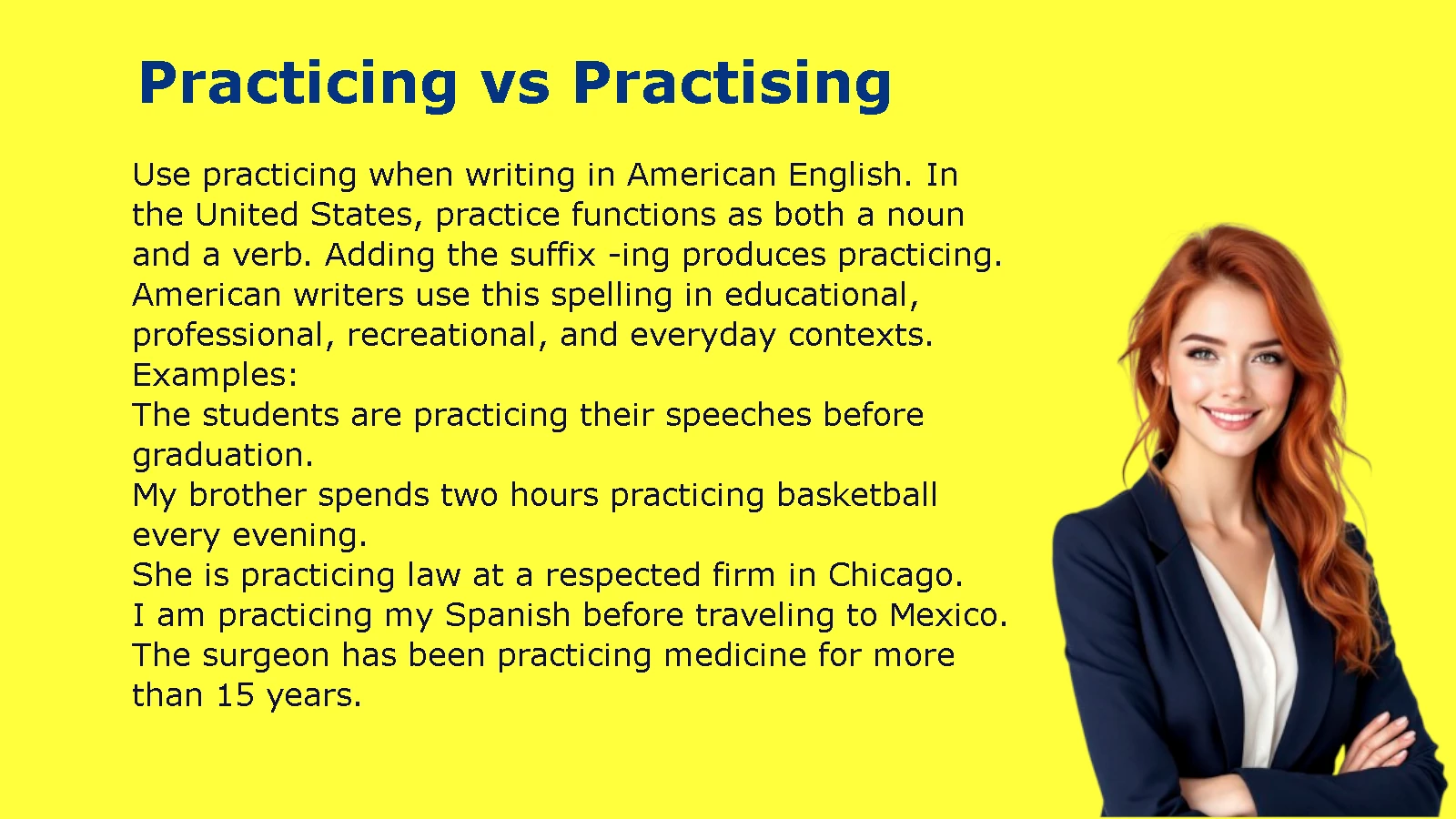
Use practicing when writing in American English. In the United States, practice functions as both a noun and a verb. Adding the suffix -ing produces practicing.
American writers use this spelling in educational, professional, recreational, and everyday contexts.
Examples:
- The students are practicing their speeches before graduation.
- My brother spends two hours practicing basketball every evening.
- She is practicing law at a respected firm in Chicago.
- I am practicing my Spanish before traveling to Mexico.
- The surgeon has been practicing medicine for more than 15 years.
Notice that American English retains the letter c when forming the -ing version of the verb.
When to Use Practising
Use practising when writing in British English or another variety that follows the British noun-and-verb distinction.
In this system, practice is the noun, while practise is the verb. Adding -ing to the verb produces practising.
Examples:
- The children are practising their spelling words.
- She is practising the violin for an upcoming concert.
- He has been practising law in London for several years.
- We are practising our presentation before the conference.
- The athlete is practising new techniques with her coach.
The letter s remains in the verb form when you add -ing.
Is There Any Difference Between Practicing and Practising?
There is no difference in meaning, pronunciation, or grammatical function between the two words. Both are present participles and gerunds formed from the verb practice or practise, depending on the regional spelling system.
The distinction is entirely regional.
| Feature | Practicing | Practising |
| Meaning | Repeating an activity to improve | Same meaning |
| Part of speech | Verb form / gerund | Verb form / gerund |
| American English | Standard | Not standard |
| British English | Not generally standard | Standard |
| Australian English | Not generally standard | Standard |
| New Zealand English | Not generally standard | Standard |
| Pronunciation | Same | Same |
| Present participle | Practicing | Practising |
For example, a musician who is practicing in New York performs the same activity as a musician who is practising in London.
The spelling changes because of regional grammar conventions, not because the activity changes.
Practicing vs Practising Meaning and Difference
The words practicing and practising mean performing an activity repeatedly to develop a skill, improve performance, gain experience, or maintain proficiency. They can also describe carrying out a profession or applying a particular method. Both forms function as the -ing form of a verb and can appear in continuous tenses or as gerunds.
Understanding their meaning becomes easier when you examine how writers use them in different situations.
What Does Practicing Mean?
Practicing means performing an activity regularly to improve your ability, develop a skill, or become more experienced. It can also mean actively working in a profession, such as law or medicine.
The word comes from the American English verb practice.
Its main grammatical characteristics include:
- Part of speech: Verb form and gerund.
- Base verb: Practice.
- Suffix: -ing.
- Pronunciation: PRAK-tuh-sing.
- Meaning: Repeating, training, performing, or carrying out an activity.
Examples:
- Emma is practicing the piano before her music examination.
- The football team is practicing for the championship.
- He is practicing his presentation to improve his confidence.
- She enjoys practicing yoga every morning.
- The doctor is practicing medicine in California.
In the first four examples, practicing describes repeated activities that help someone improve. In the final example, it refers to working professionally as a doctor.
What Does Practising Mean?
Practising has the same meaning as practicing. It describes repeating an activity, developing a skill, or carrying out a professional occupation.
The word comes from the British English verb practise.
Its grammatical characteristics include:
- Part of speech: Verb form and gerund.
- Base verb: Practise.
- Suffix: -ing.
- Pronunciation: PRAK-tuh-sing.
- Meaning: Repeating, training, performing, or carrying out an activity.
Examples:
- Oliver is practising his guitar before the concert.
- The students are practising their French pronunciation.
- She spends every afternoon practising tennis.
- The solicitor is practising law in Manchester.
- We are practising our interview answers together.
These sentences follow British-style spelling conventions. Their meanings remain identical to their American English equivalents.
Practicing and Practising Difference in Everyday Usage
Both forms appear in everyday conversations, educational settings, workplaces, and professional environments.
The regional spelling convention determines which form you should select.
Consider these examples:
| Situation | American English | British English |
| Music | She is practicing guitar. | She is practising guitar. |
| Sports | He is practicing football. | He is practising football. |
| Education | They are practicing grammar. | They are practising grammar. |
| Medicine | She is practicing medicine. | She is practising medicine. |
| Law | He is practicing law. | He is practising law. |
| Language learning | I am practicing English. | I am practising English. |
A useful way to remember the distinction is to identify your audience first. If you are writing for an American publication, choose practicing. If you are writing for a British publication, choose practising.
Practicing or Practising in American and British English
American and British English use different conventions for several words, including color/colour, organize/organise, and realize/realise. The practicing-versus-practising distinction follows a similar regional pattern, although it also reflects a grammatical difference between nouns and verbs.
Practicing in American English
Practicing is the correct standard spelling in American English.
American English generally uses practice for both the noun and the verb. Therefore, the spelling stays consistent when you add grammatical endings.
For example:
- Noun: Daily practice improves your performance.
- Verb: I practice the piano every morning.
- Present participle: I am practicing the piano.
- Past tense: I practiced yesterday.
This system makes the spelling relatively straightforward because the letter c appears throughout the word family.
American writers use practicing in:
- School assignments and educational materials.
- Business documents and professional correspondence.
- Sports and music publications.
- Medical and legal writing.
- Newspapers and online content.
For example, an American attorney would normally write, “I am practicing law in Boston.”
Practising in British English
Practising is the standard British English spelling of the verb’s -ing form.
British English distinguishes between the noun practice and the verb practise. This difference remains visible when the word takes grammatical endings.
For example:
- Noun: Regular practice improves your performance.
- Verb: I practise the piano every morning.
- Present participle: I am practising the piano.
- Past tense: I practised yesterday.
The letter s appears in the verb forms, while the noun retains c.
British writers use practising in:
- Schoolwork and academic writing.
- Professional documents.
- Sports and entertainment articles.
- Medical and legal communication.
- General British publications.
For instance, a British solicitor would normally write, “I am practising law in Birmingham.”
Why Does American English Use Practicing but British English Use Practising?
The difference developed through the separate spelling conventions of American and British English. British English preserves a distinction between the noun practice and the verb practise, while American English generally uses practice for both grammatical roles.
This convention also explains related forms such as practised and practiced.
The distinction is easier to understand through a comparison:
| Grammatical form | American English | British English |
| Noun | Practice | Practice |
| Base verb | Practice | Practise |
| Present participle | Practicing | Practising |
| Past tense | Practiced | Practised |
| Third-person singular | Practices | Practises |
The difference does not change the pronunciation. Both varieties pronounce the word in essentially the same way.
Practicing or Practising in the UK, Australia, Canada, and New Zealand
The correct spelling depends on the English conventions followed in each country. The United Kingdom, Australia, and New Zealand generally use practising. Canada commonly uses the British noun-and-verb distinction, but Canadian English also accepts some American spelling practices.
If you are writing for a specific country, check the publication’s preferred style guide and maintain consistency.
Practicing or Practising UK
In the United Kingdom, practising is the standard spelling of the verb’s -ing form.
British English follows the distinction between practice as a noun and practise as a verb.
Examples:
- She is practising her handwriting before the examination.
- The children are practising for their school play.
- He is practising medicine at a hospital in London.
- My sister is practising her driving skills.
- The solicitor has been practising law for many years.
The same rule applies to related verb forms:
- Practise (present tense).
- Practising (present participle).
- Practised (past tense).
- Practises (third-person singular).
British writers should generally avoid switching between American and British spelling within the same document.
Practicing or Practising Australia
Australian English generally follows British spelling conventions. Therefore, practising is the preferred spelling when the word functions as a verb.
Australian writers retain the distinction between practice as a noun and practise as a verb.
Examples:
- The students are practising for their final examinations.
- She is practising her swimming techniques.
- The lawyer is practising in Sydney.
- We are practising our presentation for the meeting.
- He spends an hour practising the guitar every day.
The noun remains practice.
For example:
- Correct: Regular practice helps young athletes improve.
- Correct: Young athletes are practising every afternoon.
Australian publications, educational materials, and professional documents generally follow this distinction.
Practicing or Practising Canada
Canadian English has a mixed spelling system because it combines British and American influences. For this particular word, the traditional Canadian distinction uses practice as a noun and practise as a verb. Therefore, practising is an established Canadian spelling.
However, some Canadian publications and organizations follow American-style spelling conventions or their own editorial policies.
Examples using the traditional Canadian distinction:
- She is practising her French before visiting Montreal.
- The students are practising their presentation.
- He is practising law in Toronto.
- My son is practising hockey with his teammates.
When writing for a Canadian audience, consider the organization’s preferred dictionary or style guide. Consistency matters more than forcing one convention on every publication.
Practicing or Practising NZ (New Zealand)
New Zealand English generally follows British spelling conventions. Therefore, practising is the preferred spelling of the verb’s -ing form.
The noun remains practice, while the verb uses practise.
Examples:
- The children are practising their reading skills.
- She is practising for a swimming competition.
- He has been practising medicine in Auckland.
- The team is practising ahead of the national tournament.
- I am practising my pronunciation before the interview.
Writers in New Zealand should use practising when following standard New Zealand English conventions.
Regional Spelling Comparison: Practicing vs Practising
The following table provides a quick reference for the five major English varieties covered in this article.
| Country | Preferred spelling | Regional convention |
| United States | Practicing | American English |
| United Kingdom | Practising | British English |
| Australia | Practising | Australian English |
| Canada | Practising (traditional usage) | Canadian English |
| New Zealand | Practising | New Zealand English |
Practical tip: If you manage a website with readers from several countries, choose a primary English variety for your content. Then apply it consistently across articles, headings, image alt text, and metadata.
Practice vs Practise: Understanding the Noun and Verb Difference
The difference between practice and practise explains why practicing and practising have different spellings.
In American English, practice works as both a noun and a verb. In British English, practice is a noun, while practise is a verb. This distinction also applies to other British-style spelling systems.
Learning this rule helps you avoid common grammar mistakes.
When to Use Practice as a Noun
Use practice when referring to an activity, repeated training, professional work, or an established way of doing something.
A noun names a person, place, thing, concept, or activity. In this case, practice identifies the activity or professional operation itself.
Examples:
- Daily practice helps musicians develop confidence.
- The medical practice has served the community for 20 years.
- Football practice begins at 4 p.m.
- Good writing practice improves communication skills.
- The lawyer opened a private legal practice.
Here are some common expressions that use practice as a noun:
| Expression | Meaning |
| Medical practice | A professional healthcare business or the work of a medical professional |
| Legal practice | The professional work or business of providing legal services |
| Daily practice | Regular training or repetition |
| Best practice | A recommended or effective method |
| Piano practice | Repeated musical training |
| Practice session | A period dedicated to improving a skill |
Remember that British and American English both use practice as a noun.
When to Use Practise as a Verb
In British English, practise is a verb that describes the action of repeating something to improve a skill or carrying out a profession.
A verb expresses an action, state, or occurrence.
Examples:
- I practise speaking English every morning.
- She practises yoga before breakfast.
- They practise their football skills after school.
- He practises medicine at a local clinic.
- We practise writing before the examination.
The word changes according to the subject and tense.
| Form | Example |
| Base verb | I practise every day. |
| Third-person singular | She practises every day. |
| Present participle | She is practising. |
| Past tense | She practised yesterday. |
| Past participle | She has practised for years. |
In American English, practice replaces practise in all these verb forms.
Practice vs Practise in American English
American English does not normally distinguish between the noun and verb spellings. It uses practice for both.
This means American writers use the same spelling whether they describe an activity or perform it.
Examples:
- Noun: Football practice starts at noon.
- Verb: I practice football every weekend.
- Present participle: I am practicing football.
- Past tense: I practiced football yesterday.
The context tells readers whether practice functions as a noun or a verb.
Practicing vs Practising: Verb Form Explained
The -ing form comes from adding the suffix -ing to the relevant verb spelling.
The process is simple:
American English:
Practice → Practicing
British English:
Practise → Practising
For example:
- American: He is practicing his driving skills.
- British: He is practising his driving skills.
The spelling difference also appears in past-tense forms:
- American: He practiced driving yesterday.
- British: He practised driving yesterday.
A useful way to remember the rule is to associate the letter c with the American verb spelling and the letter s with the British verb spelling.
Practicing Lawyer or Practising Lawyer: Which Is Correct?
Both practicing lawyer and practising lawyer are correct expressions, but the preferred form depends on regional spelling conventions. American legal writing uses practicing lawyer, while British-style English generally uses practising lawyer. The phrase describes a lawyer who actively works in the legal profession.
The expression is especially important in professional biographies, legal directories, employment documents, and discussions about legal qualifications.
Practicing Lawyer in American English
Practicing lawyer is the standard American English expression.
In the United States, the word practice functions as both a noun and a verb. Therefore, the present participle takes the spelling practicing.
Examples:
- She is a practicing lawyer in New York.
- The firm employs several practicing lawyers.
- He became a practicing attorney after meeting the relevant licensing requirements.
- The conference brings together experienced practicing lawyers from across the country.
The expression generally refers to an attorney who actively provides legal services or works in a legal role.
However, being a practicing lawyer can involve more than appearing in court. Attorneys may work in private firms, corporations, government agencies, nonprofit organizations, or other legal settings.
Practising Lawyer in British English
Practising lawyer is the standard British-style spelling.
British English uses practise as the verb, so the present participle becomes practising.
Examples:
- She is a practising lawyer in London.
- The firm is looking for an experienced practising solicitor.
- He has spent 12 years as a practising barrister.
- The organization provides training for newly qualified practising lawyers.
British legal terminology may also distinguish between solicitors and barristers, depending on the legal role and jurisdiction.
The spelling remains practising regardless of whether the individual works in litigation, commercial law, family law, or another legal specialty.
Practicing Lawyer vs Practising Lawyer in Other Countries
The spelling convention can change when you move between legal jurisdictions.
| Country | Common spelling | Example |
| United States | Practicing lawyer | She is a practicing lawyer in California. |
| United Kingdom | Practising lawyer | She is a practising lawyer in England. |
| Australia | Practising lawyer | He is a practising lawyer in Sydney. |
| Canada | Practising lawyer (traditional usage) | She is a practising lawyer in Toronto. |
| New Zealand | Practising lawyer | He is a practising lawyer in Auckland. |
One important distinction: spelling does not establish a person’s legal status. Whether someone qualifies as a practicing or practising lawyer depends on the licensing and professional rules of the relevant jurisdiction.
For formal legal writing, use the terminology and spelling required by the relevant regulator, court, or professional organization.
Examples of Practicing and Practising in Sentences
Sentence examples make the regional spelling difference easier to understand. Both words describe the same action, so you can often convert an American sentence into British English by changing the spelling while keeping the remaining sentence intact.
Examples Using Practicing
Here are 15 original examples using the standard American English spelling.
- Maria is practicing the violin before her music lesson.
- The basketball team is practicing for its final game.
- I spend 30 minutes practicing English pronunciation every day.
- The young athlete is practicing new techniques with her coach.
- Daniel is practicing his speech before the graduation ceremony.
- She enjoys practicing yoga in the early morning.
- The surgeon has been practicing medicine for more than a decade.
- We are practicing different strategies for the competition.
- My daughter is practicing her handwriting at home.
- The attorney is practicing law in Washington, D.C.
- They are practicing their dance routine for the school event.
- He started practicing guitar when he was seven.
- The students are practicing difficult mathematics problems.
- Our football coach is practicing defensive formations with the players.
- I am practicing my interview answers before tomorrow’s appointment.
Examples Using Practising
Here are 15 examples using the standard British-style spelling.
- Olivia is practising the piano before her examination.
- The rugby team is practising for the weekend match.
- I spend 30 minutes practising English pronunciation every day.
- The young athlete is practising new techniques with her coach.
- Daniel is practising his speech before the graduation ceremony.
- She enjoys practising yoga in the early morning.
- The surgeon has been practising medicine for more than a decade.
- We are practising different strategies for the competition.
- My daughter is practising her handwriting at home.
- The solicitor is practising law in London.
- They are practising their dance routine for the school event.
- He started practising guitar when he was seven.
- The students are practising difficult mathematics problems.
- Our football coach is practising defensive formations with the players.
- I am practising my interview answers before tomorrow’s appointment.
Common Mistakes to Avoid
Writers sometimes confuse the two spellings or apply the noun-and-verb distinction incorrectly.
Watch out for these common mistakes:
| Incorrect or unsuitable usage | Correct usage | Explanation |
| She is practiseing. | She is practising. | British verb spelling takes -ing directly. |
| He is practiccing. | He is practicing. | American spelling does not double the c. |
| Daily practise improves your skills. | Daily practice improves your skills. | Practice is the noun in both varieties. |
| I am practice every day. | I am practicing every day. | The continuous tense requires an -ing form. |
| She is practising. (US context) | She is practicing. | American English uses practicing. |
A few additional points can help you avoid errors:
- Do not add an unnecessary extra letter when forming the -ing version.
- Do not use practise as a noun in standard British English.
- Do not assume that practicing is incorrect simply because you use British English.
- Avoid mixing regional spellings in the same article.
- Follow the style guide required by your employer, school, or publisher.
How to Remember Whether to Use Practicing or Practising
The easiest way to choose between practicing and practising is to remember the spelling system used by your target audience.
You do not need to memorize two different meanings because both words describe the same action.
An Easy American English Spelling Rule
American English uses practice for both the noun and verb.
When you add -ing, the word becomes practicing.
Remember this pattern:
- Noun: Practice.
- Verb: Practice.
- Present participle: Practicing.
- Past tense: Practiced.
Example: “I am practicing my presentation before the meeting.”
An Easy British English Spelling Rule
British English uses practice as a noun and practise as a verb.
When you add -ing to the verb, the result is practising.
Remember this pattern:
- Noun: Practice.
- Verb: Practise.
- Present participle: Practising.
- Past tense: Practised.
Example: “I am practising my presentation before the meeting.”
Choose One Regional Style and Stay Consistent
Consistency is one of the most useful habits in professional writing.
Suppose you manage an American English website but publish an article containing the sentence, “She is practising her communication skills.” The sentence is understandable, but the spelling does not match the expected American convention.
The reverse can happen when a British publication uses practicing throughout an article.
To prevent this problem:
- Identify your target country before writing.
- Select American, British, Australian, Canadian, or New Zealand English.
- Apply the correct spelling throughout the article.
- Check related words such as practice, practise, practiced, and practised.
- Review headings, image alt text, captions, and metadata.
- Use the same regional convention when updating older content.
For website owners: If your website targets readers in several countries, decide whether to publish one consistent regional version or create separate localized content where the audience and search demand justify it. Do not create duplicate pages simply to target spelling variations that one well-structured article can cover.
Frequently Asked Questions
Is Practicing or Practising Correct?
Both practicing and practising are correct spellings of the same verb form. American English uses practicing, while British English uses practising. Australia and New Zealand generally follow the British convention. Canadian English also commonly uses practising, although some publishers prefer American-style spelling.
Is Practising UK or US Spelling?
Practising is the standard British English spelling. It is also generally used in Australia and New Zealand. American English uses practicing instead. The distinction comes from the British convention of using practise as a verb and practice as a noun.
Do Australians Write Practicing or Practising?
Australians generally write practising because Australian English follows British spelling conventions for this word. For example, an Australian student would normally write, “I am practising my mathematics skills.” The noun, however, remains practice, as in “Daily practice improves your results.”
Do Canadians Use Practicing or Practising?
Canadian English traditionally distinguishes between practice as a noun and practise as a verb, making practising an established spelling. However, Canadian spelling has both British and American influences. Some publishers and organizations use practicing, so follow the preferred spelling in the relevant style guide.
Is It Practicing Lawyer or Practising Lawyer?
Practicing lawyer is the standard American English spelling, while practising lawyer is the standard British-style spelling. Both expressions describe a lawyer who actively works in the legal profession. The appropriate professional terminology also depends on the rules of the relevant legal jurisdiction.
What Is the Difference Between Practice and Practise?
In American English, practice functions as both a noun and a verb. In British English, practice is a noun and practise is a verb. For example, British writers say, “I need more practice” but “I need to practise.” Both varieties use practice as a noun.
Conclusion: Practicing vs Practising
The difference between practicing vs practising comes down to regional English spelling conventions, not meaning.
Use practicing when writing in American English. Choose practising when following British, Australian, or New Zealand English conventions. Canadian English commonly uses the British-style verb spelling, although individual publishers may prefer American usage.
Remember the simple grammar rule:
- Practice is the noun in both American and British English.
- Practice is also the verb in American English.
- Practise is the verb in British English.
- Practicing is the American -ing form.
- Practising is the British -ing form.
Whether you are writing an academic assignment, updating a website, preparing a professional document, or describing a practising lawyer, choose the spelling that matches your audience.
The best approach is simple: pick one English variety, apply its spelling rules consistently, and use the same convention throughout your writing.













