Nosy or nosey is a common spelling question because both forms refer to someone who shows too much interest in other people’s private affairs. Both spellings are accepted, but nosy is the more widely preferred form in standard English, while nosey is an alternative spelling. The two words have the same meaning, pronunciation, and grammatical function. Neither should be confused with noisy, which describes something that makes a lot of sound.
Understanding the difference between nosy and nosey helps you choose the right spelling for everyday conversations, professional writing, and regional English. This guide explains their meanings, British and American usage, dictionary treatment, pronunciation, synonyms, and examples so you can use each form confidently.
| Question | Answer |
| Is it nosy or nosey? | Both are correct, but nosy is the more widely preferred spelling. |
| What does nosy mean? | It describes someone who takes too much interest in other people’s private affairs. |
| Is nosey British or American? | Nosey appears in both varieties, although it is often associated with British usage. |
| Is nosy the same as noisy? | No. Nosy means overly curious, while noisy means making a lot of sound. |
| What is a synonym for nosy? | Prying, snoopy, inquisitive, intrusive, and meddlesome are common alternatives. |
Nosy or Nosey: Which Spelling Is Correct?
Both nosy and nosey are correct English spellings. They describe someone who asks too many personal questions, interferes in other people’s affairs, or tries to discover information that does not concern them. However, nosy is the more common and widely preferred spelling in modern standard English.
The difference comes down to spelling rather than meaning. Adding an extra e does not change the word’s pronunciation or grammatical function.
For most everyday and professional writing, choose nosy. You can also use nosey when following a publication’s preferred spelling or preserving the spelling used in a particular text.
Is Nosy or Nosey the Preferred Spelling?
Nosy is the preferred spelling in most standard English writing. It is the shorter and more widely established form, particularly in American English.
The word comes from the expression of having your nose in someone else’s business. Its spelling reflects the adjective-forming suffix -y, which appears in words such as:
- Greedy
- Messy
- Bossy
- Risky
- Dusty
- Nosy
The alternative spelling nosey adds an extra e to the original word. This form is also accepted, but it is generally less common.
Consider these examples:
- My neighbor is always asking nosy questions about my family.
- Stop being so nosy and let them handle their own problems.
- Her nosey coworker kept asking about her personal life.
All three sentences communicate the same idea.
Writing recommendation: Use nosy as your default spelling. It is a straightforward choice that works across different English-speaking audiences.
Nosy vs. Nosey: Quick Comparison
The following table highlights the similarities and differences between the two spellings.
| Feature | Nosy | Nosey |
| Correct spelling | Yes | Yes |
| Part of speech | Adjective | Adjective |
| Meaning | Excessively curious or intrusive | Excessively curious or intrusive |
| Pronunciation | Same | Same |
| Grammatical function | Describes a person or behavior | Describes a person or behavior |
| Usage | More widely preferred | Accepted alternative |
| Formal writing | Generally preferred | Less commonly preferred |
| Example | Don’t be nosy. | Don’t be nosey. |
The important point is that neither spelling creates a different meaning. You can replace one with the other without changing the message.
When Should You Use Nosy Instead of Nosey?
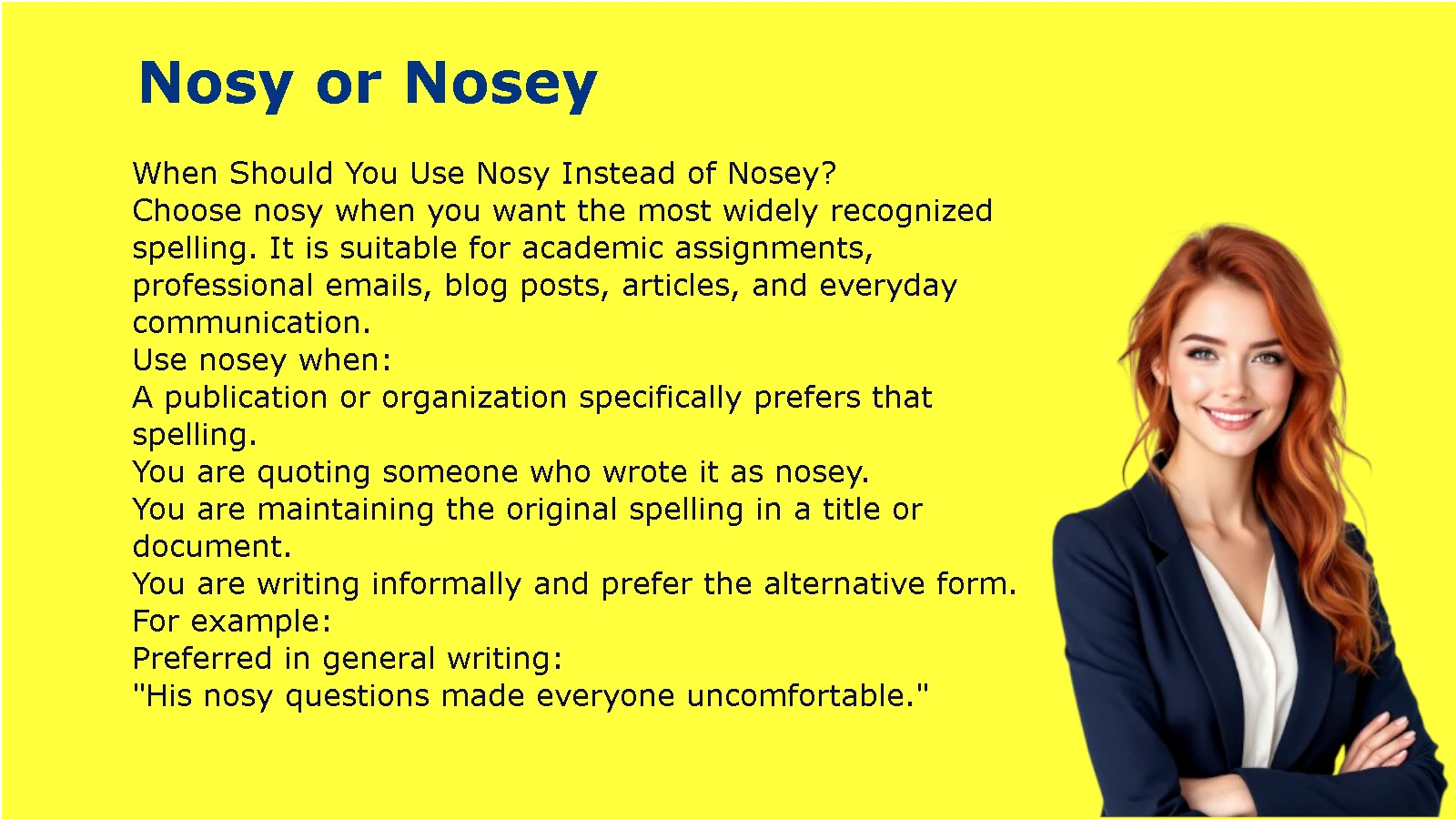
Choose nosy when you want the most widely recognized spelling. It is suitable for academic assignments, professional emails, blog posts, articles, and everyday communication.
Use nosey when:
- A publication or organization specifically prefers that spelling.
- You are quoting someone who wrote it as nosey.
- You are maintaining the original spelling in a title or document.
- You are writing informally and prefer the alternative form.
For example:
Preferred in general writing:
“His nosy questions made everyone uncomfortable.”
Alternative spelling:
“His nosey questions made everyone uncomfortable.”
Both sentences are grammatically correct. The first simply follows the more common spelling convention.
Nosy or Nosey Meaning: What Does the Word Mean?
Nosy means excessively interested in other people’s personal affairs, especially when that interest leads someone to ask intrusive questions, investigate private matters, or interfere without permission. The adjective usually carries a negative or disapproving tone, although people sometimes use it playfully among friends and family.
The alternative spelling nosey has the same definition.
Definition of Nosy
Nosy is an adjective that describes someone who wants to know too much about matters that do not concern them.
A nosy person may ask personal questions, listen to private conversations, read information that was not meant for them, or involve themselves in other people’s decisions.
For example:
- A nosy neighbor constantly asks how much money you earn.
- My aunt is nosy about everyone’s relationships.
- The manager became annoyed by his coworker’s nosy questions.
- She felt uncomfortable when strangers asked nosy questions about her marriage.
The word usually suggests that someone has crossed a social boundary.
However, being curious does not automatically make someone nosy. The difference depends on the subject, behavior, and respect for privacy.
Curious: Someone wants to learn or understand something.
Nosy: Someone shows excessive interest in information that belongs to another person.
For instance, asking a friend about their new job may show ordinary curiosity. Repeatedly demanding their salary, workplace problems, and private employment details may come across as nosy.
What Does Nosey Mean?
Nosey is an accepted alternative spelling of nosy. It describes someone who takes an excessive interest in other people’s private lives or affairs.
There is no meaningful difference between the definitions of these two forms.
Examples include:
- My nosey neighbor always watches what happens outside.
- Don’t let nosey people interfere with your decisions.
- He made a nosey comment about her financial situation.
- The children became nosey when they heard the adults whispering.
You can use nosey in informal writing, conversations, and other situations where the alternative spelling feels appropriate.
However, if you are unsure which version to choose, nosy remains the safer general-purpose option.
Nosy vs. Nosey: Is There Any Difference?
The main difference between nosy and nosey is their spelling. Both words have the same meaning, pronunciation, and grammatical role.
Neither spelling indicates a stronger level of curiosity or a different type of behavior.
| Comparison | Nosy | Nosey |
| Meaning | Intrusively curious | Intrusively curious |
| Pronunciation | /ˈnoʊ.zi/ | /ˈnoʊ.zi/ |
| Word type | Adjective | Adjective |
| Tone | Usually negative | Usually negative |
| Standard usage | More common | Alternative |
For example, compare these sentences:
- “My nosy cousin wants to know everything.”
- “My nosey cousin wants to know everything.”
Both describe the same behavior. The spelling does not affect the meaning or tone.
Nosy in Everyday Conversations
People commonly use nosy when someone ignores personal boundaries or shows unnecessary interest in private matters.
Here are some situations where the word fits naturally:
Asking personal questions
A person who repeatedly asks about your income, relationship status, or family problems may seem nosy.
Example: “I don’t want to answer his nosy questions about my salary.”
Interfering in relationships
Someone who tries to control another person’s relationship or demands private details may be described as nosy.
Example: “Her nosy relatives keep asking when she plans to get married.”
Workplace gossip
Employees who constantly investigate their coworkers’ private lives can create an uncomfortable working environment.
Example: “A nosy colleague kept asking why I had taken a day off.”
Watching other people
Someone who constantly observes their neighbors or investigates their activities may also be called nosy.
Example: “Our nosy neighbor knows everything that happens on this street.”
Social media snooping
People sometimes use nosy to describe someone who searches through another person’s online activity to uncover private information.
Example: “I don’t want nosy strangers looking through my personal photographs.”
Nosy or Nosey in UK, US, Canada, Australia, and New Zealand English
Both spellings appear across English-speaking countries, but their frequency and editorial preferences can vary. Nosy is generally the more widely preferred spelling, while nosey remains an accepted alternative.
It is important not to assume that nosey belongs exclusively to British English or that American English completely rejects it. Regional spelling preferences do not always create strict boundaries between accepted and alternative forms.
Nosy or Nosey: British English
Both nosy and nosey are used in British English. The spelling nosey is particularly familiar as an alternative in British writing and everyday communication.
However, nosy is also a recognized and established spelling in the United Kingdom.
Examples:
- The nosy neighbors keep asking about our new house.
- I wish people would stop being so nosey.
- Her colleagues were becoming increasingly nosy about her personal life.
- Don’t be nosey about things that don’t concern you.
British writers can use either form, but they should follow the spelling preference of their publisher or organization.
Nosy or Nosey: American English
Nosy is the conventional and more widely preferred spelling in American English. It appears naturally in newspapers, books, websites, and everyday conversations.
Although readers can understand nosey, it is less common than nosy in standard American writing.
Examples:
- My nosy neighbor keeps asking about my new car.
- Stop being nosy and mind your own business.
- She ignored the nosy questions from her coworkers.
- The reporter asked several nosy questions during the interview.
For American audiences, choose nosy unless you have a specific reason to preserve the alternative spelling.
Nosy or Nosey: Canadian English
Canadian English recognizes both spelling forms, although nosy is a straightforward choice for general Canadian writing.
Canadian spelling conventions share some characteristics with British English, but that does not mean every alternative British spelling becomes the preferred Canadian form.
Examples:
- My nosy neighbor always asks about my weekend plans.
- The children became nosy when they saw the unexpected visitors.
- He made a nosy comment about her personal life.
Canadian writers should prioritize consistency and follow the dictionary or editorial guide used by their organization.
Nosy or Nosey: Australian English
Both nosy and nosey appear in Australian English. The shorter form is a reliable general choice, while nosey is an accepted alternative.
Examples:
- The nosy neighbor wanted to know where everyone was going.
- Don’t be nosey about other people’s relationships.
- She found his questions rather nosy.
- The nosy children kept asking what was inside the box.
For Australian publications, the best approach is to use the spelling recommended by the relevant editorial style guide.
Nosy or Nosey: New Zealand English
New Zealand English also uses both forms. Nosy is a practical choice for general writing, while nosey can appear as an alternative spelling.
Examples:
- Our nosy neighbor keeps checking what we are doing.
- Some people are too nosey about other people’s private lives.
- He asked a nosy question during the meeting.
The difference is not a change in meaning or pronunciation. Both spellings describe excessive curiosity about another person’s affairs.
Regional Spelling Comparison Table
| English variety | Recommended general choice | Alternative |
| American English | Nosy | Nosey |
| British English | Nosy | Nosey |
| Canadian English | Nosy | Nosey |
| Australian English | Nosy | Nosey |
| New Zealand English | Nosy | Nosey |
The table provides a practical writing recommendation rather than a claim that each country has an exclusive spelling rule.
If you are writing for a specific publication, use its preferred dictionary and style guide.
Nosy or Nosey According to the Oxford Dictionary
Dictionary recognition helps explain whether a spelling is accepted, how a word functions grammatically, and what meaning readers should understand.
For nosy and nosey, the important distinction is between the main spelling and its accepted alternative. Both forms refer to excessive curiosity about other people’s private affairs.
Does Oxford Dictionary Recognize Nosy?
Nosy is an established English adjective. Its central meaning describes someone who is excessively interested in other people’s personal business.
The word commonly appears in expressions such as:
- Nosy neighbor
- Nosy questions
- Nosy people
- Nosy behavior
- Being nosy
The adjective can describe a person directly or explain the nature of a question, comment, or action.
For example:
“Her nosy questions made the conversation uncomfortable.”
Here, nosy describes the questions rather than the person asking them.
Does Oxford Dictionary Recognize Nosey?
Nosey is an alternative spelling associated with the same adjective and meaning.
It does not describe a different personality trait or introduce another grammatical category.
When checking a dictionary, look at whether the entry treats nosey as a separate headword, a spelling variant, or a cross-reference. These editorial treatments can differ between dictionary editions and products.
The key distinction remains the same: nosey and nosy communicate the same idea.
Which Spelling Should You Use in Formal Writing?
Use nosy when writing academic papers, professional documents, business communication, or general articles.
It is the more widely preferred spelling and avoids unnecessary uncertainty.
Follow these practical rules:
- Choose nosy for general-purpose writing.
- Follow your organization’s spelling guide.
- Preserve nosey when quoting an original source.
- Avoid switching between both spellings in the same article.
- Check the relevant dictionary when a publication requires a specific regional standard.
Consistency makes your writing easier to read and edit.
Nosy or Noisy: What Is the Difference?
Noisy and nosy are different words with different meanings. Nosy describes someone who shows excessive interest in other people’s private affairs, while noisy describes a person, place, object, or situation that produces a lot of sound.
Their similar appearance can cause spelling mistakes, but their meanings make them easy to distinguish.
Nosy Meaning and Usage
Nosy means overly curious or intrusive. It usually describes someone who asks unnecessary personal questions or interferes in matters that do not concern them.
Examples:
- My nosy coworker keeps asking about my weekend.
- The nosy neighbor watched everyone entering the building.
- Stop being nosy about my family matters.
- Her nosy questions made me uncomfortable.
The word relates to privacy and personal boundaries, not sound.
Noisy Meaning and Usage
Noisy describes something that makes a lot of noise or produces an unpleasant or noticeable level of sound.
It can describe people, animals, machines, environments, and events.
Examples:
- The classroom became noisy after lunch.
- We moved away from the noisy construction site.
- The children were noisy during the car journey.
- My neighbor plays music in a noisy apartment.
- The restaurant was too noisy for a quiet conversation.
Unlike nosy, noisy does not suggest that someone is interfering in another person’s affairs.
Nosy vs. Noisy Comparison Table
| Word | Part of speech | Meaning | Example |
| Nosy | Adjective | Excessively curious about private matters | My nosy neighbor asks personal questions. |
| Nosey | Adjective | Alternative spelling of nosy | That was a nosey question. |
| Noisy | Adjective | Producing a lot of sound | The children are playing in a noisy room. |
How to Remember the Difference Between Nosy and Noisy
A simple memory trick can help you avoid confusing these words.
Associate nosy with someone’s nose being in your business. The expression suggests that someone is getting involved in matters that do not concern them.
Associate noisy with noise, loud music, traffic, and other sounds.
Remember these examples:
- A nosy neighbor wants to know your personal business.
- A noisy neighbor plays loud music.
- A nosy coworker asks too many questions.
- A noisy coworker talks loudly during meetings.
The difference becomes clear when you connect each word with its meaning.
Nosy Pronunciation: How Do You Say Nosy and Nosey?
Nosy and nosey have the same pronunciation: /ˈnoʊ.zi/ in American English. Both words contain two syllables, with the stress on the first syllable. The additional letter e in nosey does not change the way the word sounds.
Phonetic Pronunciation of Nosy
The standard American English pronunciation is:
- IPA: /ˈnoʊ.zi/
- Syllables: Two
- Stress: First syllable
- Word type: Adjective
The first syllable carries the main stress, while the second syllable has a light ending sound.
The pronunciation resembles the beginning of words such as nobody and notice, although the complete sounds differ.
Is Nosey Pronounced Differently From Nosy?
No. Nosey and nosy are pronounced identically.
The extra letter in nosey does not add another syllable or change the vowel sound.
For example:
- Nosy neighbor
- Nosey neighbor
- Nosy questions
- Nosey questions
Both versions sound the same when spoken.
Nosy vs. Noisy Pronunciation
Although nosy and noisy look similar, their vowel sounds differ.
| Word | IPA (General American) | Meaning |
| Nosy | /ˈnoʊ.zi/ | Intrusively curious |
| Nosey | /ˈnoʊ.zi/ | Alternative spelling of nosy |
| Noisy | /ˈnɔɪ.zi/ | Making a lot of sound |
The main pronunciation difference appears in the vowel sound.
Nosy begins with the long O diphthong, while noisy begins with the vowel sound found in the word boy.
Practicing the words in sentences can help:
- “My nosy neighbor asks too many questions.”
- “The noisy street keeps me awake.”
Nosy Synonyms: What Are Other Words for Nosy?
Common synonyms for nosy include prying, snoopy, inquisitive, intrusive, and meddlesome. These words describe different degrees and types of curiosity. Some suggest harmless interest, while others strongly criticize someone for invading another person’s privacy.
Choosing the right synonym depends on the behavior you want to describe.
Common Synonyms for Nosy
| Synonym | Meaning | Example |
| Prying | Trying to discover private information | She asked prying questions about his divorce. |
| Snoopy | Excessively interested in other people’s affairs | My snoopy roommate checks everything. |
| Inquisitive | Eager to learn or discover information | The inquisitive student asked several questions. |
| Intrusive | Invading someone’s privacy or personal space | His intrusive comments upset the family. |
| Meddlesome | Interfering in other people’s affairs | A meddlesome relative tried to control their decision. |
| Curious | Interested in knowing something | I was curious about the new project. |
| Interfering | Getting involved in matters that do not concern you | Her interfering behavior caused arguments. |
| Inquisitorial | Questioning someone in a probing or demanding way | The interview took an inquisitorial tone. |
Not every synonym has exactly the same emotional meaning.
For instance, inquisitive can describe someone positively, especially when that person enjoys learning. Prying and snoopy usually carry a more negative meaning.
Positive and Negative Alternatives to Nosy
The word you choose can change the tone of your sentence.
Positive or neutral alternatives
- Curious
- Inquisitive
- Interested
- Observant
- Questioning
- Investigative
These words can describe someone who wants to learn without necessarily invading another person’s privacy.
Example: “The inquisitive student wanted to understand how the experiment worked.”
Negative alternatives
- Prying
- Snoopy
- Intrusive
- Meddlesome
- Interfering
- Impertinent
These words suggest that someone’s curiosity has crossed a boundary.
Example: “His prying questions made the guest uncomfortable.”
How to Choose the Right Synonym for Nosy
Use the context to select a word with the right level of criticism.
Choose curious when someone simply wants to know more.
Example: “I was curious about the new employee.”
Choose inquisitive when someone asks questions because they enjoy learning.
Example: “The inquisitive child wanted to know how airplanes fly.”
Choose prying when someone tries to uncover private information.
Example: “She refused to answer his prying questions.”
Choose snoopy when someone secretly investigates other people’s affairs.
Example: “My snoopy brother read my messages.”
Choose meddlesome when someone interferes in another person’s decisions.
Example: “A meddlesome neighbor tried to settle their argument.”
The right synonym makes your writing more precise and prevents you from using nosy repeatedly.
Examples of Nosy and Nosey in Sentences
Sentence examples show how both spellings work in everyday communication. Since nosy and nosey have the same meaning, you can use either form in the examples below.
However, the examples primarily use nosy because it is the more widely preferred spelling.
Examples Using Nosy
Here are natural examples of nosy in different situations:
- My nosy neighbor always asks where I am going.
- Stop being nosy and let me handle my own problems.
- She became uncomfortable when her coworkers asked nosy questions about her relationship.
- His nosy relatives wanted to know how much he earned.
- I don’t like nosy people who interfere in private matters.
- The reporter asked several nosy questions during the interview.
- Our nosy landlord wanted to know why we had guests.
- My sister gets nosy whenever someone mentions a secret.
- He ignored the nosy comments from his colleagues.
- The nosy children kept asking what the adults were discussing.
These sentences show that nosy can describe people, questions, comments, and behavior.
Examples Using Nosey
The alternative spelling works in the same grammatical situations.
- My nosey neighbor keeps asking about my personal life.
- Don’t be nosey about things that don’t concern you.
- Her nosey questions made the meeting uncomfortable.
- Some nosey relatives always want to know everyone’s business.
- He has a nosey habit of checking other people’s belongings.
Each sentence has the same meaning as its nosy counterpart.
Common Expressions With Nosy
Certain expressions appear frequently in conversations and informal writing.
| Expression | Meaning | Example |
| Nosy neighbor | A neighbor who takes excessive interest in others | Our nosy neighbor watches everyone. |
| Nosy questions | Questions about private or personal matters | I don’t appreciate your nosy questions. |
| Nosy people | People who interfere in other people’s affairs | Nosy people can make conversations uncomfortable. |
| Stop being nosy | A request to stop asking intrusive questions | Stop being nosy about my relationship. |
| Don’t be nosy | A warning against interfering | Don’t be nosy when others are talking. |
| Nosy about someone’s business | Excessively interested in another person’s affairs | She is always nosy about her coworkers’ business. |
A Practical Case Study: Choosing Between Nosy, Curious, and Noisy
Imagine that three coworkers are talking during a lunch break.
One employee asks a colleague how the new project works because she wants to understand the process. Another employee repeatedly asks about the colleague’s salary, personal relationships, and family problems. Meanwhile, a third employee plays loud music on a phone.
You could describe their behavior this way:
| Situation | Correct word | Reason |
| Asking how a project works | Curious | Shows an interest in learning. |
| Asking repeated personal questions | Nosy | Shows excessive interest in private affairs. |
| Playing loud music | Noisy | Produces an unwanted level of sound. |
This example demonstrates why context matters more than spelling alone.
Using the wrong word can completely change the meaning of a sentence.
Common Mistakes When Using Nosy or Nosey
Although these words are easy to understand, writers sometimes confuse their spelling, meaning, or grammatical use.
Understanding a few common mistakes will help you use them correctly.
Using Noisy Instead of Nosy
The most common confusion involves replacing nosy with noisy.
Remember:
- Nosy = excessively curious about private matters.
- Noisy = producing a lot of sound.
Incorrect: “My noisy neighbor keeps asking about my salary.”
Correct: “My nosy neighbor keeps asking about my salary.”
The second sentence communicates the intended meaning because the neighbor is asking intrusive questions.
However, if the neighbor plays loud music, noisy is correct.
Assuming Nosey Is Always Incorrect
Some writers believe nosey is a spelling mistake because nosy is more common.
That assumption is incorrect. Nosey is an accepted alternative spelling.
For example:
“Don’t be nosey about other people’s relationships.”
This sentence is grammatically acceptable. However, nosy remains the more widely preferred spelling.
Using Nosy When Curious Is More Appropriate
Not every question indicates intrusive behavior.
Someone who asks about a scientific discovery, a new technology, or an unfamiliar subject may simply be curious.
Compare:
- “The curious student asked how the machine worked.”
- “The nosy student kept asking about the teacher’s private life.”
The first sentence describes a normal interest in learning. The second suggests inappropriate curiosity.
Choosing the right adjective helps readers understand the person’s intentions.
Switching Between Nosy and Nosey Without a Reason
Using both spellings randomly in one article can make your writing appear inconsistent.
For example:
“My nosy neighbor always asks questions. The nosey man also watches everyone in the street.”
Although both spellings are correct, choosing one form makes the passage more consistent.
A better version would be:
“My nosy neighbor always asks questions. The nosy man also watches everyone in the street.”
This simple editing decision improves the overall quality of your writing.
Confusing Nosy With the Noun Nose
The word nose is a noun that refers to the part of the face used for smelling and breathing.
Nosy, by contrast, is an adjective that describes excessive curiosity.
The two words are related in appearance and word formation, but they perform different grammatical functions.
| Word | Part of speech | Meaning | Example |
| Nose | Noun | Part of the face used for smelling and breathing | My nose is cold. |
| Nosy | Adjective | Excessively interested in private matters | My neighbor is nosy. |
| Nosey | Adjective | Alternative spelling of nosy | That was a nosey question. |
The expression “stick your nose into someone’s business” helps explain the connection between the body-part noun and the adjective.
Conclusion: Should You Write Nosy or Nosey?
Both nosy and nosey are accepted English spellings with the same meaning and pronunciation. They describe someone who takes too much interest in other people’s private affairs, asks intrusive questions, or interferes in matters that do not concern them.
However, nosy is the more widely preferred spelling and the safest choice for general writing. Nosey remains an acceptable alternative, including in British and other varieties of English.
Remember that nosy and noisy are completely different words. Nosy describes excessive curiosity, while noisy describes something that produces a lot of sound.
When writing articles, emails, academic assignments, or professional documents, choose nosy unless your publication follows a different spelling preference. Keep your spelling consistent and select synonyms such as prying, snoopy, or inquisitive when they communicate your meaning more precisely.
The simple rule: Both nosy and nosey are correct, but nosy is the better default choice.













