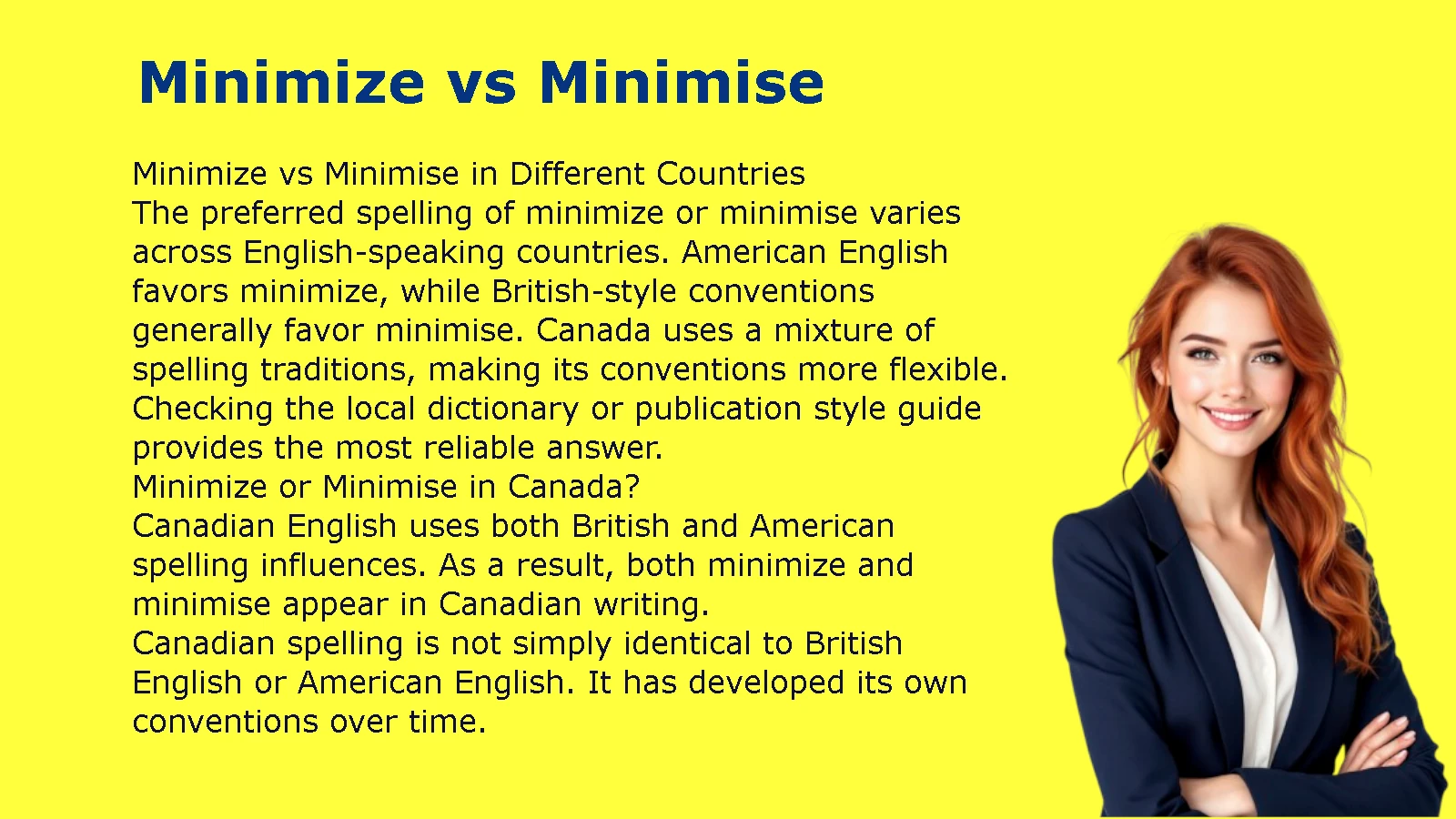
Minimize vs minimise: both spellings are correct, but the preferred version depends on the type of English you use. Minimize is the standard spelling in American English, while minimise is widely preferred in British English, Australian English, Indian English, and South African English. Canadian English accepts both, although usage varies by publisher and style guide.
The two words have exactly the same meaning: to reduce something to the smallest possible amount, degree, or level. The difference comes from regional spelling conventions, particularly the use of -ize and -ise endings. Understanding these conventions helps you choose the right spelling for academic papers, business documents, websites, and everyday writing.
| Question | Answer |
| Is minimize or minimise correct? | Both are correct spellings. |
| Is minimize American or British English? | Minimize is the standard American spelling. |
| Is minimise British or American English? | Minimise is the common British-style spelling. |
| Do Canadians use minimize or minimise? | Both appear in Canadian English, depending on the style guide. |
| Does Australia use minimize or minimise? | Minimise is generally preferred in Australian English. |
Minimize vs Minimise: Which Is Correct?
Both minimize and minimise are correct English spellings. They represent the same verb and have identical meanings. The main difference involves regional spelling preferences: American English generally uses minimize, while British English and several other varieties commonly use minimise. Neither spelling is universally more correct than the other.
Is Minimize or Minimise the Preferred Spelling?
Your preferred spelling should depend on your audience and the English convention you follow.
Use minimize when writing for an American audience. This spelling appears in American newspapers, academic publications, business documents, government materials, and websites.
Use minimise when writing for readers in the United Kingdom, Australia, India, and South Africa, where British-style spelling conventions generally influence formal writing.
Canada requires a little more consideration because Canadian English combines British and American spelling influences. Both forms appear, so following a particular publication’s style guide is the safest approach.
Here is a simple way to remember the difference:
- Minimize: Generally preferred in American English.
- Minimise: Generally preferred in British-style English.
- Both: Correct spellings with the same meaning.
Minimize vs Minimise: Quick Comparison
| Feature | Minimize | Minimise |
| Spelling | Minimize | Minimise |
| Meaning | To reduce | To reduce |
| Part of speech | Verb | Verb |
| American English | Preferred | Less common |
| British English | Accepted in some styles | Generally preferred |
| Australian English | Less common | Generally preferred |
| Canadian English | Used | Used |
| Pronunciation | Same | Same |
| Past tense | Minimized | Minimised |
| Present participle | Minimizing | Minimising |
The comparison shows that the spelling changes, but the meaning, grammatical function, and pronunciation remain the same.
Why Do Minimize and Minimise Have Different Spellings?
The difference between minimize and minimise comes from the development of English spelling conventions.
Historically, English borrowed many words from Greek and Latin. The suffix -ize has roots in Greek and entered English through Latin and French influences. It became a productive way to form verbs meaning to make, become, or cause something to have a particular quality.
For example:
- Modernize: To make something modern.
- Organize: To arrange things systematically.
- Realize: To become aware of something.
- Minimize: To reduce something.
American spelling reformers, particularly Noah Webster, helped establish distinctive American spelling preferences during the 18th and 19th centuries. American dictionaries generally retained the -ize ending in words such as minimize, while British usage developed a strong preference for -ise in many publications.
However, the distinction is not as simple as saying that every British writer uses -ise. Some British dictionaries and publications follow the Oxford spelling convention, which favors -ize in words where that ending is historically appropriate.
Therefore, both spellings have legitimate places in English.
Minimize vs Minimise in American and British English
American and British English follow different spelling conventions for many words, including those ending in -ize and -ise. Minimize is the usual American form, whereas minimise is the more common British form. These preferences reflect established writing traditions rather than differences in meaning or grammar.
Minimize in American English
Minimize is the standard spelling in American English. American dictionaries, educational materials, newspapers, and professional publications generally use the -ize ending.
American writers use minimize in several contexts, including business, technology, healthcare, education, and everyday communication.
Examples:
- The company wants to minimize its operating expenses this year.
- Regular maintenance can minimize the risk of equipment failure.
- Students should minimize distractions while studying.
- The software helps businesses minimize security risks.
- We need to minimize unnecessary delays during the project.
- Proper planning can minimize mistakes in the workplace.
Notice that the word always expresses the idea of reducing something.
If you are writing an American academic paper, professional email, business proposal, or website article, minimize is generally the appropriate choice.
Minimise in British English
Minimise is the conventional spelling in British English. Writers in the United Kingdom commonly use this form in newspapers, books, academic writing, and professional communication.
British English frequently uses -ise in words that American English writes with -ize.
For example:
- The government plans to minimise unnecessary spending.
- Employees should minimise distractions during important meetings.
- The new system helps minimise the risk of data loss.
- We must minimise the environmental impact of construction.
- The school introduced new rules to minimise classroom disruptions.
These examples show that minimise works in exactly the same grammatical situations as minimize.
When writing for a British audience, using minimise helps maintain consistency with familiar British spelling conventions.
Is Minimize Ever Correct in British English?
Yes. Minimize is also an accepted spelling in British English, particularly under the Oxford spelling convention.
The Oxford style generally retains -ize in words where the suffix is historically appropriate. This means British writers may use words such as:
- Organize
- Recognize
- Realize
- Minimize
- Modernize
However, many British newspapers, educational institutions, and publishers prefer the -ise spelling.
The important distinction is that British English does not have one universal spelling system for every publication.
For example, a British academic journal might accept minimize under its chosen style guide, while a British newspaper may consistently use minimise.
Practical advice: Follow the spelling convention required by your publisher, university, employer, or client rather than assuming that every British publication uses the same system.
Minimize vs Minimise in Different Countries
The preferred spelling of minimize or minimise varies across English-speaking countries. American English favors minimize, while British-style conventions generally favor minimise. Canada uses a mixture of spelling traditions, making its conventions more flexible. Checking the local dictionary or publication style guide provides the most reliable answer.
Minimize or Minimise in Canada?
Canadian English uses both British and American spelling influences. As a result, both minimize and minimise appear in Canadian writing.
Canadian spelling is not simply identical to British English or American English. It has developed its own conventions over time.
For example, Canadian writers often use British-style spellings such as:
- Colour instead of color.
- Centre instead of center.
- Honour instead of honor.
However, Canadian English also shares many spelling patterns with American English, particularly in everyday business and digital communication.
The -ize ending is established in Canadian English, and many Canadian dictionaries and publishers recognize it. The -ise form also appears in Canadian publications.
Consider these examples:
- The organization wants to minimize unnecessary expenses.
- The organization wants to minimise unnecessary expenses.
Both sentences communicate the same idea.
Which should Canadians choose?
For formal Canadian writing, follow the spelling used by your preferred Canadian dictionary, employer, educational institution, or publication. Do not assume that minimise is automatically more Canadian simply because it looks British.
Minimize or Minimise in the UK?
In the United Kingdom, minimise is generally the preferred spelling.
British writers commonly use the -ise ending in words such as organise, recognise, realise, and minimise.
Examples:
- We should minimise the amount of plastic waste.
- The company introduced new policies to minimise expenses.
- These changes will minimise the risk of accidents.
- Teachers should minimise interruptions during examinations.
However, the Oxford spelling convention also recognizes minimize.
If you are writing for a British newspaper, school, or organization, check its editorial guidelines before choosing between the two forms.
Minimize or Minimise in Australia?
Australian English generally follows British-style spelling conventions. Therefore, minimise is the preferred spelling in most Australian formal and professional writing.
Australian dictionaries and educational materials commonly use -ise forms.
Examples:
- Businesses should minimise unnecessary operating costs.
- The new policy aims to minimise environmental damage.
- Regular inspections can minimise workplace risks.
- Students should minimise distractions when completing assignments.
Australian writers should generally choose minimise when preparing documents for local readers.
However, if an Australian company follows an international or American corporate style guide, it may use minimize instead.
Minimize or Minimise in India?
Indian English has strong historical connections with British English. Consequently, minimise is generally preferred in formal Indian writing.
You will commonly encounter British-style spelling in Indian schools, universities, government documents, newspapers, and professional communication.
Examples:
- The government introduced measures to minimise pollution.
- Businesses must minimise unnecessary expenditure.
- Proper planning can minimise project delays.
- Students should minimise errors in their assignments.
However, American English also influences Indian digital content, software documentation, and international business communication.
For that reason, both spellings may appear in Indian publications.
If you are writing an academic paper, follow your institution’s prescribed spelling convention. For general formal Indian English, minimise is a sensible default.
Minimize or Minimise in South Africa?
South African English generally follows British-style spelling conventions in many formal contexts. Therefore, minimise is the more familiar spelling in South African professional and educational writing.
South African publications commonly retain British spelling patterns in words such as colour, centre, organise, and minimise.
Examples:
- The department wants to minimise unnecessary expenditure.
- Companies should minimise their environmental impact.
- These procedures help minimise workplace accidents.
- The school introduced measures to minimise classroom disruptions.
For South African readers, minimise is generally the safer choice.
As with other countries, individual organizations may adopt different international spelling standards.
Country-by-Country Spelling Comparison Table
The following table provides a quick reference for choosing the appropriate spelling.
| Country | Generally preferred spelling |
| United States | Minimize |
| United Kingdom | Minimise |
| Canada | Both are used |
| Australia | Minimise |
| India | Minimise |
| South Africa | Minimise |
Remember that these are general preferences, not absolute rules for every publisher or organization.
Minimize vs Minimise: Meaning and Definition
Minimize and minimise mean to reduce something to the smallest possible amount, degree, or level. Both spellings describe the same action and function as verbs. Writers use them when discussing costs, risks, errors, waste, damage, effort, or other things they want to reduce.
What Does Minimize or Minimise Mean?
The verb minimize means to make something as small, low, limited, or insignificant as possible.
The British-style spelling minimise carries exactly the same definition.
For example, when a business wants to minimize expenses, it tries to reduce unnecessary spending without damaging its operations.
Similarly, when a doctor recommends minimizing stress, the advice involves reducing stressful situations or their effects.
Here are some common situations where people use the word:
- Business: Minimize operating expenses.
- Healthcare: Minimize health risks.
- Technology: Minimize security vulnerabilities.
- Education: Minimize distractions.
- Environment: Minimize pollution and waste.
- Manufacturing: Minimize production errors.
The word does not always mean eliminating something completely. It usually means reducing it as much as reasonably possible.
For instance, minimizing expenses does not necessarily mean spending no money. It means controlling costs and avoiding unnecessary spending.
Minimize vs Minimise: Are Their Meanings Different?
No. There is no difference in meaning between minimize and minimise.
Both words:
- Have the same definition.
- Function as verbs.
- Follow the same grammatical rules.
- Have the same pronunciation.
- Work in the same sentence structures.
The only difference is the spelling convention.
Compare these sentences:
American English:
The company wants to minimize production costs.
British English:
The company wants to minimise production costs.
Both sentences express the same idea. Neither one changes the meaning or grammatical structure.
Synonyms of Minimize and Minimise
Several English verbs can replace minimize or minimise, depending on the context.
| Synonym | Meaning | Example |
| Reduce | Make something smaller or lower | Reduce monthly expenses. |
| Decrease | Become or make less | Decrease unnecessary spending. |
| Lower | Bring something down | Lower operating costs. |
| Diminish | Make something less significant | Diminish the impact of damage. |
| Lessen | Reduce the amount or intensity | Lessen the effects of stress. |
| Curtail | Restrict or reduce something | Curtail unnecessary spending. |
| Mitigate | Make something less harmful or severe | Mitigate potential risks. |
| Limit | Keep something within boundaries | Limit access to sensitive information. |
Although these words share similar meanings, they are not always interchangeable.
For example, mitigate usually focuses on reducing the severity or harmful effects of something, while reduce has a broader meaning.
Similarly, curtail often suggests deliberately restricting an activity, expense, or process.
Choose the synonym that best communicates your intended meaning.
Minimize vs Minimise in Sentences
Both spellings work in the same grammatical situations. The best way to understand their usage is to examine examples from different contexts. The following sentences demonstrate how American and British writers use these forms in everyday communication, business, education, technology, and professional writing.
Examples of Minimize in American English
Here are ten original sentences using the American spelling.
- The company introduced a new strategy to minimize operating expenses.
- Regular software updates help minimize security vulnerabilities.
- Students should minimize distractions while preparing for examinations.
- Proper packaging can minimize product damage during transportation.
- The manager wants to minimize unnecessary meetings.
- Exercise and healthy habits may help minimize certain health risks.
- We changed the schedule to minimize delays.
- The new equipment helps minimize energy consumption.
- Careful planning can minimize mistakes during construction.
- The organization is working to minimize its environmental footprint.
Examples of Minimise in British English
Here are ten examples using the British-style spelling.
- The business introduced new procedures to minimise operating costs.
- Regular maintenance can minimise the risk of equipment failure.
- Students should minimise distractions while studying.
- The government aims to minimise environmental pollution.
- Employees must minimise unnecessary workplace interruptions.
- These changes will minimise the impact of construction work.
- We need to minimise waste throughout the production process.
- The new software helps minimise data security risks.
- Careful preparation can minimise errors during examinations.
- The school introduced new guidelines to minimise classroom disruptions.
How to Choose the Correct Spelling in Professional Writing
Choosing between minimize and minimise becomes easier when you identify your intended audience.
For professional writing, follow these practical steps:
Identify your audience.
Determine whether you are writing for American, British, Canadian, Australian, Indian, or South African readers.
Check the required style guide.
Universities, companies, newspapers, and publishers often have established spelling preferences.
Maintain consistency.
If you choose minimize, use related forms such as minimized and minimizing. If you choose minimise, use minimised and minimising.
Check your document before publishing.
A spelling checker can help identify inconsistencies, particularly in long reports and articles.
Consider international readers.
When writing for a global audience, choose one recognized spelling convention and apply it throughout the document.
Other Forms of Minimize vs Minimise
The spelling difference between minimize and minimise continues in their related grammatical forms. American English generally retains the -ize pattern, while British-style English commonly uses -ise. Understanding these variations helps you maintain consistent spelling when writing past-tense verbs, participles, and nouns.
Minimized vs Minimised
Minimized is the American spelling, while minimised is the common British-style spelling.
Both are the past-tense and past-participle forms of the verb.
Examples:
American English:
- The company minimized its expenses last year.
- We minimized the risk through careful planning.
- The new process minimized production errors.
British English:
- The company minimised its expenses last year.
- We minimised the risk through careful planning.
- The new process minimised production errors.
Both versions are grammatically correct.
Minimizing vs Minimising
Minimizing is the American spelling, whereas minimising is the common British-style spelling.
These forms function as present participles and gerunds.
Examples:
American English:
- We are minimizing unnecessary expenses.
- Minimizing distractions can improve concentration.
- The company is minimizing its environmental impact.
British English:
- We are minimising unnecessary expenses.
- Minimising distractions can improve concentration.
- The company is minimising its environmental impact.
The spelling difference does not affect how these words function in sentences.
Minimization vs Minimisation
Minimization is the standard American noun spelling, while minimisation is the common British-style noun spelling.
Both refer to the process or act of reducing something.
Examples:
American English:
- Cost minimization is important for small businesses.
- Risk minimization requires careful planning.
- Waste minimization can improve production efficiency.
British English:
- Cost minimisation is important for small businesses.
- Risk minimisation requires careful planning.
- Waste minimisation can improve production efficiency.
These nouns commonly appear in business, economics, engineering, healthcare, and environmental discussions.
Minimize vs Minimise Word Forms Comparison Table
| American English | British-style English | Grammatical form |
| Minimize | Minimise | Base verb |
| Minimizes | Minimises | Third-person singular |
| Minimized | Minimised | Past tense |
| Minimizing | Minimising | Present participle |
| Minimization | Minimisation | Noun |
Grammar tip: The spelling convention should remain consistent across all related forms. Avoid switching between minimize and minimisation in the same document unless you are discussing the spelling differences themselves.
Common Mistakes When Using Minimize and Minimise
Although both spellings are correct, writers sometimes misunderstand their regional usage or mix different spelling conventions. Knowing these common mistakes can help you produce clearer and more consistent writing.
Mixing American and British Spellings
One common mistake involves using American and British spelling conventions interchangeably in the same document.
For example:
The company wants to minimize expenses and organise its operations more efficiently.
This sentence combines the American spelling minimize with the British spelling organise.
A more consistent American version would be:
The company wants to minimize expenses and organize its operations more efficiently.
A consistent British-style version would be:
The company wants to minimise expenses and organise its operations more efficiently.
Mixing spelling systems is not always grammatically wrong, but it can make professional writing appear inconsistent.
Assuming Minimise Is Always Incorrect
Some American writers assume that minimise is a spelling mistake because American dictionaries generally prefer minimize.
However, minimise is a legitimate spelling used in British English and several other English varieties.
For example:
- The British company aims to minimise production costs.
- Australian schools encourage students to minimise distractions.
These sentences use standard regional spelling conventions.
Assuming Minimize Is Always American-Only
Another mistake is believing that minimize is never acceptable in British English.
As discussed earlier, the Oxford spelling convention uses -ize in appropriate words, including minimize.
Therefore, you may encounter minimize in British academic writing, books, and publications that follow Oxford-style spelling.
The safest approach is to check the relevant editorial requirements.
Choosing a Spelling Without Considering Your Audience
A spelling may be correct but unsuitable for the audience you are addressing.
For example, an American company preparing a US customer guide would generally choose minimize. An Australian publisher would normally prefer minimise.
Before publishing, consider:
- Where your readers live.
- Which English variety they expect.
- Whether your organization has a house style.
- Which spelling your other content already uses.
This small decision helps maintain consistency across websites, reports, presentations, and business documents.
Which Spelling Should You Use: Minimize or Minimise?
The correct choice depends on your audience, publication requirements, and preferred English convention. Use minimize for standard American English and generally use minimise for British-style English. Canadian writers should check their preferred Canadian reference or style guide because both forms are established in Canadian usage.
Use Minimize When Writing For:
Choose minimize when your content targets:
- American readers.
- US educational institutions.
- American businesses.
- US government organizations.
- American newspapers and websites.
- Publications that follow American spelling conventions.
For example:
The company wants to minimize its operating expenses without affecting product quality.
This sentence follows standard American spelling.
Use Minimise When Writing For:
Choose minimise when your content targets:
- British readers.
- Australian audiences.
- Indian readers who follow British-style conventions.
- South African readers.
- British-style educational institutions.
- Publications that prefer -ise spellings.
For example:
The organization introduced new policies to minimise unnecessary expenditure.
This sentence follows common British-style spelling conventions.
What If You Are Writing for an International Audience?
International writing requires a consistent spelling strategy.
If your website targets readers from several English-speaking countries, you do not need to create separate versions of every sentence. Instead, select a recognized English spelling convention and use it consistently.
For example, a website primarily targeting American visitors may use minimize throughout its content, even when international visitors read the articles.
A British-focused website may use minimise consistently.
A practical approach includes:
- Choose one main English spelling convention.
- Follow your organization’s editorial guidelines.
- Use the same spelling in headings, body text, tables, and image descriptions.
- Keep related word forms consistent.
- Review your content before publication.
Real-world example: Imagine an international software company preparing a user manual for customers in the United States, United Kingdom, and Australia. The company can maintain one international document using a consistent spelling system or prepare localized versions for each market. The right choice depends on its audience, editorial policy, and localization requirements.
Consistency matters more than choosing one spelling as universally correct.
Conclusion: Minimize vs Minimise
The difference between minimize and minimise comes down to regional spelling conventions, not meaning. Both words are correct, and both describe the act of reducing something to the smallest possible amount or degree.
Use minimize for standard American English. Choose minimise for British English and other varieties that generally follow British-style spelling conventions, including Australian, Indian, and South African English. Canadian English accepts both forms, so check the relevant style guide before making your choice.
If you are unsure, identify your target audience and follow its preferred spelling system. Most importantly, maintain consistency throughout your writing.













