Excellence vs excellent: Excellence is a noun that describes outstanding quality, while excellent is an adjective that describes something exceptionally good. Although both words express a high standard, they serve different grammatical purposes and cannot always replace each other. Understanding this distinction helps you write correctly about excellent service, academic excellence, excellent performance, professional excellence, and outstanding work.
The main difference comes down to how you use each word. You pursue excellence, demonstrate excellence, and achieve excellence. However, you deliver excellent work, provide excellent service, and produce excellent results. Both words share the same idea of exceptional quality, but their grammatical roles determine which one belongs in a sentence.
| Question | Answer |
| What is the difference between excellence and excellent? | Excellence is a noun, while excellent is an adjective. |
| Should you say excellence service or excellent service? | Excellent service is correct when describing service quality. |
| Is it excellence or excellent performance? | Excellent performance describes a particular performance; excellence in performance describes a general standard. |
| Is excellence a noun or adjective? | Excellence is a noun. |
| What does par excellence mean? | It means the finest or most characteristic example of something. |
Excellence vs Excellent: What’s the Difference?
Excellence names the quality of being outstanding, whereas excellent describes a person, object, service, result, or experience that possesses that quality. The first is a noun; the second is an adjective.
Consider these examples:
- Her commitment to excellence helped the company grow.
- She delivered an excellent presentation.
- The school promotes academic excellence.
- The students achieved excellent results.
Notice how the words fit into different sentence structures. In the first and third examples, excellence represents a quality or standard. In the second and fourth examples, excellent modifies a noun.
Excellence Meaning
Excellence is a noun that means the quality of being exceptionally good, outstanding, or superior. It describes a high standard of achievement, performance, skill, or quality. People often use it when discussing professional standards, academic success, personal development, and the consistent pursuit of improvement.
Excellence is not limited to being better than someone else. It can also mean doing something to the highest standard you can reasonably achieve.
For example, a teacher demonstrates excellence by preparing effective lessons, supporting students, and continuously improving teaching methods.
Here are some original examples:
- The organization built its reputation through a commitment to excellence.
- Academic excellence requires discipline, curiosity, and consistent effort.
- Her dedication to excellence influenced the entire team.
- The hospital maintains high standards of excellence in patient care.
- Achieving excellence in sports takes practice, patience, and determination.
Common expressions containing excellence:
- Pursuit of excellence
- Commitment to excellence
- Academic excellence
- Business excellence
- Operational excellence
- Excellence in customer service
- Standard of excellence
- Professional excellence
In each expression, excellence refers to a quality, principle, or standard rather than directly describing a noun.
Excellent Meaning
Excellent is an adjective that means extremely good, outstanding, or of very high quality. It describes something that performs exceptionally well or meets a particularly high standard. You can use it before a noun or after linking verbs such as be, seem, and look.
For example:
- The company provides excellent customer support.
- Her research produced excellent results.
- Your explanation was excellent.
- The restaurant offers excellent food.
- He has excellent communication skills.
Excellent can describe almost anything that deserves particularly positive evaluation.
Common expressions containing excellent:
- Excellent service
- Excellent performance
- Excellent work
- Excellent results
- Excellent opportunity
- Excellent communication
- Excellent leadership
- Excellent quality
The adjective helps readers understand the quality of the specific thing being discussed.
Excellence vs Excellent at a Glance
The following table summarizes their grammatical and semantic differences.
| Feature | Excellence | Excellent |
| Part of speech | Noun | Adjective |
| Meaning | Outstanding quality | Extremely good |
| Main function | Names a quality or standard | Describes a person or thing |
| Sentence position | Subject or object | Before a noun or after a linking verb |
| Common usage | Academic excellence | Excellent grades |
| Another example | Commitment to excellence | Excellent performance |
| Related word | Excel | Excellently |
One simple way to remember the difference is to think of excellence as the quality you want to achieve and excellent as the description you give to something that demonstrates that quality.
Should You Use Excellence or Excellent?
Choose excellence when you need a noun to represent outstanding quality. Choose excellent when you need an adjective to describe something as exceptionally good. The correct choice depends on the grammatical position of the word and the meaning you want to communicate.
For example, compare these sentences:
- The team strives for excellence.
- The team delivers excellent results.
Both sentences communicate high standards, but they emphasize different things. The first focuses on the team’s overall goal. The second describes the quality of its results.
When to Use Excellence
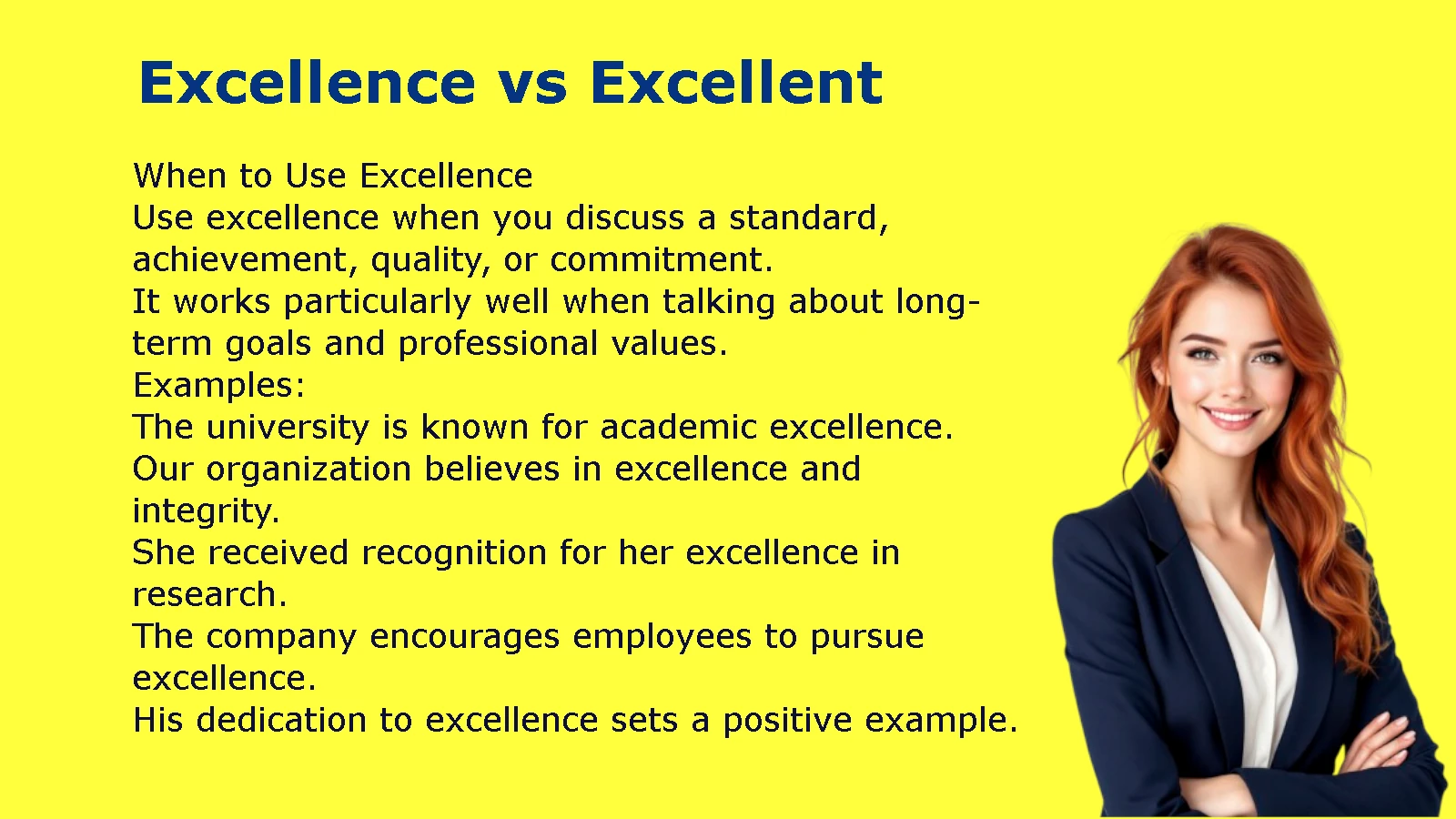
Use excellence when you discuss a standard, achievement, quality, or commitment.
It works particularly well when talking about long-term goals and professional values.
Examples:
- The university is known for academic excellence.
- Our organization believes in excellence and integrity.
- She received recognition for her excellence in research.
- The company encourages employees to pursue excellence.
- His dedication to excellence sets a positive example.
You can also use excellence when discussing an abstract quality that cannot be measured through one isolated result.
For instance, a business might achieve a profitable quarter without consistently demonstrating operational excellence. The first describes a particular outcome; the second refers to an ongoing standard of performance.
When to Use Excellent
Use excellent when you want to describe the quality of a particular person, action, experience, or thing.
It usually appears before a noun, although it can also follow linking verbs.
Examples:
- The manager provided excellent guidance.
- We received excellent customer feedback.
- She wrote an excellent research paper.
- The hotel offers excellent accommodation.
- His performance was excellent.
You can also use excellent when giving feedback.
For example, instead of saying, “Your excellence was very good,” you could say, “Your work was excellent.”
The second sentence communicates the intended meaning more naturally.
Common Mistakes When Using Excellence and Excellent
Writers sometimes confuse these words because they share the same root and express similar ideas. However, replacing an adjective with a noun can make a sentence grammatically incorrect.
Here are common mistakes and their corrections.
| Incorrect sentence | Correct sentence | Explanation |
| She provides excellence service. | She provides excellent service. | Service needs an adjective. |
| He delivered excellence work. | He delivered excellent work. | Excellent describes work. |
| The performance was excellence. | The performance was excellent. | Excellent follows the linking verb was. |
| We strive to achieve excellent. | We strive to achieve excellence. | Achieve requires a noun here. |
| They maintain excellent in education. | They maintain excellence in education. | Excellence acts as the object. |
| The company has excellence standards. | The company has excellent standards. | Excellent modifies standards. |
A useful editing technique is to identify the noun in your sentence first.
Ask yourself:
- Am I naming a quality? Use excellence.
- Am I describing a person or thing? Use excellent.
- Am I referring to a standard or goal? Excellence will often fit.
- Am I describing the quality of a specific result? Excellent will often fit.
This simple check can prevent most common mistakes.
Excellence vs Excellent in Common Expressions
The difference becomes easier to understand when you examine common phrases. Both words appear frequently in business, education, customer service, and professional communication. However, each phrase follows a different grammatical structure.
Excellent Service vs Excellence in Service
Excellent service describes customer service that is exceptionally good. Excellence in service refers to the broader standard of quality an organization maintains when serving its customers.
Both expressions are correct, but they communicate slightly different ideas.
| Expression | Meaning | Example |
| Excellent service | Service of very high quality | The hotel provides excellent service. |
| Excellence in service | A high standard of customer care | The company promotes excellence in service. |
| Service excellence | Consistently outstanding service quality | Service excellence remains our main objective. |
Consider a hotel that receives positive customer feedback because its employees respond quickly, solve problems, and treat guests respectfully.
You could say:
“The hotel provides excellent service.”
However, if you are discussing the hotel’s long-term customer service strategy, you might write:
“The hotel invests in staff training to achieve excellence in service.”
The first sentence evaluates the service. The second describes an organizational standard.
Which phrase should you choose?
Use excellent service when writing:
- Customer reviews
- Business descriptions
- Product and service evaluations
- Marketing content
- Recommendations
Use excellence in service when discussing:
- Business values
- Employee training
- Customer service strategies
- Organizational standards
- Long-term service improvement
Excellent Performance vs Excellence in Performance
Excellent performance describes a specific achievement or result that demonstrates exceptional ability. Excellence in performance refers to a consistent standard of outstanding work, skill, or execution.
Both phrases are grammatically correct.
For example:
- The athlete delivered an excellent performance during the final.
- The organization encourages excellence in performance.
- Her excellent performance earned her a promotion.
- The school recognizes excellence in academic performance.
The distinction becomes important when discussing individual achievements versus broader expectations.
A student who earns outstanding marks in one examination demonstrates excellent performance. A student who consistently maintains high academic standards demonstrates excellence in performance.
Here are additional examples:
| Expression | Example |
| Excellent performance | The employee received praise for his excellent performance. |
| Excellence in performance | The company rewards excellence in performance. |
| Academic excellence | She received a scholarship for academic excellence. |
| Performance excellence | The organization introduced new standards for performance excellence. |
Practical writing tip: Use excellent performance when evaluating a particular result. Use excellence in performance when discussing the standard someone should maintain over time.
Excellent Work vs Excellence in Work
Excellent work describes a task, project, or result completed to a very high standard. Excellence in work describes a broader commitment to quality, accuracy, responsibility, and consistent improvement.
For example:
- You did excellent work on the project.
- The organization values excellence in work.
- Her excellent work impressed the management team.
- Excellence in work requires attention to detail.
Imagine an employee who completes a difficult project before its deadline. The final report contains accurate information, clear explanations, and useful recommendations.
A manager could say:
“You have done excellent work on this project.”
However, if the manager wants to describe the employee’s overall approach, the manager might say:
“Your commitment to excellence in work makes you a valuable team member.”
The first statement praises a particular achievement. The second describes a continuing professional standard.
Other natural expressions include:
- Excellent quality of work
- Commitment to excellent work
- Striving for excellence at work
- Workplace excellence
- Professional excellence
Excellence Award vs Excellent Award
Excellence Award is a natural expression for an award recognizing outstanding achievement or quality. Award for excellence is another common construction. Although excellent award is grammatically possible, it usually describes the award itself as particularly good rather than naming the reason someone receives it.
Consider these examples:
- She received the Employee Excellence Award.
- The university presented him with an Award for Academic Excellence.
- The organization introduced an Excellence Award for outstanding leadership.
- The committee created an award to recognize excellence in research.
Now compare:
“The school presented her with an excellent award.”
This sentence means that the award itself was excellent, perhaps because it was valuable, meaningful, or impressive. It does not necessarily mean the award recognizes excellence.
| Phrase | Meaning |
| Excellence Award | An award recognizing outstanding achievement |
| Award for Excellence | Recognition for exceptional quality or performance |
| Excellent Award | An award that is particularly good or impressive |
| Award of Excellence | A formal recognition of outstanding achievement |
When naming a formal recognition program, use Excellence Award or Award for Excellence if the purpose is to recognize high standards.
Excellence and Excellent in Different Contexts
Both words appear across many fields. Understanding how professionals use them can help you choose the right expression in formal documents, business communication, academic writing, and everyday conversations.
Excellence and Excellent in Business
Businesses use excellence to communicate organizational standards and excellent to describe the quality of their products, services, and results.
Common business expressions include:
- Business excellence
- Operational excellence
- Customer service excellence
- Excellent customer experience
- Excellent leadership
- Excellent business performance
For example:
“Our company is committed to operational excellence and continuous improvement.”
This sentence describes a business philosophy rather than one specific result.
Compare it with:
“Our company delivered excellent results during the latest reporting period.”
Here, excellent describes the results achieved during a particular period.
Business excellence often involves several connected areas:
- Customer satisfaction: Understanding customer needs and resolving complaints effectively.
- Operational efficiency: Reducing unnecessary costs and improving workflows.
- Employee development: Helping staff develop their skills and knowledge.
- Quality management: Maintaining consistent product and service standards.
- Innovation: Finding better ways to solve problems and serve customers.
A business may describe its customer support as excellent, but maintaining excellence requires consistent performance across many customer interactions.
Excellence and Excellent in Education
Educational institutions frequently use excellence to describe high academic standards, achievements, and teaching quality.
Excellent usually describes particular results, students, teachers, or educational resources.
Examples include:
- The university promotes academic excellence.
- She earned excellent grades in mathematics.
- The teacher delivered an excellent lesson.
- The institution received recognition for excellence in education.
- His excellent academic performance earned him a scholarship.
The difference also appears in educational policies.
A school might establish a culture of excellence by encouraging students to develop curiosity, discipline, and independent thinking.
Individual students demonstrate excellent performance when they produce particularly strong results.
Common educational expressions:
| Expression | Meaning |
| Academic excellence | Outstanding academic achievement |
| Excellent grades | Very high academic marks |
| Excellence in teaching | A high standard of teaching |
| Excellent learning experience | An exceptionally positive educational experience |
| Educational excellence | High standards throughout education |
Excellence and Excellent in Everyday English
You do not need formal or professional writing to use these words correctly. Both appear naturally in everyday conversations.
For example:
- That was an excellent idea.
- Your presentation was excellent.
- She always strives for excellence.
- This restaurant serves excellent food.
- His commitment to excellence is impressive.
In casual communication, excellent often expresses approval or enthusiasm.
Someone might respond to a suggestion by saying:
“Excellent idea! Let’s try it.”
Excellence sounds more abstract and is more common when discussing personal standards, achievement, and long-term goals.
For example:
“Excellence comes from consistent effort.”
Both words are useful, but they serve different conversational purposes.
Par Excellence vs Excellent: Are They the Same?
Par excellence means the finest, most outstanding, or most characteristic example of a particular type of person or thing. Excellent simply means extremely good. Although both expressions communicate high quality, par excellence emphasizes something as an outstanding example of its category, while excellent describes its quality more generally.
For example:
- She is a teacher par excellence.
- She is an excellent teacher.
Both sentences praise the teacher, but the first presents her as an outstanding example of what a teacher should be.
What Does Par Excellence Mean?
Par excellence is a French expression used in English to describe something that represents the finest or most characteristic example of its kind.
The expression literally conveys the idea of excellence to the highest degree.
Writers often use it in formal, literary, or sophisticated communication.
Examples:
- He is a leader par excellence.
- The restaurant is a destination for seafood lovers par excellence.
- She is a musician par excellence.
- This historic building represents traditional architecture par excellence.
- The novel is an example of modern storytelling par excellence.
The expression adds emphasis and often sounds more formal than ordinary adjectives.
It is particularly useful when you want to describe someone or something as a model example of a particular category.
Par Excellence vs Excellent: What Is the Difference?
Excellent is a regular adjective that describes high quality. You can use it in almost any type of writing or conversation.
Par excellence is a fixed expression that emphasizes an outstanding or representative example.
| Feature | Par Excellence | Excellent |
| Origin | French expression | English adjective |
| Function | Emphasizes a supreme or characteristic example | Describes very high quality |
| Tone | More formal or literary | Neutral and widely used |
| Usage | Usually follows a noun or noun phrase | Usually comes before a noun or after a linking verb |
| Example | A leader par excellence | An excellent leader |
Par Excellence vs Excellent Examples
Consider these sentence pairs:
Example 1: Leadership
- She is an excellent leader.
- She is a leader par excellence.
The first sentence says she leads exceptionally well. The second presents her as an outstanding example of leadership.
Example 2: Education
- He is an excellent teacher.
- He is a teacher par excellence.
Both sentences praise his teaching ability, but the second has a stronger, more formal tone.
Example 3: Art
- The gallery displays excellent paintings.
- The gallery displays examples of painting par excellence.
The second expression emphasizes exceptional artistic quality and distinction.
Grammar tip: Treat par excellence as a fixed expression. Do not use it as a direct replacement for excellent in every sentence.
How to Pursue Excellence and Develop an Excellent Spirit
Pursuing excellence means consistently working toward high standards in your personal and professional life. Developing an excellent spirit involves building the attitude, discipline, integrity, and willingness to improve that support those standards. Neither requires perfection. Both depend on consistent effort and a commitment to doing meaningful work well.
For example, an employee who checks every report carefully, accepts feedback, and improves weak areas demonstrates a commitment to excellence.
Someone who simply wants to appear successful without improving their work may achieve short-term recognition, but that approach rarely produces lasting quality.
Set Clear Standards for Yourself
Excellence begins with knowing what good work looks like.
Without clear standards, it becomes difficult to measure progress or identify weaknesses.
Start by defining what you want to improve.
For example:
- A student can aim to understand difficult subjects rather than simply memorize answers.
- A business owner can focus on reducing customer complaints and improving service quality.
- A writer can work toward clearer explanations, stronger research, and more accurate grammar.
- An athlete can improve technique, endurance, and consistency.
Use measurable goals whenever possible.
Instead of saying, “I want to become better at writing,” establish a specific target such as completing three well-researched articles each week and reviewing them for accuracy and clarity.
Clear standards turn the pursuit of excellence into practical action.
Develop Consistent Habits
Excellence rarely comes from one extraordinary effort. It usually develops through repeated actions that gradually improve performance.
A person who practices a skill regularly often makes more sustainable progress than someone who works intensely for a short period and then stops.
Build habits such as:
- Planning your most important tasks each day.
- Practicing difficult skills regularly.
- Reviewing your work before submitting it.
- Reading and learning about your field.
- Managing distractions.
- Maintaining realistic deadlines.
For example, a student who studies for one focused hour each day may develop stronger understanding than someone who relies entirely on last-minute preparation.
The same principle applies to businesses. Consistent quality checks, employee training, and customer feedback can help an organization maintain high standards.
Learn From Feedback and Mistakes
People who pursue excellence do not treat mistakes as permanent failures. They examine what went wrong and use that information to improve future performance.
Constructive feedback can reveal problems that you may not notice yourself.
Consider a writer who repeatedly receives feedback that their articles contain unclear explanations.
Instead of ignoring the comments, the writer can:
- Identify sentences that confuse readers.
- Review paragraph structure.
- Replace unnecessary technical terms.
- Add practical examples.
- Edit future articles using the same lessons.
This process turns criticism into measurable improvement.
The same approach works in management, education, sports, and personal development.
A useful principle: Do not measure progress only by the results you achieve. Also measure how effectively you learn from the process.
Maintain an Excellent Attitude
An excellent attitude supports the habits required to pursue excellence.
It involves taking responsibility, treating people respectfully, remaining open to improvement, and maintaining high standards even when nobody is watching.
Some qualities that support an excellent spirit include:
| Quality | How it supports excellence |
| Integrity | Encourages honest and responsible behavior |
| Discipline | Helps maintain consistent effort |
| Patience | Supports long-term improvement |
| Curiosity | Encourages learning and discovery |
| Accountability | Helps people accept responsibility |
| Humility | Makes constructive feedback easier to accept |
| Resilience | Helps people recover from setbacks |
For example, an employee with an excellent attitude does not simply complete assigned tasks. They communicate clearly, support colleagues, take responsibility for mistakes, and look for ways to improve their work.
These qualities help create a culture where excellence becomes a consistent practice rather than an occasional achievement.
Related Words and Expressions for Excellence and Excellent
Understanding related words can strengthen your vocabulary and help you express different degrees and types of quality.
Although excellence and excellent share a word family, their synonyms do not always fit the same grammatical structures.
Synonyms of Excellence
Excellence has several synonyms that describe exceptional quality, distinction, or achievement.
| Synonym | Meaning | Example |
| Superiority | Higher quality compared with others | The product demonstrated technical superiority. |
| Distinction | Recognized achievement or exceptional quality | She graduated with distinction. |
| Perfection | A state without flaws | The artist worked toward perfection. |
| Greatness | Exceptional quality or importance | His dedication contributed to greatness. |
| Mastery | Advanced knowledge or skill | Years of practice helped her achieve mastery. |
| Outstanding quality | A particularly high standard | The organization is known for outstanding quality. |
These words have related meanings, but they are not always interchangeable.
For instance, mastery emphasizes skill, while distinction often emphasizes recognized achievement.
Excellence has a broader meaning because it can describe quality across many different areas.
Synonyms of Excellent
Excellent has a wider range of everyday adjective alternatives.
| Synonym | Meaning | Example |
| Outstanding | Exceptionally good | She delivered an outstanding presentation. |
| Exceptional | Unusually high in quality | The team achieved exceptional results. |
| Superb | Extremely impressive | The restaurant serves superb food. |
| Remarkable | Worthy of attention or admiration | He made remarkable progress. |
| First-rate | Of the highest standard | They provide first-rate customer support. |
| Superior | Better in quality or performance | The new model offers superior performance. |
Choose synonyms according to the context.
For example, superb may suit a restaurant review, while first-rate often works in business descriptions.
Excellence and Excellent Word Forms
Both words belong to the same word family as excel and excellently.
Understanding these related forms helps you build grammatically correct sentences.
| Word | Part of speech | Meaning | Example |
| Excel | Verb | To perform exceptionally well | She excels in mathematics. |
| Excellent | Adjective | Extremely good | He delivered an excellent speech. |
| Excellence | Noun | Outstanding quality | The company values excellence. |
| Excellently | Adverb | In an exceptionally good way | The team performed excellently. |
Notice how the word form changes the structure of a sentence.
Compare:
- She demonstrates excellence.
- She is excellent.
- She excels at mathematics.
- She performed excellently.
All four sentences communicate strong performance, but each uses a different grammatical form.
Quick Grammar Rules for Using Excellence and Excellent
A few simple grammar rules can help you avoid confusion when using excellence and excellent.
The most important point is to identify the grammatical role the word needs to perform.
Can Excellence Describe a Person?
Yes. Excellence can describe a person’s outstanding qualities, achievements, or abilities. However, it usually refers to the quality itself rather than directly modifying the person’s name or role.
For example:
- Her excellence in leadership earned widespread respect.
- His commitment to excellence inspired his colleagues.
- The athlete demonstrated excellence throughout the competition.
However, if you want to describe the person directly, excellent is usually more natural.
Compare:
- She is an excellent manager.
- She demonstrates excellence in management.
Both sentences are correct, but the first directly describes the manager, while the second emphasizes her professional quality.
Can Excellent Be Used as a Noun?
Excellent normally functions as an adjective, not a noun.
You generally should not write:
“Her excellent is recognized by everyone.”
Instead, use excellence:
“Her excellence is recognized by everyone.”
You can also use a suitable noun depending on your intended meaning:
- Her achievements are widely recognized.
- Her performance received praise.
- Her work demonstrates exceptional quality.
Remember that excellent describes something, while excellence names the quality being described.
What Words Commonly Follow Excellence?
Excellence frequently appears in expressions that refer to standards, values, and achievements.
Common combinations include:
- Excellence in education
- Excellence in leadership
- Excellence in customer service
- Commitment to excellence
- Pursuit of excellence
- Standard of excellence
- Academic excellence
- Operational excellence
- Professional excellence
- Excellence in research
Examples:
“The university maintains a strong commitment to academic excellence.”
“The organization recognizes employees who demonstrate excellence in leadership.”
These combinations work because excellence functions as a noun.
What Words Commonly Follow Excellent?
Excellent commonly appears before nouns that describe people, objects, experiences, and results.
Common combinations include:
- Excellent service
- Excellent performance
- Excellent work
- Excellent results
- Excellent opportunity
- Excellent communication
- Excellent leadership
- Excellent quality
- Excellent experience
- Excellent decision
Examples:
“The company offers excellent customer support.”
“Her excellent communication skills helped resolve the disagreement.”
You can also use excellent after linking verbs:
- The presentation was excellent.
- The food looks excellent.
- His results seem excellent.
This flexibility makes excellent useful in everyday and professional writing.
Practical Case Study: Using Excellence and Excellent in Business Writing
Consider a fictional company called BrightPath Solutions. The company provides customer support services to small businesses.
Its management team wants to communicate two things:
- The organization aims to maintain consistently high customer service standards.
- Its employees deliver very good customer support.
Using the correct word helps distinguish these two messages.
Version A: General business statement
“BrightPath Solutions is committed to excellence in customer service.”
This statement communicates the company’s long-term standard and organizational values.
Version B: Specific service description
“BrightPath Solutions provides excellent customer service to small businesses.”
This statement describes the quality of the service customers receive.
Version C: Performance evaluation
“The support team demonstrated excellent performance by resolving customer complaints quickly and accurately.”
Here, excellent describes the team’s performance during a particular period.
Version D: Organizational goal
“The company continues to pursue excellence through employee training, quality monitoring, and customer feedback.”
This statement explains how the company intends to maintain and improve its standards.
The lesson is straightforward: choose excellence when discussing a quality or standard, and choose excellent when describing something that demonstrates that quality.
Conclusion: Choose Excellence or Excellent Correctly
The difference between excellence and excellent becomes simple once you understand their grammatical roles. Excellence is a noun that describes outstanding quality, while excellent is an adjective that describes something exceptionally good.
Use excellence in expressions such as academic excellence, commitment to excellence, and excellence in customer service. Choose excellent when describing excellent work, excellent performance, excellent service, or excellent results.
Remember these two examples:
- We should always strive for excellence.
- We should always produce excellent work.
Both words communicate high standards, but they belong in different sentence structures.
When editing your writing, identify whether you need to name a quality or describe something. This small habit will help you choose the right word and make your English clearer.
Keep learning related word forms, practice with original sentences, and apply these grammar rules in everyday communication. Excellence comes from consistent improvement, and excellent writing begins with choosing the right words.













