Emphasize vs emphasise is a common spelling question because both forms are correct, but their usage depends on regional English conventions. American English generally uses emphasize, while British English commonly prefers emphasise. Canadian and South African English follow their own spelling preferences, which can vary by dictionary and editorial style guide.
Both words have exactly the same meaning: to give special importance, attention, or prominence to something. The difference lies in spelling, not grammar, pronunciation, or meaning. Understanding these regional conventions will help you choose the right form for academic papers, professional documents, websites, and everyday writing.
| Question | Answer |
| Is it emphasize or emphasise? | Both are correct spellings. |
| Which spelling is American? | Emphasize is the standard American spelling. |
| Which spelling is British? | Emphasise is the common British preference, although -ize is also accepted in some British styles. |
| Do emphasize and emphasise mean the same thing? | Yes. Both mean to give something special importance or attention. |
| Does Canada use emphasize or emphasise? | Both occur, depending on the dictionary and writing style followed. |
Emphasize or Emphasise: Which Spelling Is Correct?
Both emphasize and emphasise are correct English spellings. The main difference concerns regional spelling conventions. American English normally uses emphasize, whereas British English commonly uses emphasise. Both forms function as verbs and describe the act of giving something greater importance, attention, or prominence.
Neither spelling is inherently more correct than the other. Your choice should depend on your intended audience, the publication’s editorial rules, and the variety of English you want to follow.
Emphasize Is the American English Spelling
Emphasize is the standard spelling in American English. Writers in the United States use the -ize ending in this word and many related verbs.
American dictionaries and editorial conventions generally prefer -ize over -ise in words such as:
- Emphasize
- Organize
- Recognize
- Realize
- Prioritize
- Apologize
- Modernize
For example:
- The teacher wanted to emphasize the importance of independent thinking.
- This report will emphasize the company’s financial performance.
- The manager continued to emphasize the need for teamwork.
- Good leaders emphasize communication and accountability.
American businesses, universities, newspapers, and publishers generally follow this spelling.
If you are writing for an American audience, use emphasize and maintain the same -ize convention in related words.
Emphasise Is the British English Spelling
Emphasise is the common British English spelling. It follows the spelling preference found in many British publications and educational materials.
British writers commonly use -ise in words such as:
- Emphasise
- Organise
- Recognise
- Realise
- Prioritise
- Apologise
- Modernise
For example:
- The teacher wanted to emphasise the importance of independent thinking.
- This report will emphasise the company’s financial performance.
- The manager continued to emphasise the need for teamwork.
- Good leaders emphasise communication and accountability.
One important detail: British English also accepts many -ize spellings. The -ize ending has a long history in British English and appears in established British publishing conventions.
Therefore, it is more accurate to describe emphasise as the common British preference rather than claim that emphasize is always incorrect in the UK.
Emphasize vs Emphasise: What Is the Difference?
The difference between emphasize and emphasise is mainly regional spelling. Both words have the same definition, grammatical function, and standard pronunciation. American English generally prefers emphasize, while British English commonly uses emphasise. Neither form changes the meaning of a sentence, so writers should select one according to their audience and maintain consistency.
| Feature | Emphasize | Emphasise |
| Spelling | -ize ending | -ise ending |
| Common regional preference | American English | British English |
| Part of speech | Verb | Verb |
| Meaning | Give special importance | Give special importance |
| Pronunciation | Same | Same |
| Present tense | Emphasize | Emphasise |
| Past tense | Emphasized | Emphasised |
| Present participle | Emphasizing | Emphasising |
The easiest way to remember the distinction is to associate emphasize with American spelling and emphasise with the common British spelling.
Do Emphasize and Emphasise Have the Same Meaning?
Yes. Emphasize and emphasise have exactly the same meaning. Both verbs describe the act of highlighting something, drawing attention to an important point, or making an idea stand out.
The words do not communicate different levels of importance. A writer using emphasize does not express a stronger idea than someone using emphasise.
Consider these examples:
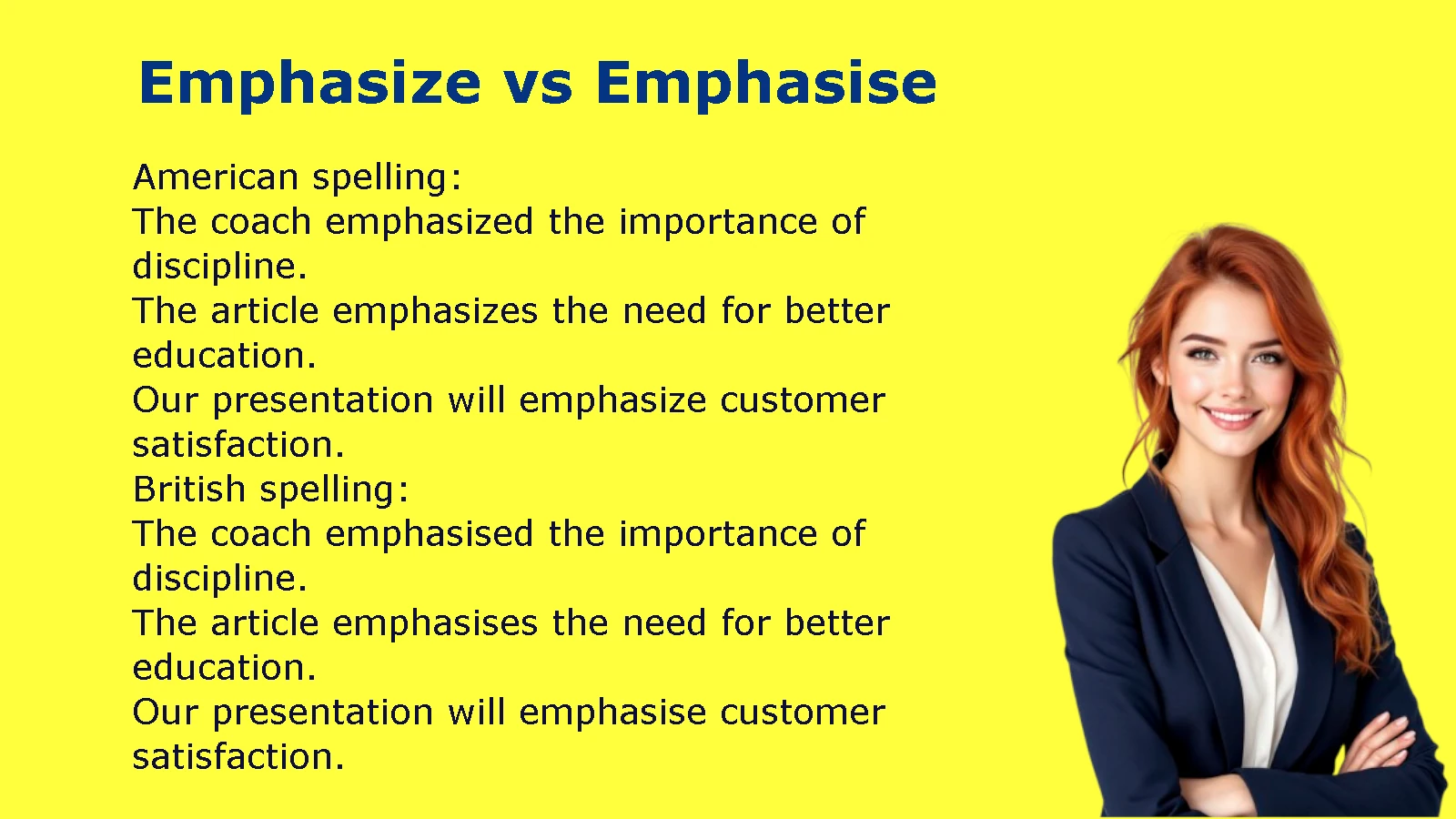
American spelling:
- The coach emphasized the importance of discipline.
- The article emphasizes the need for better education.
- Our presentation will emphasize customer satisfaction.
British spelling:
- The coach emphasised the importance of discipline.
- The article emphasises the need for better education.
- Our presentation will emphasise customer satisfaction.
Notice that only the spelling changes. The message remains identical.
The verb can also describe several kinds of emphasis:
- Communication: A speaker emphasizes an important point during a presentation.
- Education: A teacher emphasises critical thinking in the classroom.
- Business: A company emphasizes customer service in its marketing strategy.
- Writing: An author emphasises a central argument through examples.
- Design: A designer emphasizes a headline through size, spacing, and contrast.
In each situation, the word means making something more noticeable or important.
Are Emphasize and Emphasise Pronounced the Same?
Yes. Emphasize and emphasise generally have the same pronunciation. The spelling changes, but the spoken word does not.
In standard English pronunciation, both forms are commonly represented as:
/ˈem.fə.saɪz/
The word has three syllables, with stress on the first syllable.
The pronunciation can be understood in three parts:
- First syllable: Em
- Second syllable: Fuh
- Third syllable: Size
The final sound resembles the word “size.”
For example, an American speaker may write emphasize, while a British speaker may write emphasise. However, both normally pronounce the word in the same way.
This distinction matters because some spelling differences also affect pronunciation, but this pair does not follow that pattern.
When Should You Use Emphasize or Emphasise?
Choose the spelling that matches your audience and writing convention. The most important rule is consistency.
Use emphasize when:
- Writing for readers in the United States.
- Preparing American academic assignments.
- Creating content for US-based websites.
- Following an American editorial style guide.
- Writing business reports for American organizations.
Use emphasise when:
- Writing for a British audience that follows -ise spelling.
- Preparing content for many UK publications.
- Creating educational material using British spelling conventions.
- Writing for South African readers who follow British-style spelling.
For Canadian English, check the preferred dictionary or publication style guide before choosing.
Avoid switching between emphasize and emphasise within the same document unless you are discussing the spelling differences themselves.
Emphasize or Emphasise in British English
Emphasise is the common preferred spelling in British English, although emphasize is also accepted under established British spelling conventions. The choice depends on the dictionary and editorial style a writer follows. British English does not automatically reject every word ending in -ize, so writers should distinguish between common preference and accepted usage.
The distinction often causes confusion because people associate all -ize endings with American English. However, that assumption is too broad.
British English has two established spelling patterns for many verbs ending in this sound.
Is Emphasize Ever Correct in British English?
Yes. Emphasize can be correct in British English.
Some British dictionaries and publishers accept -ize spellings because the ending has historical roots in English and follows a recognized spelling convention.
For example, certain British publications use:
- Organize
- Recognize
- Realize
- Emphasize
- Prioritize
Other British publications prefer:
- Organise
- Recognise
- Realise
- Emphasise
- Prioritise
Both systems have established usage.
The important difference is editorial preference. A publisher that follows an -ise convention will generally expect emphasise. Another publication that follows an -ize convention may prefer emphasize.
Practical rule: Do not automatically treat emphasize as an American-only spelling. Check the style guide when writing for a British publication.
Emphasise vs Emphasize in British Writing
British writing often uses emphasise because the -ise ending is familiar across newspapers, educational resources, government documents, and everyday publications.
However, the -ize form remains acceptable in British English under certain style conventions.
Here is how the choice works in practice:
| Writing situation | Recommended approach |
| British school assignment | Follow the school’s spelling guidance; emphasise is a common choice. |
| UK newspaper article | Follow the publication’s house style. |
| British business report | Maintain the organization’s preferred spelling. |
| UK academic paper | Follow the required referencing and editorial guidelines. |
| Personal writing | Choose either accepted convention and remain consistent. |
For example:
- British -ise style: The report will emphasise the benefits of renewable energy.
- British -ize style: The report will emphasize the benefits of renewable energy.
Both sentences are understandable and can follow accepted British conventions.
Emphasize or Emphasise in the UK, Canada, and South Africa
The preferred spelling varies across English-speaking countries. The UK commonly uses emphasise, although -ize is also accepted in some British styles. South African English generally follows British-style spelling and favors emphasise. Canadian English has mixed conventions, so writers should consult their chosen Canadian dictionary or editorial style guide.
These regional differences matter when preparing content for international audiences. A spelling choice that looks natural in one country may appear unfamiliar in another.
Emphasize or Emphasise in the UK
In the United Kingdom, emphasise is a common spelling preference.
British English often uses -ise endings in everyday and professional writing. This pattern appears in words such as organise, recognise, realise, and prioritise.
For example:
- The government should emphasise the importance of public safety.
- Teachers must emphasise clear communication.
- The report will emphasise the need for economic growth.
- The company wants to emphasise its commitment to quality.
However, British English also recognizes the -ize spelling convention. Some British dictionaries, publishers, and academic institutions use emphasize.
This means the correct choice depends on the editorial standard being followed.
Quick UK rule: Emphasise is a common British preference, but emphasize is not automatically wrong in British English.
Emphasize or Emphasise in Canada
Canadian English has a more mixed spelling system because it reflects influences from both British and American English.
Canadian writers may encounter both emphasize and emphasise. The preferred form can depend on the dictionary, institution, publisher, or organization’s editorial rules.
Canadian English commonly uses British-style spellings in some areas and American-style spellings in others. This makes it important to avoid applying a simple British-versus-American rule to every Canadian word.
For example, Canadian writers may use:
- Colour rather than color.
- Centre rather than center.
- Organize or organise, depending on the style followed.
- Emphasize or emphasise, depending on the preferred convention.
When writing for Canadian readers, consider these guidelines:
- Check the dictionary: Use the spelling listed as preferred in your chosen Canadian reference.
- Follow the publisher: Newspapers and organizations may have their own spelling policies.
- Maintain consistency: Do not alternate between -ize and -ise forms without a clear reason.
- Consider the audience: A Canadian academic institution may specify a particular editorial standard.
For example:
- The instructor wants to emphasize the importance of research.
- The instructor wants to emphasise the importance of research.
Both forms can occur in Canadian writing. The appropriate choice depends on the spelling standard being followed.
Emphasize or Emphasise in South Africa
South African English generally follows British-style spelling conventions. Therefore, emphasise is the usual preference in South African writing.
This convention appears in educational materials, professional communication, government publications, and many South African websites.
Examples include:
- Schools should emphasise the importance of reading.
- The report will emphasise the country’s economic priorities.
- Managers should emphasise workplace safety.
- The speaker wanted to emphasise the need for cooperation.
South African English shares many spelling patterns with British English, including:
- Organise
- Recognise
- Realise
- Prioritise
- Emphasise
If you are creating content for a South African audience, emphasise is generally the safer choice.
However, organizations that use a different editorial standard may make different choices. Follow the relevant publication guidelines whenever they exist.
Regional Spelling Comparison Table
The following table summarizes the common preferences across the four regions.
| Country or region | Common preferred spelling | Explanation |
| United States | Emphasize | Standard American English spelling |
| United Kingdom | Emphasise | Common preference, although -ize is also accepted |
| Canada | Emphasize / Emphasise | Depends on the dictionary and editorial convention |
| South Africa | Emphasise | Generally follows British-style spelling |
This comparison provides a useful starting point, but a country’s spelling conventions do not always determine the rules used by every organization.
For international content, identify the target market before publishing.
Emphasize vs Emphasise Example Sentences
Examples make the difference between emphasize and emphasise easier to understand. Both forms work in the same grammatical situations, and neither changes the meaning of a sentence. The following examples show how each spelling appears in everyday communication, education, business, and professional writing.
Examples Using Emphasize
Use emphasize when following American English spelling conventions.
- The teacher wanted to emphasize the importance of regular reading.
- This report will emphasize the company’s long-term goals.
- Her presentation helped emphasize the main findings.
- The manager continued to emphasize teamwork.
- We should emphasize the benefits of this approach.
- The speaker used several examples to emphasize his argument.
- Parents should emphasize the value of honesty.
- The advertisement aims to emphasize product quality.
- The research findings emphasize the need for further investigation.
- Good leaders emphasize communication and accountability.
Each example uses the same basic meaning: giving something special importance or drawing attention to it.
Examples Using Emphasise
Use emphasise when following a British-style spelling convention.
- The teacher wanted to emphasise the importance of regular reading.
- This report will emphasise the company’s long-term goals.
- Her presentation helped emphasise the main findings.
- The manager continued to emphasise teamwork.
- We should emphasise the benefits of this approach.
- The speaker used several examples to emphasise his argument.
- Parents should emphasise the value of honesty.
- The advertisement aims to emphasise product quality.
- The research findings emphasise the need for further investigation.
- Good leaders emphasise communication and accountability.
The examples show that the two spellings can replace each other without changing the sentence’s meaning.
How to Choose the Correct Spelling in a Sentence
Choosing between emphasize and emphasise becomes easier when you follow a consistent process.
Step 1: Identify your target audience.
Determine whether your readers primarily use American, British, Canadian, or South African English.
Step 2: Select a spelling convention.
In American English, choose emphasize. For common British and South African conventions, choose emphasise. For Canadian English, consult your preferred style guide.
Step 3: Check related words.
If you choose emphasize, use related American forms such as emphasized and emphasizing.
If you choose emphasise, use emphasised and emphasising.
Step 4: Review the entire document.
Check for inconsistent spellings before publishing or submitting your work.
For example, this sentence is inconsistent:
“The manager wants to emphasise customer service and emphasize product quality.”
A consistent British-style version would be:
“The manager wants to emphasise customer service and product quality.”
A consistent American-style version would be:
“The manager wants to emphasize customer service and product quality.”
This simple editing habit makes your writing look more professional.
Emphasize vs Emphasise: Related Word Forms
The spelling difference between emphasize and emphasise also affects their grammatical forms. American English uses emphasized, emphasizing, and emphasizes, while British -ise spelling commonly produces emphasised, emphasising, and emphasises. The noun emphasis, however, keeps the same spelling in both varieties of English.
Understanding these forms helps prevent spelling inconsistencies in longer documents.
| Word form | American English | Common British -ise spelling |
| Base verb | Emphasize | Emphasise |
| Third-person singular | Emphasizes | Emphasises |
| Past tense | Emphasized | Emphasised |
| Past participle | Emphasized | Emphasised |
| Present participle | Emphasizing | Emphasising |
| Noun | Emphasis | Emphasis |
| Adjective | Emphatic | Emphatic |
| Adverb | Emphatically | Emphatically |
Notice that the noun, adjective, and adverb do not change their spelling between the two conventions.
Emphasize vs Emphasise in the Past Tense
The past-tense forms are emphasized and emphasised.
Both forms describe an action that happened in the past.
Examples:
American English:
- The teacher emphasized the importance of attendance.
- The manager emphasized the need for better communication.
- The report emphasized the company’s achievements.
British English:
- The teacher emphasised the importance of attendance.
- The manager emphasised the need for better communication.
- The report emphasised the company’s achievements.
The same distinction applies to the past participle.
For example:
- American: The importance of safety has been emphasized.
- British: The importance of safety has been emphasised.
Both sentences use the present perfect tense correctly.
Emphasizing vs Emphasising
Emphasizing is the American present participle, while emphasising is the common British -ise form.
Both forms can function in continuous verb constructions or as gerunds.
Examples:
American English:
- The professor is emphasizing the importance of evidence.
- Emphasizing the main argument makes the article clearer.
- She kept emphasizing the same point.
British English:
- The professor is emphasising the importance of evidence.
- Emphasising the main argument makes the article clearer.
- She kept emphasising the same point.
The grammatical function remains unchanged.
Remember that the spelling of the base verb determines the spelling of its related forms. If your document uses emphasise, avoid switching to emphasizing later.
Does the Word Emphasis Change Its Spelling?
No. Emphasis has the same spelling in American, British, Canadian, and South African English.
It is a noun that describes special importance, attention, or prominence given to something.
Examples:
- The school places great emphasis on practical learning.
- The report puts particular emphasis on financial stability.
- Her presentation gave more emphasis to customer experience.
- The course places an emphasis on independent research.
The plural form is emphases.
For example:
“The article discusses several different emphases in modern education.”
The noun does not follow the -ize or -ise spelling distinction because it does not end with that verb-forming suffix.
It is also useful to understand the difference between the noun and verb:
| Word | Part of speech | Meaning |
| Emphasis | Noun | Special importance or attention |
| Emphasize | Verb | To give special importance |
| Emphasise | Verb | To give special importance |
| Emphatic | Adjective | Expressing something forcefully |
| Emphatically | Adverb | In a forceful or definite manner |
For example:
- Noun: The speaker placed emphasis on education.
- Verb: The speaker wanted to emphasize education.
- Adjective: She gave an emphatic response.
- Adverb: He emphatically rejected the suggestion.
Why Do Emphasize and Emphasise Have Different Spellings?
The difference between emphasize and emphasise comes from the development of English spelling conventions. American English generally favors the -ize ending, while British English commonly uses -ise. Historical spelling practices, dictionary standards, and publishing preferences helped establish these regional patterns, even though both forms remain accepted.
The distinction is part of a much larger pattern of spelling differences between American and British English.
Words such as color and colour, center and centre, and organize and organise show how the same language developed different written conventions across regions.
The History of the -Ize and -Ise Endings
The -ize and -ise endings have historical connections to the Greek-derived -izein ending, which entered English through French and Latin influences.
Over time, English adopted different spellings for many words containing this ending.
The -ize form has a long history in English and was not invented exclusively by American writers. British English has also used it for centuries.
However, -ise became a widespread preference in British writing, while American English developed a stronger preference for -ize.
This explains why both forms can be found in English publications today.
The distinction is not unique to emphasize.
Consider these examples:
| American spelling | Common British spelling |
| Organize | Organise |
| Recognize | Recognise |
| Realize | Realise |
| Prioritize | Prioritise |
| Apologize | Apologise |
| Modernize | Modernise |
| Emphasize | Emphasise |
The underlying meaning remains the same in each pair.
Why American English Prefers Emphasize
American English generally favors -ize endings in verbs that follow this spelling pattern.
This preference became stronger through American dictionary traditions and spelling standardization.
Noah Webster, an influential American lexicographer, helped establish spelling conventions that distinguished American English from British English. His work encouraged greater consistency in American spelling, although the history of -ize itself predates his reforms.
Today, American dictionaries and many major US publishing styles consistently use emphasize.
The same convention appears in numerous related verbs:
- Organize your schedule.
- Recognize an achievement.
- Realize your potential.
- Prioritize important tasks.
- Modernize outdated equipment.
For American writers, using -ize forms creates consistency across related words.
Why British English Often Uses Emphasise
British English commonly favors -ise endings in many everyday words.
This preference became established through British dictionaries, publishers, educational institutions, and editorial traditions.
As a result, emphasise often appears more familiar to British readers.
The same pattern can be seen in:
- Organise
- Recognise
- Realise
- Prioritise
- Apologise
However, British spelling is not governed by one universal -ise rule.
Some British style conventions retain -ize endings, particularly in words where that form has an established historical and linguistic basis.
Therefore, both emphasize and emphasise can appear in British publications.
The best approach is to understand the publication’s preferred convention instead of assuming that one spelling is universally required.
Emphasize vs Emphasise: Which One Should You Use?
The correct choice depends on your audience and the spelling convention required by your publication. Use emphasize for standard American English, emphasise for common British and South African usage, and check a recognized Canadian dictionary or editorial guide for Canadian writing. Consistency matters more than choosing one form as universally correct.
Use Emphasize for American Audiences
Choose emphasize when writing for readers in the United States.
This is the standard form in:
- American academic papers.
- US business reports.
- American newspapers and magazines.
- US-based websites and blogs.
- American educational resources.
- Professional documents following American English.
For example:
“Our company wants to emphasize the importance of customer satisfaction.”
This sentence follows standard American spelling.
If your article also contains words such as organize, recognize, and prioritize, maintain the same spelling pattern.
Use Emphasise for British and South African Audiences
Choose emphasise when following common British or South African spelling conventions.
This spelling is appropriate for many:
- UK educational publications.
- British business documents.
- South African websites.
- British-style academic writing.
- Professional communication following -ise spelling.
For example:
“Our company wants to emphasise the importance of customer satisfaction.”
This version follows the common British-style convention.
Remember that some British publishers accept -ize forms. Follow their individual requirements when writing for a specific publication.
Check Your Style Guide for Canadian English
Canadian English combines spelling conventions associated with both British and American English.
As a result, writers should not assume that every -ise or -ize word follows one universal Canadian rule.
When writing for a Canadian audience:
- Identify the dictionary or style guide required by your organization.
- Check its preferred spelling of emphasize.
- Apply the same convention to related verbs.
- Review the document for consistency.
For example, a Canadian organization may prefer emphasize, while another publication may follow a different established convention.
The goal is to match the expected standard rather than mix spellings randomly.
Quick Rule to Remember
Use this simple reference when deciding between the two spellings:
- American English: Emphasize.
- British English: Emphasise is common; emphasize is also accepted in some styles.
- South African English: Emphasise is generally preferred.
- Canadian English: Follow the chosen Canadian dictionary or style guide.
If you remember these four guidelines, you can make the correct spelling choice for most everyday and professional writing situations.
Frequently Asked Questions
Is It Emphasize or Emphasise?
Both emphasize and emphasise are correct. American English generally uses emphasize, while British English commonly prefers emphasise. Both words have the same meaning and pronunciation. Choose the form that matches your intended audience and maintain consistency throughout your writing.
Is Emphasise British or American?
Emphasise is commonly associated with British English. It is the preferred spelling in many British publications and is also widely used in South African English. American English generally uses emphasize. However, the -ize spelling is also accepted in some British spelling conventions.
Do Canadians Spell It Emphasize or Emphasise?
Canadian English can use both forms, depending on the dictionary and editorial style followed. Canadian spelling combines British and American influences, so writers should consult their organization’s preferred reference. The most important rule is to use one spelling consistently throughout a document.
Does South Africa Use Emphasize or Emphasise?
South African English generally follows British-style spelling conventions, making emphasise the common preference. You will often find the same pattern in related words such as organise, recognise, and prioritise. However, individual publications may follow different editorial standards.
Do Emphasize and Emphasise Mean the Same Thing?
Yes. Both words mean to give something special importance, attention, or prominence. They function as verbs and can replace each other without changing a sentence’s meaning. The only difference is their spelling convention.
Is Emphasized or Emphasised Correct?
Both forms are correct. Emphasized is the standard American spelling, while emphasised is the common British -ise form. Both describe something that received special importance or attention in the past.
Conclusion: Emphasize vs Emphasise
The difference between emphasize vs emphasise comes down to regional spelling preferences, not meaning or pronunciation. Both forms are correct, and both communicate the same idea: giving special importance, attention, or prominence to something.
Use emphasize when writing in standard American English. Choose emphasise when following common British or South African spelling conventions. For Canadian English, check your preferred dictionary or editorial style guide.
Keep these simple rules in mind:
- American English: Emphasize.
- British English: Emphasise is common, but emphasize is also accepted.
- Canadian English: Follow your chosen style guide.
- South African English: Emphasise is generally preferred.
The most important writing habit is consistency. Once you select a spelling convention, apply it to related forms such as emphasized, emphasising, and emphasizes.
Before publishing your next article, report, or academic assignment, check your target audience and choose the spelling that matches its English convention.













