Em dash vs en dash is a common punctuation question because both marks look similar but serve different purposes. An em dash (—) creates a break, adds emphasis, or separates extra information in a sentence, while an en dash (–) primarily connects numerical ranges, dates, and related terms. A hyphen (-) serves a different purpose: it joins words to form compound expressions.
Understanding the difference between an em dash, en dash, and hyphen helps you write clearer sentences and avoid punctuation mistakes. These marks also follow different conventions in AP Style, legal writing, academic writing, and AI-generated content. You can even insert them using specific Windows and Mac keyboard shortcuts.
| Question | Answer |
| What is the difference between an em dash and an en dash? | An em dash creates interruptions and emphasis, while an en dash connects ranges and related terms. |
| Which dash is longer? | An em dash (—) is traditionally longer than an en dash (–). |
| When should you use an en dash? | Use it for numerical ranges, date ranges, and certain relationships between terms. |
| How do you type an em dash on a keyboard? | On Mac, press Option + Shift + Hyphen. On Windows, use Alt + 0151 with the numeric keypad. |
| Is an em dash the same as a hyphen? | No. A hyphen joins words, an en dash connects ranges, and an em dash separates parts of a sentence. |
What Is the Difference Between an Em Dash and an En Dash?
An em dash (—) and an en dash (–) differ in length, appearance, and grammatical function. An em dash creates a strong pause or interruption within a sentence. An en dash usually connects numerical ranges, dates, times, and related terms. Choosing the correct mark makes your writing more consistent and easier to understand.
What Is an Em Dash (—)?
An em dash is a long punctuation mark that separates parts of a sentence. Writers use it to introduce additional information, emphasize a point, indicate an interruption, or create a noticeable pause.
It offers more emphasis than a comma and often feels less formal than parentheses. You can use one em dash to introduce an explanation or two em dashes to surround extra information.
Examples of em dashes:
- I wanted to attend the meeting—but something unexpected happened.
- Her latest article—which took three weeks to complete—received excellent feedback.
- There was only one person who could solve the problem—Sarah.
- The final decision was clear—we needed a better strategy.
In each example, the em dash creates a noticeable break. It guides readers toward additional information or an important point.
Main characteristics of an em dash:
- It is the longest of the three common dash marks.
- It creates emphasis and noticeable pauses.
- It can replace commas, parentheses, or colons in suitable sentences.
- It can indicate interrupted dialogue.
- It often appears in informal, creative, and professional writing.
The em dash works particularly well when you want readers to notice an explanation rather than pass over it as ordinary background information.
What Is an En Dash (–)?
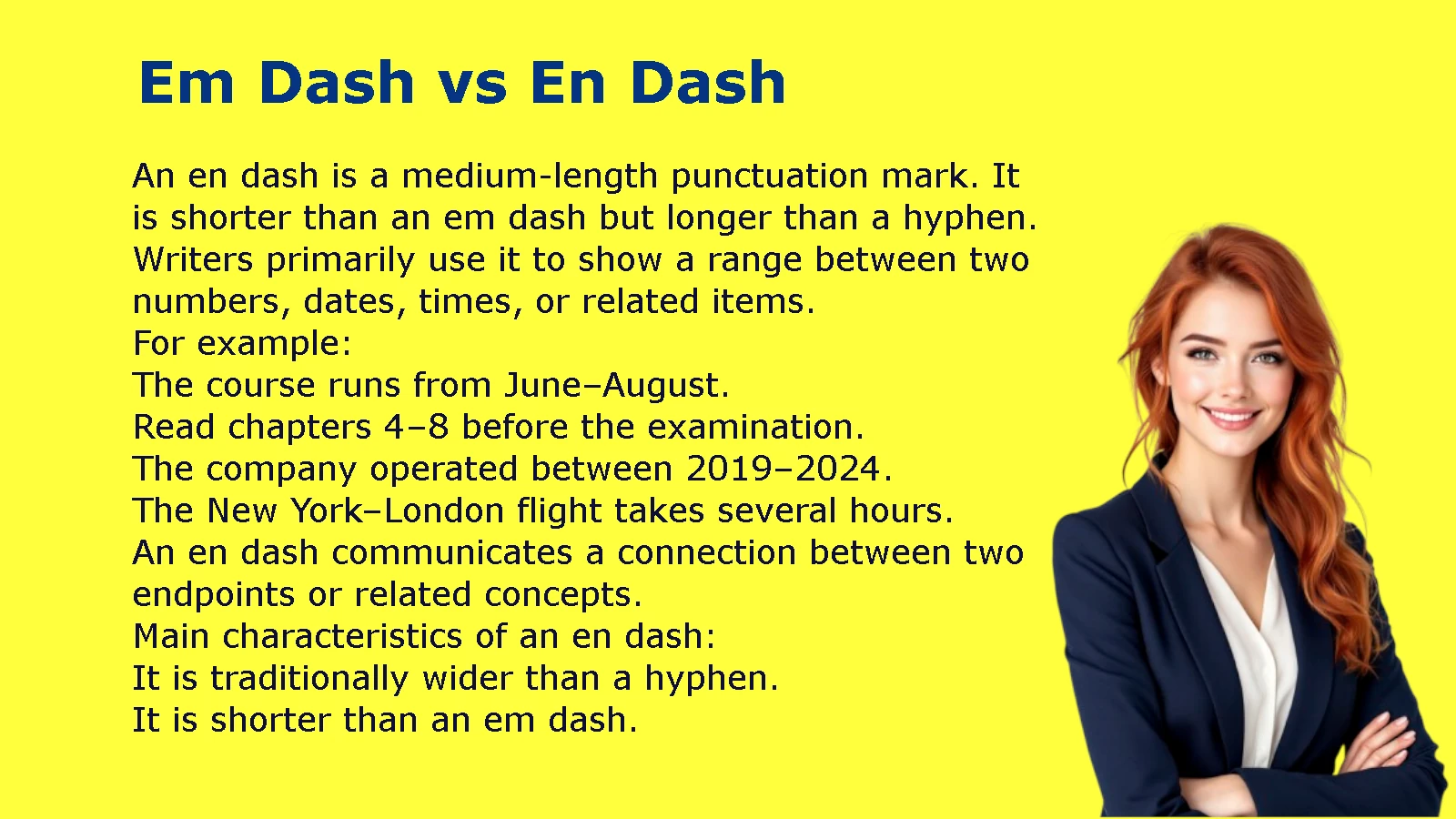
An en dash is a medium-length punctuation mark. It is shorter than an em dash but longer than a hyphen. Writers primarily use it to show a range between two numbers, dates, times, or related items.
For example:
- The course runs from June–August.
- Read chapters 4–8 before the examination.
- The company operated between 2019–2024.
- The New York–London flight takes several hours.
An en dash communicates a connection between two endpoints or related concepts.
Main characteristics of an en dash:
- It is traditionally wider than a hyphen.
- It is shorter than an em dash.
- It commonly represents numerical and date ranges.
- It can connect related or opposing terms.
- It usually appears without surrounding spaces in closed numerical ranges.
One important grammar point: avoid combining an en dash with words such as from or between when the sentence already expresses the range.
Incorrect: The program runs from June–August.
Better: The program runs from June to August.
Also correct: The program runs June–August.
Em Dash vs En Dash: Quick Comparison Table
The easiest way to remember the difference is to associate each punctuation mark with its main function.
| Feature | Em Dash (—) | En Dash (–) |
| Length | Long | Medium |
| Main purpose | Interruption and emphasis | Ranges and relationships |
| Common use | Additional information | Numerical ranges |
| Sentence function | Separates thoughts | Connects endpoints |
| Example | She arrived—finally. | Pages 20–35 |
| Typical spacing | Depends on style guide | Usually no spaces in ranges |
| Common context | Essays, articles, dialogue | Dates, times, statistics |
Remember: Use an em dash when you want to interrupt or emphasize a thought. Choose an en dash when you want to connect two endpoints or related concepts.
Why Are They Called Em Dash and En Dash?
The names come from traditional typography, where the letters M and N helped describe the approximate widths of these punctuation marks.
An em dash traditionally had a width equivalent to one em unit, while an en dash had a width equivalent to one en unit. These units are typographic measurements related to the typeface and font size.
Their actual appearance can vary across fonts and digital applications.
The names describe their traditional typographic measurements, not a universal rule that every em dash must equal the visible width of a capital M.
Em Dash vs En Dash vs Hyphen: What’s the Difference?
An em dash, en dash, and hyphen are three separate punctuation marks. Although they look similar, they perform different jobs. A hyphen joins words, an en dash connects ranges or relationships, and an em dash separates thoughts or adds emphasis. Understanding these functions prevents common grammar and formatting mistakes.
What Is a Hyphen (-)?
A hyphen is the shortest of these three punctuation marks. Writers use it to connect words, word parts, and certain compound expressions.
Unlike an em dash or en dash, a hyphen does not usually create a dramatic pause in a sentence.
Examples of hyphens:
- Well-known author
- Part-time employee
- Long-term investment
- User-friendly website
- Twenty-five students
- Self-confidence
Hyphens help readers understand how words work together.
For example, consider these sentences:
Without a hyphen:
She works for a small business focused on customer service.
With a hyphen:
She works for a customer-focused business.
The hyphen connects customer and focused to create a compound modifier.
However, not every combination of words needs a hyphen. Usage depends on grammar, established spelling, and the position of the expression within a sentence.
When Should You Use an Em Dash?
Use an em dash when you want to create a noticeable break or add information that deserves emphasis.
Common situations include:
- Interruptions: I planned to call you—but I forgot.
- Extra information: My brother—the youngest in our family—lives in Texas.
- Emphasis: There was only one solution—start again.
- Explanations: She finally understood the problem—her instructions were incomplete.
- Dialogue interruptions: “I thought you said—” “Please let me finish.”
The em dash gives writers more control over sentence rhythm and emphasis.
When Should You Use an En Dash?
Use an en dash when connecting two endpoints or related terms.
Common examples include:
- Numerical ranges: 10–20.
- Page ranges: 45–60.
- Year ranges: 2020–2026.
- Date ranges: March–May.
- Time ranges: 9 a.m.–5 p.m.
- Relationships: teacher–student relationship.
An en dash is especially useful in reports, academic papers, schedules, and professional documents.
Hyphen vs En Dash vs Em Dash Examples
This comparison makes their different functions easier to remember.
| Punctuation | Main function | Correct example |
| Hyphen (-) | Joins words | Long-term plan |
| En dash (–) | Connects ranges | 2022–2026 |
| Em dash (—) | Creates a break | I tried—but failed. |
Consider this practical example:
Hyphen: The company hired a full-time editor.
En dash: The editor reviewed pages 15–35.
Em dash: The editor completed the assignment—despite the tight deadline.
Each mark serves a different grammatical purpose.
Common Mistakes When Choosing Between the Three
Writers frequently confuse these punctuation marks because they appear similar on a screen.
Watch out for these mistakes:
Using a hyphen instead of an en dash
Incorrect: The conference runs from 2022-2025.
Better: The conference runs from 2022 to 2025.
Also correct: The conference runs 2022–2025.
Using an em dash for every compound expression
Incorrect: This is a long—term project.
Correct: This is a long-term project.
Using an en dash for a sentence interruption
Incorrect: I wanted to explain – but nobody listened.
Better: I wanted to explain—but nobody listened.
Mixing punctuation styles
A document should follow consistent punctuation conventions. If you use closed em dashes in one section and spaced em dashes in another without a reason, the result may look poorly edited.
When Should You Use an Em Dash?
An em dash works best when a writer wants to separate thoughts, emphasize information, or create a noticeable interruption. It can replace commas, parentheses, or colons in certain sentence structures. However, writers should use it selectively because too many em dashes can make paragraphs feel fragmented.
To Add Extra Information or Parenthetical Details
An em dash can surround additional information that readers can remove without changing the sentence’s main meaning.
For example:
- My sister—who recently moved to Chicago—works as a designer.
- The proposal—which took several months to prepare—received approval.
- Our manager—a former software engineer—understands the technical challenges.
You can also use commas or parentheses for these sentences.
However, em dashes create stronger emphasis.
Compare:
Commas: My sister, who recently moved to Chicago, works as a designer.
Parentheses: My sister (who recently moved to Chicago) works as a designer.
Em dashes: My sister—who recently moved to Chicago—works as a designer.
The information remains the same, but the tone changes.
To Emphasize an Important Point
An em dash can draw attention to a conclusion, explanation, or important detail.
Examples:
- She had everything she needed—except time.
- The answer was simple—consistency matters.
- We discovered the real problem—poor communication.
The information after the dash receives extra attention.
This technique works particularly well in blog articles, opinion pieces, and conversational writing.
To Show an Interruption in Dialogue
Writers use em dashes to show that someone interrupts another speaker or stops speaking suddenly.
Examples:
“Wait, I thought you were going to—”
“Please let me explain first.”
Another example:
“I was about to tell you—”
“Then why didn’t you?”
An em dash can also indicate that a speaker’s words stop abruptly because of an external interruption.
This differs from an ellipsis (…), which commonly represents a trailing-off thought, hesitation, or omitted words.
To Introduce an Explanation or Conclusion
An em dash can introduce an explanation that clarifies the statement before it.
Examples:
- He had one priority—finishing the project.
- The result was unexpected—nobody had prepared for the change.
- She made the right decision—her team needed more time.
A colon can also introduce explanations and lists. However, an em dash often creates a more conversational tone.
Em Dash Examples in Different Types of Writing
Different writing situations call for different punctuation choices.
| Writing type | Example |
| Everyday communication | I’ll call you later—I’m busy right now. |
| Blog articles | There is one important rule—clarity comes first. |
| Academic writing | The results—which varied across groups—required further analysis. |
| Fiction | “I never said that—you misunderstood me.” |
| Business communication | We have one objective—improve customer satisfaction. |
For formal academic and business documents, consider whether a comma, colon, or parentheses would communicate the information more clearly.
When Should You Use an En Dash?
An en dash primarily connects numerical ranges, date ranges, time periods, and related terms. It shows a relationship between two endpoints without requiring extra words. Writers commonly use it in academic papers, reports, schedules, and professional publications where compact range notation improves readability.
To Show Number and Page Ranges
One of the most common uses of an en dash is showing a range of numbers.
Examples:
- Pages 10–25.
- Chapters 3–7.
- Exercises 5–12.
- Sections 20–30.
- Scores of 85–95.
The en dash communicates that the range includes the numbers between the two endpoints, subject to the context.
For example:
Please review pages 40–55 before the meeting.
This sentence means the reader should review the complete range from page 40 through page 55.
To Show Date and Time Ranges
En dashes can connect dates, months, years, and times.
Examples:
- January–March.
- June–September.
- 2021–2026.
- Monday–Friday.
- 9 a.m.–5 p.m.
They make schedules and date ranges compact.
However, avoid unnecessary combinations of words and dashes.
Incorrect: The workshop runs from 9 a.m.–5 p.m.
Correct: The workshop runs from 9 a.m. to 5 p.m.
Also correct: The workshop runs 9 a.m.–5 p.m.
To Connect Relationships Between Words
An en dash can connect two terms that have a meaningful relationship, particularly when both terms are multiword expressions or equally important concepts.
Examples:
- New York–London flight.
- Parent–child relationship.
- Teacher–student communication.
- Supply–demand relationship.
- East–West trade discussions.
The en dash signals a connection between the terms rather than joining them into one ordinary compound word.
En Dash Examples in Professional Writing
Professional writers often use en dashes to make information more compact.
Academic writing:
The study examined participants aged 18–35.
Business reports:
Sales increased during the January–March reporting period.
Editorial writing:
The article covers the 2024–2026 financial outlook.
Research documents:
The relationship between teacher–student communication and academic performance requires further examination.
When Not to Use an En Dash
An en dash is not a universal replacement for hyphens or em dashes.
Avoid using it in these situations:
- Ordinary compound adjectives: Use customer-focused, not customer–focused.
- Sentence interruptions: Use an em dash when creating a noticeable break.
- Compound words: Use established hyphenation rules.
- Ranges with unnecessary wording: Prefer “from 10 to 20” rather than “from 10–20.”
Remember that an en dash connects endpoints. It does not automatically make every pair of words a suitable combination.
Em Dash vs Comma: Which One Should You Use?
An em dash and a comma can both separate additional information, but they create different effects. A comma usually provides a lighter grammatical separation, while an em dash creates a stronger interruption or emphasis. Choose a comma for ordinary sentence flow and an em dash when you want readers to notice a particular thought.
How an Em Dash Differs From a Comma
The main difference is the strength of the pause.
A comma separates words, phrases, and clauses according to grammatical rules. An em dash creates a more noticeable break and can draw attention to information that follows or appears between two dashes.
Compare these examples:
Comma:
My friend, who lives in Boston, is visiting tomorrow.
Em dash:
My friend—who lives in Boston—is visiting tomorrow.
Both sentences communicate the same information. However, the em dash gives the additional detail more emphasis.
When to Use an Em Dash Instead of a Comma
Choose an em dash when:
- You want to emphasize an explanation.
- You need to show a sudden interruption.
- You want to highlight an unexpected detail.
- You want a stronger pause than a comma provides.
Examples:
- She had one concern—her budget.
- I finally understood the problem—it was a communication issue.
- The meeting was productive—much more than we expected.
When a Comma Is Better Than an Em Dash
A comma is generally better for ordinary grammatical separation.
Examples:
- After lunch, we returned to work.
- My brother, who lives nearby, visits regularly.
- The company hired designers, writers, and developers.
Using em dashes in every sentence can make writing unnecessarily dramatic.
For example:
Overwritten: My brother—who lives nearby—visits regularly—and usually brings lunch.
More natural: My brother, who lives nearby, visits regularly and usually brings lunch.
The second version reads more smoothly.
Em Dash vs Comma: Example Sentences
| Purpose | Comma | Em dash |
| Additional detail | She, surprisingly, agreed. | She—surprisingly—agreed. |
| Explanation | The answer, according to him, was simple. | The answer—according to him—was simple. |
| Emphasis | I wanted one thing, peace. | I wanted one thing—peace. |
| Interruption | I wanted to speak, but nobody listened. | I wanted to speak—but nobody listened. |
Neither punctuation mark is automatically better. The right choice depends on sentence structure and the effect you want.
Em Dash vs En Dash in AP Style
AP Style follows editorial conventions designed to make news writing clear, consistent, and readable. Writers should distinguish between em dashes used for interruptions and explanations and en dashes used for ranges or relationships where the publication’s style permits them. Always check the current AP Stylebook for exact punctuation and spacing rules.
Does AP Style Use Em Dashes?
Yes. Em dashes appear in AP-style writing to separate thoughts, introduce explanations, and create interruptions.
For example:
The investigation revealed one major problem — the records were incomplete.
AP style traditionally uses spaces around an em dash. This differs from some other editorial conventions that close up the dash without spaces.
However, spacing is only one part of editorial consistency. Writers should also consider whether an em dash improves the sentence or whether a comma or period would work better.
Does AP Style Use En Dashes?
En dash conventions require particular attention because US editorial styles do not always use them in the same way.
Some publications prefer a hyphen for numerical ranges, while others use an en dash. Do not automatically assume that every style guide follows the same convention.
For AP-style publications, follow the current house and stylebook rules rather than importing Chicago-style punctuation conventions.
AP Style Em Dash vs En Dash Examples
| Situation | Editorial consideration |
| Sentence interruption | Em dash |
| Additional explanation | Em dash |
| Numerical range | Follow the publication’s range convention |
| Date range | Follow the publication’s date-range convention |
| Compound expression | Use the appropriate hyphenation rule |
Common AP Style Dash Mistakes
Avoid these mistakes when preparing news or editorial content:
- Applying another style guide’s spacing rules automatically.
- Using an em dash where a comma would be clearer.
- Confusing hyphens with dashes.
- Changing punctuation conventions halfway through an article.
- Assuming all publications use identical range formatting.
The most reliable approach is to follow one editorial standard consistently.
Em Dash vs En Dash in Legal Writing
In legal writing, punctuation must support precise meaning. An em dash can separate explanatory information or create a deliberate interruption, while an en dash can connect numerical ranges and related legal concepts. Neither mark is universally better. The correct choice depends on the document, applicable drafting conventions, and the need to avoid ambiguity.
How Legal Writers Use Em Dashes
Legal writers can use em dashes to separate additional information or clarify a sentence.
For example:
The agreement—which both parties reviewed—became effective on January 1.
An em dash can also introduce a clarification:
The court identified one central issue—the interpretation of the agreement.
However, legal documents often contain long sentences with multiple qualifications. Too many em dashes can make these sentences difficult to interpret.
For contracts and statutes, a period, colon, or carefully structured subsection may provide greater clarity.
How Legal Writers Use En Dashes
En dashes can help legal writers represent ranges and relationships.
Examples include:
- Sections 10–15.
- Pages 120–145.
- The 2022–2025 reporting period.
- Plaintiff–defendant communication.
Always confirm whether the relevant court, publisher, law firm, or drafting manual prefers an en dash or another convention for references and ranges.
Which Dash Is Better for Contracts and Legal Documents?
Neither dash is universally better.
Choose an em dash when you need a clear interruption or explanatory break. Choose an en dash when you need to connect a range or related terms.
For legal contracts, clarity should take priority over stylistic variation.
Consider this example:
Less clear:
The supplier will deliver the products—subject to the conditions listed below—within 30 days.
Clearer drafting:
The supplier will deliver the products within 30 days, subject to the conditions listed below.
The second sentence places the main obligation first and reduces unnecessary interruption.
Common Dash Mistakes in Legal Documents
Legal writers should avoid:
- Ambiguous sentence interruptions.
- Incorrect date and number ranges.
- Inconsistent punctuation in defined terms.
- Excessive parenthetical information.
- Using dashes when separate clauses would be clearer.
A useful rule is to keep legal punctuation functional rather than decorative.
Em Dash vs En Dash in AI Writing
AI-generated writing sometimes uses em dashes frequently to introduce explanations, separate related thoughts, and create conversational pauses. However, an em dash is not proof of AI authorship. Writers should evaluate each punctuation choice based on sentence clarity, natural rhythm, and grammatical purpose rather than automatically removing every dash.
Why Does AI Often Use Em Dashes?
AI writing tools learn patterns from large collections of written material. Em dashes frequently appear in explanatory, conversational, and editorial writing, so language models may reproduce those patterns.
Several factors contribute to their frequent appearance:
- Sentence expansion: AI tools often add explanations to an existing statement.
- Conversational tone: Em dashes create a natural-sounding pause.
- Parenthetical information: Models frequently insert extra context into sentences.
- Emphasis: An em dash can introduce a conclusion or important detail.
- Repeated writing patterns: AI-generated paragraphs may use similar sentence structures repeatedly.
For example:
The strategy is effective—it saves time, reduces costs, and improves productivity.
There is nothing grammatically wrong with this sentence. However, if an entire article uses the same construction repeatedly, the writing can feel predictable.
Are Em Dashes a Sign of AI-Generated Content?
No. Em dashes do not prove that a person or AI system wrote a particular passage.
Human authors have used em dashes for centuries. Novelists, journalists, academics, and professional editors use them regularly.
AI-generated writing can also contain very few em dashes.
Therefore, punctuation frequency alone cannot reliably identify AI-generated content.
A better way to assess writing quality is to examine:
- Repetitive sentence structures.
- Generic explanations.
- Unsupported claims.
- Unnatural transitions.
- Repeated phrases.
- Lack of specific examples.
- Inconsistent tone.
These characteristics provide more useful editing signals than counting em dashes.
How to Edit AI-Generated Em Dashes Naturally
You do not need to remove every em dash from an AI-generated article. Instead, decide whether each one improves readability.
Use these editing techniques:
Replace unnecessary em dashes with commas.
Before: The process—which takes only a few minutes—can improve productivity.
After: The process, which takes only a few minutes, can improve productivity.
Use periods when a sentence contains too many ideas.
Before: The team reviewed the proposal—it identified several problems—and decided to revise the budget.
After: The team reviewed the proposal and identified several problems. It then decided to revise the budget.
Use colons when introducing a clear explanation or list.
Before: The company needs three things—better planning, stronger communication, and reliable data.
After: The company needs three things: better planning, stronger communication, and reliable data.
Retain em dashes when they create useful emphasis.
Before: There was only one solution—start again.
After: There was only one solution—start again.
The original sentence already works well.
Before-and-After Examples of AI Dash Editing
| Original sentence | Edited sentence |
| Writing well—it takes practice—requires patience. | Writing well requires practice and patience. |
| The solution—although simple—works effectively. | The simple solution works effectively. |
| She reviewed the report—it contained several errors. | She reviewed the report, which contained several errors. |
| The company needs one thing—better communication. | The company needs one thing: better communication. |
| The results were impressive—and unexpected. | The results were both impressive and unexpected. |
Should You Remove Every Em Dash From AI Content?
No. Removing every em dash can make writing less expressive and sometimes less readable.
The goal is not to eliminate a particular punctuation mark. The goal is to create natural, varied, and grammatically correct writing.
Use an em dash when it adds value. Replace it when a comma, colon, or period communicates the same idea more clearly.
Em Dash vs En Dash Keyboard Shortcuts: How to Type Them
You can type em dashes and en dashes using keyboard shortcuts, character codes, and symbol menus. The exact method depends on your operating system and writing application. Windows users can use numeric Alt codes, while Mac users can use Option-key combinations. Microsoft Word and Google Docs also provide ways to insert both marks.
How to Type an Em Dash on Windows
Windows users can insert an em dash using its numeric character code.
Em dash shortcut:
Hold Alt and type 0151 on the numeric keypad.
Steps:
- Turn on Num Lock if necessary.
- Hold down the Alt key.
- Type 0151 using the numeric keypad.
- Release Alt.
The em dash (—) should appear.
Important: This shortcut generally requires a numeric keypad. The number row above the letters may not produce the same result.
You can also use the Character Map application:
- Open the Windows Start menu.
- Search for Character Map.
- Find the em dash character.
- Select it and copy it.
- Paste it into your document.
How to Type an En Dash on Windows
Windows users can insert an en dash with a similar Alt code.
En dash shortcut:
Hold Alt and type 0150 on the numeric keypad.
Steps:
- Enable Num Lock.
- Hold Alt.
- Type 0150.
- Release Alt.
The en dash (–) should appear.
Here is a quick reference:
| Character | Windows Alt code |
| Em dash (—) | Alt + 0151 |
| En dash (–) | Alt + 0150 |
Em Dash vs En Dash Mac Keyboard Shortcuts
Mac users can insert both marks without opening a symbol menu.
Em dash on Mac:
Press Option + Shift + Hyphen.
En dash on Mac:
Press Option + Hyphen.
These shortcuts work in many standard Mac text-entry environments.
| Character | Mac shortcut |
| Em dash (—) | Option + Shift + Hyphen |
| En dash (–) | Option + Hyphen |
For example, if you are writing a blog article in a Mac word processor, these shortcuts let you insert punctuation without interrupting your typing.
How to Type an Em Dash on a Keyboard Without a Dedicated Key
Most standard keyboards do not include separate physical keys for em dashes and en dashes.
However, you can still insert them using several methods:
- Use operating-system shortcuts.
- Copy and paste the required character.
- Open the symbol or character menu.
- Configure text replacement.
- Use your word processor’s automatic formatting.
You can copy these characters directly:
Em dash: —
En dash: –
Hyphen: –
Keep them somewhere convenient if you frequently write articles or edit documents.
How to Insert Em and En Dashes in Microsoft Word
Microsoft Word provides several ways to insert dashes.
Method 1: Use keyboard shortcuts
On Windows, use the numeric Alt codes. On Mac, use the Option-key combinations.
Method 2: Use the Insert Symbol menu
- Open your Word document.
- Select the Insert tab.
- Choose Symbol.
- Open More Symbols if necessary.
- Find the em dash or en dash.
- Insert the character.
Method 3: Use AutoCorrect and AutoFormat
Word can automatically replace certain character combinations with typographic punctuation.
For example, depending on your settings, typing two hyphens between words may trigger automatic replacement with an em dash.
You can check the relevant options under Word’s AutoCorrect settings.
How to Insert Em and En Dashes in Google Docs
Google Docs provides a built-in special-character tool.
Follow these steps:
- Open your Google Docs document.
- Select Insert.
- Choose Special characters.
- Search for “em dash” or “en dash.”
- Select the character you need.
Google Docs may also support automatic substitution rules, depending on your preferences and configuration.
Em Dash vs En Dash Keyboard Shortcut Comparison
| Platform | Em dash | En dash |
| Windows | Alt + 0151 | Alt + 0150 |
| Mac | Option + Shift + Hyphen | Option + Hyphen |
| Microsoft Word | Alt code or Insert Symbol | Alt code or Insert Symbol |
| Google Docs | Special Characters | Special Characters |
If you frequently create digital content, learning these shortcuts can save time and improve formatting consistency.
Em Dash, En Dash, and the Oxford Comma: Understanding the Differences
An em dash, en dash, and Oxford comma perform different grammatical functions. Dashes separate or connect parts of a sentence, while an Oxford comma separates the final two items in a list. Understanding these differences helps writers choose the correct punctuation for explanations, ranges, and lists.
What Is the Oxford Comma?
The Oxford comma is the comma placed before the final coordinating conjunction in a list of three or more items.
For example:
I bought apples, oranges, and bananas.
The comma before and is the Oxford comma.
Without it:
I bought apples, oranges and bananas.
Both versions can be acceptable, depending on the style guide. However, the Oxford comma can help prevent ambiguity.
Consider this example:
I invited my parents, Taylor Swift and Harry Styles.
This sentence could suggest that the speaker’s parents are Taylor Swift and Harry Styles.
A clearer version is:
I invited my parents, Taylor Swift, and Harry Styles.
The additional comma separates the items more clearly.
Oxford Comma vs Em Dash
An Oxford comma separates items in a list, while an em dash creates an interruption or introduces an explanation.
Oxford comma:
The team includes writers, editors, and designers.
Em dash:
The team has one responsibility—deliver high-quality content.
These marks are not interchangeable.
Oxford Comma vs En Dash
An Oxford comma separates list items. An en dash connects endpoints or related concepts.
Oxford comma:
The report covers sales, marketing, and customer service.
En dash:
The report covers the 2023–2026 financial period.
Both marks improve readability, but they serve different purposes.
When Should You Use the Oxford Comma?
Use the Oxford comma when it improves clarity or follows your required style guide.
It is particularly useful in:
- Academic writing.
- Business documents.
- Legal and technical writing.
- Complex lists.
- Content with potentially ambiguous items.
For example:
The training covers communication, leadership, and problem-solving.
The final comma makes the list structure clear.
Common Em Dash and En Dash Mistakes to Avoid
Even experienced writers sometimes confuse dashes because their functions overlap in appearance but differ in grammar. The most common problems include incorrect spacing, inappropriate range formatting, and overusing em dashes. A consistent approach makes documents easier to read and improves their professional appearance.
Using an Em Dash for Every Sentence Interruption
An em dash should not replace every comma or conjunction.
Incorrect:
The report was complete—however—the figures needed checking.
Better:
The report was complete; however, the figures needed checking.
Use an em dash only when the sentence benefits from a stronger interruption.
Replacing Every Comma With an Em Dash
Commas handle many ordinary grammatical separations.
Overwritten:
My colleague—who works in marketing—prepared the presentation—and shared it with the team.
Better:
My colleague, who works in marketing, prepared the presentation and shared it with the team.
The revised sentence sounds more natural.
Using Hyphens for Numerical Ranges
A hyphen and an en dash are different characters.
Incorrect: Pages 15-25.
Preferred typographic form: Pages 15–25.
Some publications use hyphens for ranges as an editorial convention. Follow the required style guide rather than assuming one format applies everywhere.
Adding Incorrect Spaces Around Dashes
Spacing conventions depend on the style guide.
For example:
Closed em dash:
The answer was simple—start again.
Spaced em dash:
The answer was simple — start again.
Both conventions appear in professional writing. What matters is consistency and compliance with the publication’s rules.
En dashes used for numerical ranges generally have no surrounding spaces:
Correct: 2020–2026.
Mixing Punctuation Conventions in One Document
A document should not switch between different spacing and range conventions without a clear reason.
Create a simple editorial checklist covering:
- Em dash spacing.
- En dash usage.
- Hyphenation.
- Date and number ranges.
- Oxford comma preferences.
- Compound-word formatting.
This is especially useful when multiple writers and editors work on the same document.
Using Dashes When a Period Would Improve Clarity
Long sentences often become difficult to understand when writers insert several interruptions.
Instead of:
The company reviewed the proposal—which included several recommendations—and approved the first section—but delayed the remaining work.
Write:
The company reviewed the proposal, which included several recommendations. It approved the first section but delayed the remaining work.
The revised version communicates the information more directly.
How to Choose Between an Em Dash, En Dash, and Hyphen
The simplest way to choose the correct punctuation mark is to identify what you want it to accomplish. Use an em dash for interruptions and emphasis, an en dash for ranges and relationships, and a hyphen to connect words. This practical rule covers most everyday writing situations.
Use an Em Dash When You Want To
Choose an em dash when you need to:
- Interrupt a sentence.
- Emphasize an important point.
- Add parenthetical information.
- Introduce an explanation.
- Show interrupted dialogue.
Example:
She had one goal—finish the project before Friday.
Use an En Dash When You Want To
Choose an en dash when you need to:
- Show a numerical range.
- Connect dates.
- Indicate a time period.
- Connect two related concepts.
- Express a relationship between terms.
Example:
The training program runs from 2024–2026.
A more precise alternative is: The training program runs from 2024 to 2026.
Use a Hyphen When You Want To
Choose a hyphen when you need to:
- Join compound words.
- Connect certain prefixes and words.
- Create compound modifiers.
- Write certain numbers in words.
Examples:
- Full-time employee.
- Well-known author.
- Self-employed professional.
- Twenty-one participants.
Quick Punctuation Decision Table
| Your writing situation | Correct punctuation |
| A sentence interruption | Em dash |
| A strong explanatory break | Em dash |
| A parenthetical statement with emphasis | Em dash |
| A page range | En dash |
| A date range | En dash |
| A time range | En dash |
| A relationship between two terms | En dash |
| A compound adjective | Hyphen |
| A compound word | Hyphen |
| A list of three or more items | Commas, with an Oxford comma when appropriate |
A Practical Editing Case Study
Imagine you are editing a business report that contains the following paragraph:
The company launched a customer focused campaign in 2022-2025—it generated impressive results—and expanded its operations.
The paragraph contains several punctuation problems.
Step 1: Correct the compound adjective.
Change customer focused to customer-focused when it functions as a compound modifier.
Step 2: Correct the range.
Replace the hyphen in 2022-2025 with an en dash if the chosen editorial style uses typographic range marks.
Step 3: Improve the sentence structure.
The em dash interrupts the sentence unnecessarily.
Revised version:
The company launched a customer-focused campaign during 2022–2025. It generated impressive results and helped the business expand its operations.
The revised paragraph uses each punctuation mark appropriately and communicates the information more clearly.
Frequently Asked Questions About Em Dash vs En Dash
What Is the Main Difference Between an Em Dash and an En Dash?
An em dash (—) creates a strong pause, interruption, or emphasis within a sentence. An en dash (–) connects numerical ranges, dates, times, and related terms. For example, “She finally arrived—late again” uses an em dash, while “2020–2026” uses an en dash.
Is an Em Dash Longer Than an En Dash?
Yes. An em dash is traditionally longer than an en dash. The em dash (—) is the longest of the three common marks, followed by the en dash (–) and hyphen (-). Their names come from traditional typographic measurements.
Should I Use an Em Dash or En Dash for a Date Range?
Use an en dash for date ranges when your style guide follows that convention. For example, write June–August or 2022–2026. You can also write “from June to August” or “from 2022 to 2026” when using words to express the range.
How Do I Type an Em Dash on My Keyboard?
On Windows, hold Alt and type 0151 using the numeric keypad. On Mac, press Option + Shift + Hyphen. You can also insert an em dash through the symbol menus in Microsoft Word and Google Docs.
Is an Em Dash the Same as a Hyphen?
No. An em dash creates an interruption or emphasizes information, while a hyphen joins words. For example, “long-term project” uses a hyphen, while “The project was successful—eventually” uses an em dash.
Why Does AI Use So Many Em Dashes?
AI writing tools often use em dashes to introduce explanations, create conversational pauses, and connect related ideas. However, human writers use them too. Their frequency alone cannot establish whether a passage was AI-generated. Good editing focuses on clarity, variety, and natural sentence structure.
Conclusion: Master the Difference Between Em Dash and En Dash
Understanding em dash vs en dash makes your writing clearer, more consistent, and easier to read. Although both punctuation marks look similar, they serve different purposes.
Remember these three basic rules:
- Em dash (—): Use it for interruptions, emphasis, explanations, and additional information.
- En dash (–): Use it for numerical ranges, date ranges, time periods, and related terms.
- Hyphen (-): Use it to connect words and form compound expressions.
You should also consider your audience and editorial requirements. AP Style, legal writing, academic writing, and professional publishing may follow different punctuation conventions, particularly when it comes to spacing and ranges.
If you write frequently, learn the Windows and Mac keyboard shortcuts to insert both marks quickly. Most importantly, choose punctuation that makes your meaning clear rather than adding dashes simply for style.
Your next step: Review your latest article or document. Check every hyphen and dash, correct any misplaced punctuation, and make sure your writing follows one consistent style.













