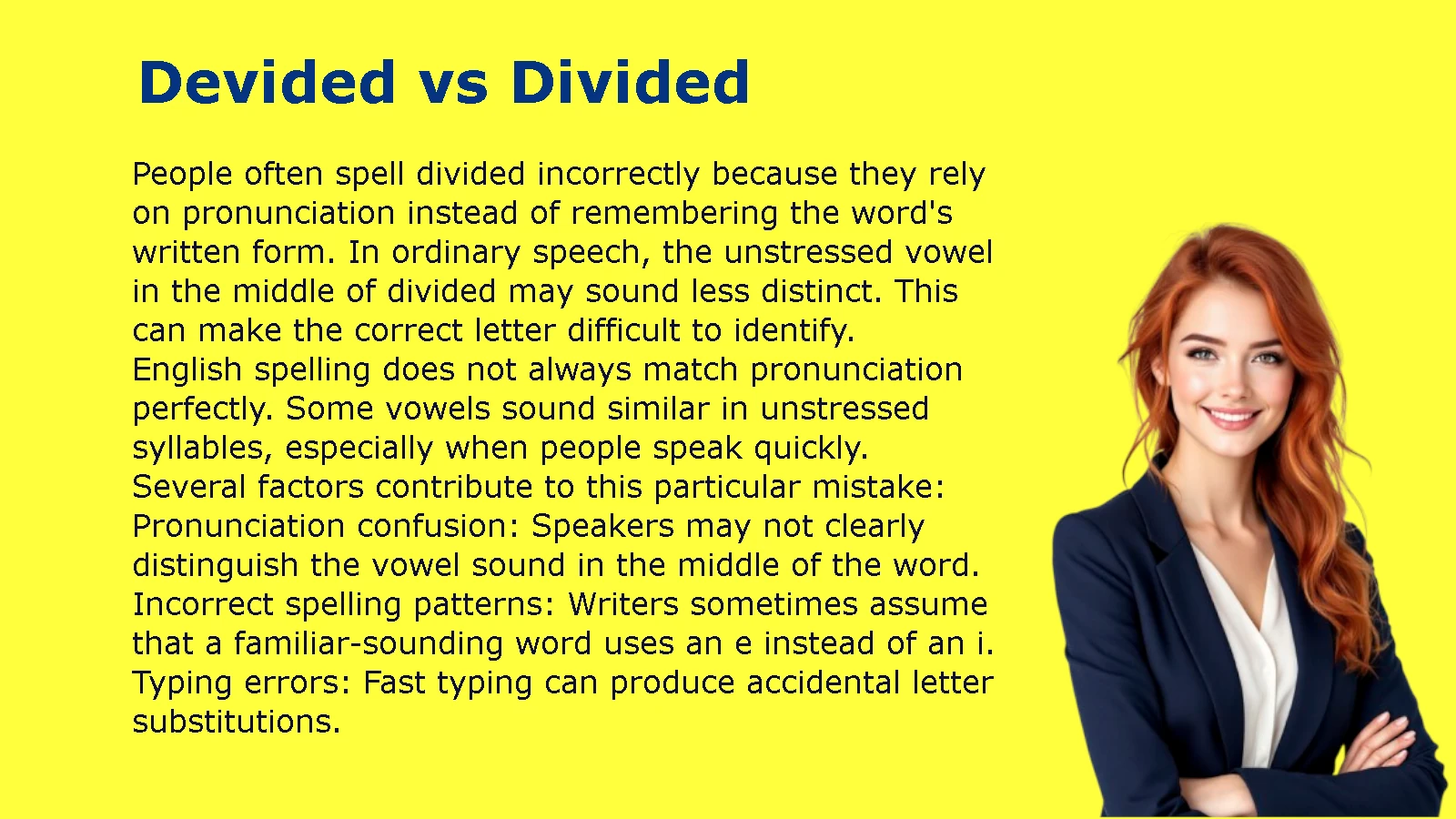
Devided vs divided is a common English spelling confusion, but only divided is correct. The word devided is a misspelling and does not represent an accepted alternative in American or British English. Divided is the past tense and past participle of the verb divide, meaning to separate something into parts, groups, or portions.
The confusion often comes from how people pronounce the word and remember its vowel pattern. Understanding the relationship between divide, divided, and division makes the correct spelling easier to remember. It also helps you use expressions such as divided into, divided in half, and divided by correctly in everyday writing and mathematics.
| Question | Answer |
| Is it devided or divided? | Divided is the correct spelling. |
| Is devided a real English word? | No. It is a misspelling of divided. |
| What does divided mean? | Separated into parts, groups, or portions. |
| Is divided the past tense of divide? | Yes. Divided is both the simple past and past participle. |
| Should you write divided in or divided into? | Use divided into when identifying the resulting groups or parts. |
Devided vs Divided: Which One Is Correct?
Divided is the only correct spelling when you want to describe something that has been separated into parts or groups. Devided is an incorrect spelling that commonly occurs when writers confuse the vowel pattern in the word. You should always write divided in academic, professional, and everyday English.
Although both forms may appear in online searches, dictionaries, documents, and informal messages, their status is different. Divided is a standard English word, while devided is simply a spelling error.
Devided or Divided: Quick Answer
The correct spelling is divided, with an i after the first consonant. The incorrect form, devided, uses an e in that position.
Consider these examples:
- Correct: The teacher divided the students into four groups.
- Incorrect: The teacher devided the students into four groups.
- Correct: The company divided its profits among the shareholders.
- Incorrect: The company devided its profits among the shareholders.
The correct form comes from the base verb divide. When you change this verb into its past tense or past participle, you add -d because the original word already ends in e.
This gives you:
- Divide → Divided
- Not: Divide → Devided
Remembering the original verb is one of the easiest ways to avoid this mistake.
Why Do People Spell Divided as Devided?
People often spell divided incorrectly because they rely on pronunciation instead of remembering the word’s written form. In ordinary speech, the unstressed vowel in the middle of divided may sound less distinct. This can make the correct letter difficult to identify.
English spelling does not always match pronunciation perfectly. Some vowels sound similar in unstressed syllables, especially when people speak quickly.
Several factors contribute to this particular mistake:
- Pronunciation confusion: Speakers may not clearly distinguish the vowel sound in the middle of the word.
- Incorrect spelling patterns: Writers sometimes assume that a familiar-sounding word uses an e instead of an i.
- Typing errors: Fast typing can produce accidental letter substitutions.
- Limited familiarity: Learners who rarely use the verb divide may not recognize its correct past-tense form.
A simple memory trick can help. Think of the base word divide whenever you need to write its past form.
For example:
“The manager will divide the tasks tomorrow.”
“The manager divided the tasks yesterday.”
Both sentences preserve the same spelling pattern.
What Does Divided Mean?
Divided means separated, split, or distributed into two or more parts. It is the past tense and past participle of divide, and it can also function as an adjective. People use the word when describing physical separation, mathematical operations, shared responsibilities, and differences in opinions.
The meaning depends on the surrounding sentence. A divided cake has been separated into pieces, while a divided committee may contain members who disagree.
Here are the main meanings:
| Meaning | Explanation | Example |
| Physical separation | Something has been split into parts. | The land was divided into smaller plots. |
| Distribution | Something has been shared among people. | The money was divided equally. |
| Mathematical operation | A number has been separated into equal groups. | Twenty divided by four equals five. |
| Disagreement | People hold different opinions. | The committee remained divided. |
| Organization | A larger unit has been separated into sections. | The report is divided into five chapters. |
Divided as a Verb
As a verb, divided describes an action that separated something into smaller parts, groups, or categories.
It commonly appears when someone has completed an action in the past.
For example:
- The chef divided the dough into eight equal portions.
- The principal divided the students into smaller classes.
- The partners divided the business expenses equally.
- The workers divided the project into manageable tasks.
- The family divided the property among three children.
In each sentence, divided describes an action that someone performed.
The word can also appear in passive constructions, where the sentence focuses on the object receiving the action rather than the person performing it.
For example:
“The profits were divided equally among the investors.”
This sentence emphasizes the distribution of profits rather than identifying who distributed them.
Another example:
“The road was divided into two lanes.”
Here, the sentence focuses on the road’s arrangement.
Divided as an Adjective
Divided can also describe a condition in which something exists in separate parts or opposing groups.
As an adjective, it often describes disagreement, separation, or a lack of unity.
Examples include:
- The divided community struggled to reach an agreement.
- A divided team cannot always work toward the same objective.
- The country remained politically divided after the election.
- The committee had divided opinions about the proposal.
- Their divided responsibilities created confusion.
Notice that the adjective does not always describe a physical object.
A community can be divided by political beliefs, a team can be divided over a strategy, and a family can be divided by disagreements.
The common idea is separation or a lack of agreement.
Divided as a Past Tense and Past Participle
Divided serves two important grammatical functions.
First, it is the simple past tense of divide. You use it when describing an action that happened and finished in the past.
Example:
“The teacher divided the class into six groups.”
Second, divided is the past participle of divide. You use it with helping verbs such as has, have, and had.
Examples:
- The company has divided its departments into smaller units.
- We have divided the responsibilities equally.
- The property had been divided before the sale.
- The students have divided themselves into teams.
The distinction becomes clearer when you compare the constructions:
| Grammatical form | Structure | Example |
| Simple past | Subject + divided | She divided the cake. |
| Present perfect | Has/have + divided | She has divided the cake. |
| Past perfect | Had + divided | She had divided the cake. |
| Passive voice | Was/were + divided | The cake was divided. |
In all these examples, the spelling remains divided.
Divided vs Divide: What’s the Difference?
Divide is the base form of the verb, while divided is its simple past and past participle form. Use divide when discussing a present action, a future action, an instruction, or a general fact. Use divided when describing a completed action or a resulting condition.
The difference is mainly grammatical, not a difference in the basic meaning.
Both words describe separation into parts, groups, or portions.
When to Use Divide
Use divide when the action is happening in the present, will happen in the future, or describes a general rule.
Examples:
- Divide the total cost among all participants.
- We need to divide the workload fairly.
- The river can divide the region into two sections.
- You should divide the ingredients before mixing them.
- The teacher will divide the students into smaller groups.
The base form also appears after modal verbs such as can, should, must, and will.
For example:
“You should divide the assignment into three sections.”
Here, divide follows should because modal verbs take the base form of the main verb.
When to Use Divided
Use divided when discussing a completed action or describing something that has already been separated.
Examples:
- The manager divided the employees into two teams.
- They divided the expenses equally.
- The garden was divided into separate areas.
- The committee has divided its responsibilities.
- The audience remained divided over the final decision.
You will also see divided in passive sentences and adjective phrases.
For instance:
“The organization is divided into five departments.”
This construction describes the organization’s existing structure.
Examples of Divide and Divided in Sentences
The following comparisons show how changing the verb form affects the timing of an action.
| Divide | Divided |
| We divide the work every Monday. | We divided the work yesterday. |
| The teacher will divide the class. | The teacher divided the class. |
| Divide the money equally. | They divided the money equally. |
| The road divides the town. | The road divided the town. |
| We need to divide the property. | We have divided the property. |
Practical writing tip: Before choosing between divide and divided, identify when the action happens. If it is a completed past action, divided is usually the appropriate form.
Divided In or Divided Into: Which Is Correct?
Divided into is generally the correct choice when you want to identify the groups, categories, or parts created by separating something. However, divided in is also grammatical in specific expressions, including divided in half and divided in two. The right preposition depends on the meaning and structure of the sentence.
This distinction matters because both expressions appear in everyday English, but they do not always communicate the same idea.
When to Use Divided Into
Use divided into when describing how a larger object, group, or organization has been separated into smaller parts.
The word into emphasizes the resulting sections or categories.
Examples:
- The book is divided into ten chapters.
- The students were divided into four teams.
- The company is divided into several departments.
- The property was divided into three separate plots.
- The presentation is divided into five main sections.
In each sentence, into introduces the parts created by the division.
You can use this construction in academic writing, business communication, instructions, and everyday conversations.
For example, a teacher might write:
“The examination is divided into three sections: reading, writing, and mathematics.”
This sentence clearly identifies the structure of the examination.
When to Use Divided In
Use divided in in particular expressions that describe the manner, proportion, or condition of a division.
The most familiar examples include:
- Divided in half
- Divided in two
- Divided in equal portions
- Divided in its opinions
Consider these sentences:
- The sandwich was divided in half.
- The property was divided in two.
- The participants were divided in equal proportions.
- The committee remained divided in its opinions.
These examples show that in can describe the form or condition of separation.
However, do not replace into with in automatically.
For example:
Incorrect or unnatural: The students were divided in four groups.
Better: The students were divided into four groups.
The second sentence clearly identifies the resulting groups.
Divided In vs Divided Into: Comparison Table
| Expression | Main purpose | Example |
| Divided into | Identifies resulting parts or groups | The report is divided into six chapters. |
| Divided in half | Describes two equal portions | The apple was divided in half. |
| Divided in two | Describes separation into two parts | The land was divided in two. |
| Divided in equal portions | Describes the manner of distribution | The food was divided in equal portions. |
| Divided in opinion | Describes disagreement or different views | The members were divided in their opinions. |
Easy rule: If you are naming the resulting groups or categories, use divided into. If you are describing a recognized proportion or condition, divided in may be appropriate.
Divided By: Meaning and Mathematical Usage
Divided by is a mathematical expression that describes the operation of splitting one number by another. The first number is called the dividend, the second is the divisor, and the answer is the quotient. For example, in 20 ÷ 4 = 5, 20 is the dividend, 4 is the divisor, and 5 is the quotient.
Although divided by belongs to mathematics, it is closely related to the ordinary meaning of divide.
When you divide something mathematically, you calculate how many equal portions or groups a quantity can form.
Understanding Dividend, Divisor, and Quotient
Every basic division problem contains three main elements.
Consider:
24 ÷ 6 = 4
| Mathematical term | Number | Meaning |
| Dividend | 24 | The number being divided |
| Divisor | 6 | The number used to divide |
| Quotient | 4 | The result of the division |
You can also express the same operation in words:
“Twenty-four divided by six equals four.”
Understanding these terms helps you interpret more complicated division expressions.
What Does Divided by 2 Mean?
Dividing a number by two means splitting it into two equal portions or finding how many groups of two it contains.
For example:
20 ÷ 2 = 10
If you have 20 apples and distribute them equally between two people, each person receives 10 apples.
Other examples include:
- 10 ÷ 2 = 5
- 36 ÷ 2 = 18
- 50 ÷ 2 = 25
- 100 ÷ 2 = 50
You can use division by two to calculate half of a quantity.
For instance, half of $80 is $40 because:
$80 ÷ 2 = $40.
What Does Divided by 3 Mean?
Dividing a number by three means separating it into three equal portions or determining how many groups of three it contains.
For example:
30 ÷ 3 = 10
Imagine that three friends share 30 dollars equally. Each friend receives 10 dollars.
Additional examples:
- 12 ÷ 3 = 4
- 21 ÷ 3 = 7
- 45 ÷ 3 = 15
- 90 ÷ 3 = 30
Division by three is useful when distributing resources, calculating portions, or solving basic arithmetic problems.
What Does Divided by 4 Mean?
Dividing a number by four means separating it into four equal parts.
For example:
40 ÷ 4 = 10
If four people share 40 identical items equally, each person receives 10.
Other examples include:
- 16 ÷ 4 = 4
- 28 ÷ 4 = 7
- 64 ÷ 4 = 16
- 100 ÷ 4 = 25
This operation is also useful when calculating one-quarter of a quantity.
For instance, one-quarter of 200 is 50 because:
200 ÷ 4 = 50.
What Happens When a Number Is Divided by 2 and Then by 3?
When you divide a number by two and then divide the result by three, you perform two separate operations in sequence.
For example:
60 ÷ 2 ÷ 3 = 10
Follow these steps:
- Start with 60.
- Divide 60 by 2 to get 30.
- Divide 30 by 3 to get 10.
The final answer is 10.
This is different from dividing 60 by the product of 2 and 3:
60 ÷ (2 × 3) = 60 ÷ 6 = 10.
In this particular example, both methods produce the same result because sequential division by two and three is equivalent to division by their product.
However, parentheses still matter when interpreting more complicated expressions.
For example:
60 ÷ (2 ÷ 3) = 90
The expression inside the parentheses must be evaluated first.
This distinction helps prevent mistakes when solving longer mathematical problems.
What Does Divided by 4 Divided by 2 Mean?
The expression divided by 4 divided by 2 normally represents two consecutive division operations.
For example:
40 ÷ 4 ÷ 2 = 5
Calculate it from left to right:
- First: 40 ÷ 4 = 10.
- Next: 10 ÷ 2 = 5.
The final answer is 5.
However, parentheses can change the result.
Compare:
| Expression | Calculation | Answer |
| 40 ÷ 4 ÷ 2 | (40 ÷ 4) ÷ 2 | 5 |
| 40 ÷ (4 ÷ 2) | 40 ÷ 2 | 20 |
| 40 ÷ (4 × 2) | 40 ÷ 8 | 5 |
The first two expressions produce different answers because they use different groupings.
Important: Multiplication and division have equal precedence in standard arithmetic. When they appear together without parentheses, evaluate them from left to right.
Correct and Incorrect Examples of Divided in Sentences
The best way to understand a spelling rule is to see it in context. The following examples demonstrate how divided works in everyday communication, education, business, and mathematics.
Correct Examples of Divided
Here are original sentences showing the correct spelling and usage.
Everyday English
- My brother divided the pizza into eight slices.
- We divided the household chores equally.
- She divided the chocolates between her two children.
- The coach divided the players into smaller teams.
- The river divided the village into two sections.
Academic Writing
- The research paper is divided into four main chapters.
- The teacher divided the examination into two sections.
- The students were divided into groups for the science project.
- The textbook is divided into several units.
- The lesson has been divided into manageable activities.
Business and Professional English
- The company divided its annual budget among five departments.
- The partners divided the profits according to their agreement.
- The manager divided the responsibilities between the employees.
- The organization is divided into regional offices.
- The project was divided into smaller stages to improve efficiency.
Mathematical Usage
- Twenty divided by five equals four.
- Thirty-six divided by six equals six.
- The total amount was divided equally among four people.
- Eighty divided by ten produces a quotient of eight.
These examples show that divided works naturally in different contexts without changing its spelling.
Incorrect Examples of Divided
Some sentences contain spelling mistakes, while others use an unsuitable preposition or grammatical construction.
| Incorrect sentence | Correct sentence | Explanation |
| The money was devided equally. | The money was divided equally. | Devided is misspelled. |
| The teacher devided the class. | The teacher divided the class. | Use the correct past form. |
| The cake was devided into pieces. | The cake was divided into pieces. | Correct the spelling. |
| The students were divided in four groups. | The students were divided into four groups. | Into introduces the resulting groups. |
| She has divide the work. | She has divided the work. | Present perfect requires the past participle. |
One important distinction is that not every incorrect example involves the spelling of divided.
For instance, “The students were divided in four groups” contains the correct spelling of divided, but divided into is more natural for identifying the resulting groups.
Similarly, “She has divide the work” uses the wrong verb form. The correct sentence requires the past participle divided.
Learning these differences helps you improve both spelling and sentence structure.
Related Words and Forms of Divide
The word divide belongs to a family of related English words. Each form has a different grammatical function, but they share the same basic idea of separation, distribution, or division.
Learning these forms makes it easier to recognize divided and avoid the incorrect spelling devided.
Divide
Divide is the base form of the verb.
It describes the action of separating something into parts or groups.
Examples:
- Divide the cake into six pieces.
- We need to divide the expenses equally.
- The highway divides the city into two areas.
Divides
Divides is the third-person singular present form of divide.
Use it with singular subjects such as he, she, it, or a singular noun.
Examples:
- The river divides the two regions.
- The teacher divides the class into groups.
- This line divides the diagram into two sections.
Dividing
Dividing is the present participle and gerund form of divide.
It describes an ongoing action or functions as a noun.
Examples:
- The company is dividing its operations into smaller units.
- Dividing the work fairly improves productivity.
- She is dividing the ingredients into separate bowls.
Divided
Divided is the simple past and past participle form of divide. It can also function as an adjective.
Examples:
- They divided the property equally.
- The class was divided into four teams.
- The community remained divided over the issue.
Division
Division is a noun referring to the process or result of dividing.
It also describes disagreement, organizational sections, or a mathematical operation.
Examples:
- Division helps students understand basic arithmetic.
- The division of responsibilities improved teamwork.
- The company created a new sales division.
- The disagreement caused division within the group.
Divisible
Divisible is an adjective describing something that can be divided evenly or separated into parts.
In mathematics, a number is divisible by another number when the division produces a whole number without a remainder.
Examples:
- Twelve is divisible by three.
- Twenty is divisible by four.
- Fifteen is divisible by five.
- Seven is not divisible by two without a remainder.
Complete Word Family Comparison
| Word | Part of speech | Meaning | Example |
| Divide | Verb | To separate into parts | Divide the work equally. |
| Divides | Verb | Separates in the present tense | The road divides the town. |
| Dividing | Verb/gerund | The act of separating | Dividing the tasks saves time. |
| Divided | Verb/adjective | Separated or split | The group was divided. |
| Division | Noun | The process of separating | Division is a basic operation. |
| Divisible | Adjective | Capable of being divided evenly | Eight is divisible by two. |
Spelling reminder: All these words belong to the same word family, but their endings change according to their grammatical functions. Devided does not belong to this standard word family.
Simple Tricks to Remember the Correct Spelling
Remembering the correct spelling becomes easier when you connect divided with other familiar words.
Instead of memorizing divided as an isolated word, learn its relationship with divide and division.
Remember Divide Before Writing Divided
The simplest technique is to start with the base verb.
Write:
Divide → Divided
The original word already ends in e, so you only need to add d to form the past tense.
You do not replace the original vowel with another letter.
Compare:
- Divide → Divided
- Arrive → Arrived
- Decide → Decided
- Provide → Provided
These examples follow a similar spelling pattern.
Remembering this pattern makes it easier to avoid writing devided.
Connect Divided With Division
Another useful technique is to connect divided with division.
Both words begin with the same spelling pattern:
- Divide
- Divided
- Division
When you remember how to spell division, you have another reference point for writing divided correctly.
For example:
“The division of responsibilities was completed after the manager divided the tasks.”
The two words appear naturally in the same sentence, reinforcing their relationship.
Check the Word Family
When you are unsure about the spelling, look at the base word and its related forms.
Use this simple reference:
- Present: Divide
- Third-person singular: Divides
- Present participle: Dividing
- Past tense: Divided
- Past participle: Divided
- Noun: Division
This method works because English verbs often form related words through predictable spelling changes.
You can also use a quick proofreading technique:
- Find the word divided in your sentence.
- Replace it mentally with the base verb divide.
- Check whether the sentence still communicates the intended meaning.
- Restore the correct past-tense or participle form.
For example:
“The manager devided the employees into teams.”
The base verb is divide, so the correct sentence is:
“The manager divided the employees into teams.”
Final Verdict: Devided or Divided?
The correct spelling is divided, not devided. Divided is the standard past tense and past participle of divide, and it can also function as an adjective describing something separated into parts or groups.
Remember these key points:
- Divided is the correct spelling in standard English.
- Devided is a common spelling mistake.
- Divide is the base verb, while divided is its past tense and past participle.
- Use divided into when identifying resulting groups or sections.
- Use divided in half and similar expressions when describing proportions.
- Use divided by when explaining a mathematical operation.
- Divide, divided, dividing, division, and divisible belong to the same word family.
If you want to avoid this mistake in your writing, remember the original word divide before adding its past-tense ending.
The next time you write about separating money, organizing a team, splitting a cake, or solving a mathematical problem, choose divided. It is the correct spelling every time you mean the standard English word.
Frequently Asked Questions
Is It Devided or Divided?
Divided is correct, while devided is incorrect. Divided is the past tense and past participle of divide. Use it when describing something that has been separated into parts, groups, or portions.
Example: “The students were divided into three groups.”
Why Is Divided Spelled With an I Instead of an E?
Divided retains the spelling of its base verb, divide. Since divide already ends in the letter e, you form its past tense by adding d, producing divided. The spelling does not change to devided.
Is Divided the Past Tense of Divide?
Yes. Divided is the simple past tense and past participle of divide.
Examples:
- Simple past: She divided the money equally.
- Present perfect: She has divided the money equally.
- Past perfect: She had divided the money equally.
The same spelling works in all three constructions.
Should I Use Divided In or Divided Into?
Use divided into when explaining how something has been separated into groups, categories, or sections.
Example: “The report is divided into five chapters.”
Use divided in in expressions such as divided in half or divided in two.
Example: “The apple was divided in half.”
Is Divided by 2 the Same as Divided Into 2?
No. The expressions describe related but different ideas.
Divided by 2 describes a mathematical operation in which a number is divided by two.
Example: 20 ÷ 2 = 10.
Divided into 2 describes separating something into two resulting parts or groups.
Example: “The class was divided into two teams.”
Is Devided Ever Correct in English?
No. Devided is not an accepted standard spelling of the word divided in American or British English. If you want to describe something separated into parts, always use divided.













