Category vs categories comes down to singular and plural grammar: category refers to one group, while categories refers to two or more groups. Both spellings are correct, but you need to choose the form that matches your sentence. Understanding this difference also helps you use related terms such as classification, class, and type correctly.
A category helps organize information, products, ideas, and objects based on shared characteristics. Categories appear in online stores, school subjects, databases, blogs, research, and everyday conversations. Once you understand how the word works, you can also avoid common mistakes involving each category, most categories, and category types.
| Question | Answer |
| Is category or categories correct? | Both are correct. Use category for one group and categories for multiple groups. |
| What is the plural of category? | Categories. |
| Should I write each category or each categories? | Each category is correct. |
| What is the difference between category and classification? | A category is a group or label; classification often refers to the process or system of grouping. |
| What does category mean in Spanish? | Categoría. The plural, categories, translates to categorías. |
Category vs Categories: What Is the Difference?
Category is a singular countable noun, while categories is its plural form. Use category when referring to one group, and use categories when referring to multiple groups. For example, “This category contains books” is singular, while “These categories contain books” refers to several groups.
Category vs Categories at a Glance
The main difference is grammatical number, not meaning. Both words describe groupings, but they tell readers how many groups you mean.
| Feature | Category | Categories |
| Grammatical number | Singular | Plural |
| Meaning | One group or division | Two or more groups or divisions |
| Article | A category | Categories or some categories |
| Demonstrative | This category | These categories |
| Verb example | The category is useful. | The categories are useful. |
| Example | The clothing category is popular. | The clothing categories are popular. |
For example:
- Singular: Our website has a separate category for grammar.
- Plural: Our website has several categories for language topics.
The correct choice depends on what you want to describe. If you mean one organizational group, use category. If you mean multiple groups, use categories.
Which Is Correct: Category or Categories?
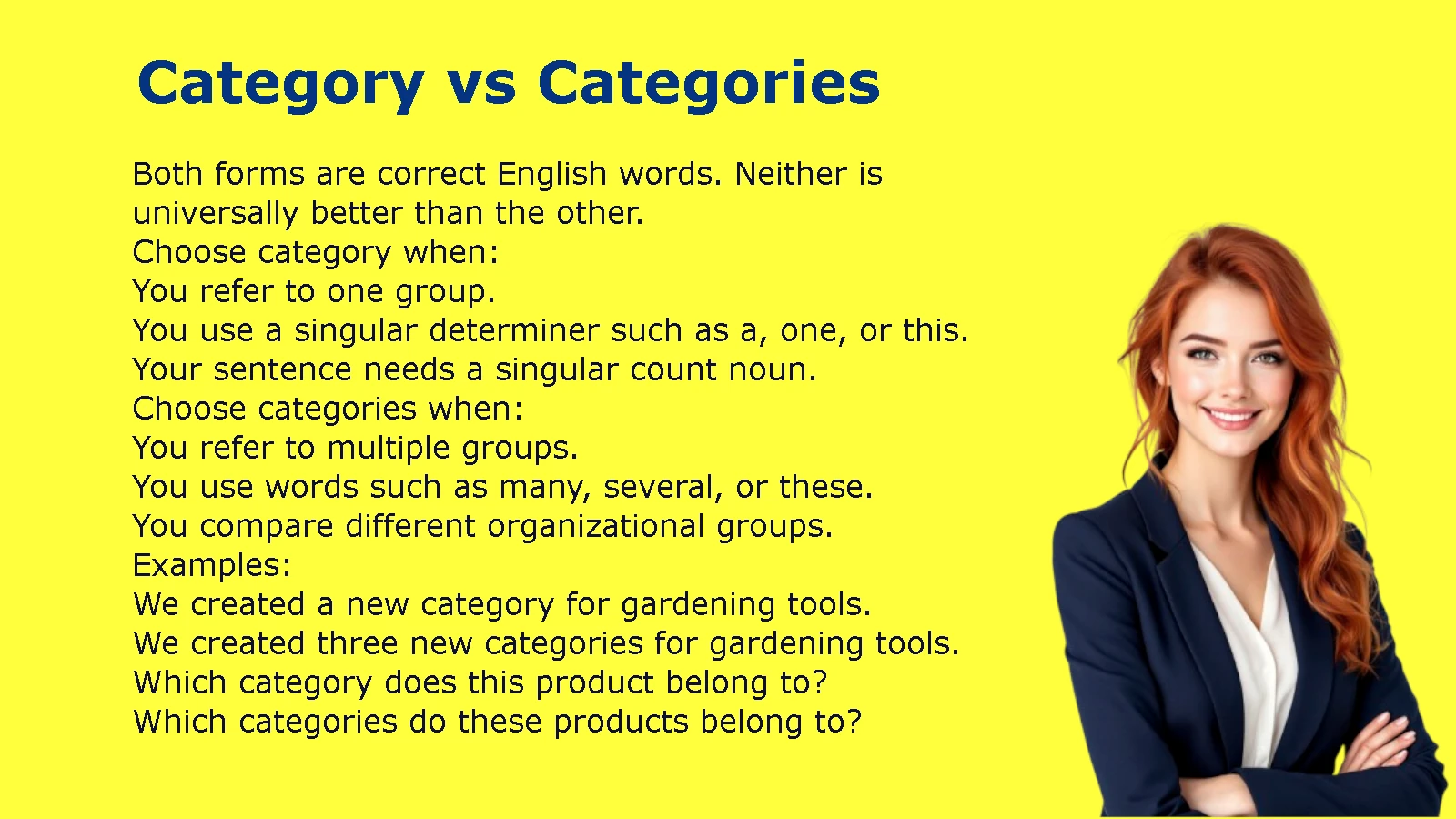
Both forms are correct English words. Neither is universally better than the other.
Choose category when:
- You refer to one group.
- You use a singular determiner such as a, one, or this.
- Your sentence needs a singular count noun.
Choose categories when:
- You refer to multiple groups.
- You use words such as many, several, or these.
- You compare different organizational groups.
Examples:
- We created a new category for gardening tools.
- We created three new categories for gardening tools.
- Which category does this product belong to?
- Which categories do these products belong to?
A useful editing trick is to replace the noun with group or groups. If your sentence means one group, use category. If it means multiple groups, use categories.
What Does Category Mean?
A category is a group of people, objects, ideas, or information that share a particular characteristic or fit a defined set of criteria. People use categories to organize information, make comparisons, identify patterns, and find things more easily.
For instance, a bookstore might organize its inventory into categories such as fiction, history, biographies, and children’s books.
Each category helps customers find relevant titles without searching through every book.
Category Meaning and Definition
The word category functions mainly as a noun.
Category (noun): A class, group, or division of things that share common features or belong together under a particular system.
Examples:
- Mathematics is a category of academic subjects in a particular curriculum.
- A retailer may place refrigerators in the home appliances category.
- A research team may organize survey responses into categories.
- A website may use categories to group articles by topic.
The exact boundaries of a category depend on the system that defines it.
For example, a food website might classify tomatoes under vegetables for cooking purposes, while a botanical classification treats tomatoes as fruits. The category depends on the purpose and criteria of the grouping.
This distinction matters whenever a category serves a technical, scientific, legal, or commercial purpose. A useful category should have clear criteria so people can apply it consistently.
What Are Categories Used For?
Categories are used to organize related items, reduce confusion, and make information easier to find or analyze.
They serve several practical purposes.
Website organization
Bloggers and publishers use categories to group related articles.
For example:
- Grammar
- Vocabulary
- Writing
- Punctuation
A reader looking for spelling advice can browse the grammar category instead of searching the entire site.
Online shopping
Retailers use categories to organize product catalogs.
Common examples include:
- Clothing
- Electronics
- Furniture
- Beauty products
A well-designed category structure helps shoppers narrow their choices.
Education
Teachers and institutions use categories to organize learning materials, assignments, and subjects.
For example, a learning platform might divide resources into science, mathematics, history, and language arts.
Data management
Organizations classify records into categories for reporting, analysis, and retrieval.
For example, a customer feedback system might group comments into delivery, pricing, product quality, and customer service.
However, categories need clear rules. If two employees classify the same record differently, the resulting reports may become inconsistent.
Examples of Categories in Everyday Life
Categories appear in many situations, often without people thinking about them.
| Context | Example categories | Purpose |
| Grocery store | Produce, dairy, bakery | Organize food products |
| School | Science, mathematics, history | Arrange subjects |
| Online store | Shoes, clothing, accessories | Help shoppers browse |
| Blog | Grammar, vocabulary, writing | Group articles |
| Library | Fiction, nonfiction, reference | Organize books |
| Customer support | Billing, technical issues, returns | Route requests |
Consider a small online bookstore.
Instead of listing 5,000 books in one long catalog, the owner can create categories such as fiction, nonfiction, children’s books, and reference materials.
The categories make browsing easier. They also create a foundation for search filters, product recommendations, and inventory reports.
The same principle applies to a grammar website: useful categories help readers discover related articles and give search engines clearer contextual signals about the site’s structure.
When to Use Category vs Categories
Use category for one group and categories for more than one. The choice affects not only the noun but also related words, including determiners, demonstratives, and verbs.
When to Use Category (Singular)
Use category when your sentence identifies one group, one label, or one classification.
Common singular expressions include:
- A category
- One category
- This category
- That category
- Every category
- Each category
- Another category
Examples:
- This category contains beginner-friendly articles.
- Every category needs a clear label.
- We added one category to the website.
- Another category may suit this product better.
- The category includes five related subjects.
Notice that a singular category can contain many individual items.
For example, one category called Grammar may contain hundreds of articles. The number of items inside the group does not change the noun’s grammatical number.
When to Use Categories (Plural)
Use categories when your sentence refers to multiple groups.
Common plural expressions include:
- Two categories
- Several categories
- Many categories
- Different categories
- These categories
- Those categories
- Most categories
Examples:
- These categories cover the main topics.
- Several categories need updated descriptions.
- We created two categories for the new products.
- Different categories attract different audiences.
- Most categories contain multiple articles.
A plural category structure can also contain overlapping topics. For example, an article about academic writing may relate to both grammar and writing.
If your organizational system allows one article to belong to multiple categories, explain that structure clearly to avoid confusion.
Category vs Categories in Example Sentences
These examples show how the correct form changes with context.
| Singular: Category | Plural: Categories |
| This category is popular. | These categories are popular. |
| The category needs a description. | The categories need descriptions. |
| One category is missing. | Two categories are missing. |
| Each category has a label. | All categories have labels. |
| That category contains books. | Those categories contain books. |
| A category can contain many items. | Categories can contain many items. |
| The category was updated. | The categories were updated. |
| Every category serves a purpose. | Several categories serve different purposes. |
| Which category should we choose? | Which categories should we choose? |
| The category appears in the menu. | The categories appear in the menu. |
Here are additional examples from different contexts.
Business: Each product category has a separate inventory report.
Education: The school introduced new categories for its learning resources.
Research: The researcher assigned each response to a relevant category.
Publishing: Our blog categories help readers explore related articles.
Technology: The application stores documents under predefined categories.
Retail: The store moved this product to another category.
These examples reinforce one simple rule: identify the number of groups before selecting the noun.
Category vs Categories: Grammar Rules and Common Mistakes
The spelling difference between category and categories is only part of the issue. You also need to understand subject-verb agreement and the words that commonly appear before these nouns.
Each Category vs Most Categories
Each category refers to every individual group separately and takes a singular noun. Most categories refers to the majority of groups and normally takes a plural noun. The verb must agree with the grammatical subject of the sentence.
Compare these sentences:
- Each category has a unique identifier.
- Most categories have unique identifiers.
- Each category is clearly labeled.
- Most categories are clearly labeled.
The word each emphasizes individual members of a group.
For example:
“Each category needs its own description.”
This sentence treats categories individually. Even if a website contains 40 categories, each category takes the singular verb needs.
The word most expresses a majority.
For example:
“Most categories need updated descriptions.”
Here, the subject is plural, so the verb need agrees with categories.
Quick comparison:
| Expression | Correct usage |
| Each category | Each category is useful. |
| Every category | Every category has a name. |
| Most categories | Most categories are useful. |
| Many categories | Many categories have descriptions. |
| One category | One category is missing. |
| Several categories | Several categories are missing. |
A common mistake is writing “each categories.” In standard English, each takes a singular count noun in this construction.
Is Category Singular or Plural?
Category is singular. Categories is plural.
The spelling changes because the noun ends in a consonant followed by y.
For many English nouns ending in consonant + y, change the y to ies to form the plural.
Examples:
| Singular | Plural |
| Category | Categories |
| Country | Countries |
| Dictionary | Dictionaries |
| Library | Libraries |
| Company | Companies |
| Activity | Activities |
The spelling rule does not apply to every noun ending in y.
When a noun ends in a vowel + y, it usually takes s.
Examples:
- Boy → Boys
- Key → Keys
- Day → Days
- Toy → Toys
For category, the correct plural is categories, not categorys.
Category vs Categories With Is and Are
Use is with a singular subject and are with a plural subject in ordinary present-tense sentences.
Examples:
- This category is relevant.
- The category is empty.
- These categories are relevant.
- The categories are empty.
However, a sentence can contain both singular and plural nouns. The verb agrees with its subject, not necessarily the closest noun.
For example:
“The category of products is growing.”
The subject is category, which is singular. The phrase of products does not make the subject plural.
Compare:
“The categories of products are growing.”
Now the subject is categories, so the verb are is correct.
This distinction becomes especially useful in longer sentences, where extra phrases can distract readers from the actual subject.
Common Category and Categories Mistakes
Avoid these common errors.
Incorrect: We created three category.
Correct: We created three categories.
A number greater than one normally requires the plural form.
Incorrect: Each categories has a title.
Correct: Each category has a title.
Each takes a singular count noun.
Incorrect: These category are outdated.
Correct: These categories are outdated.
These normally introduces a plural noun.
Incorrect: Most category needs attention.
Correct: Most categories need attention.
Use the plural noun and verb when referring to multiple categories.
Incorrect: The categories is listed below.
Correct: The categories are listed below.
The plural subject takes a plural verb.
Incorrect: We added a new categories.
Correct: We added a new category.
The article a takes a singular count noun.
One additional mistake involves confusing groups with their contents.
For example, “This category contains 20 products” refers to one category and many products. The noun category remains singular because the sentence describes one group.
Category vs Classification: What’s the Difference?
A category is a group or label used to organize things, while classification can refer to the process, method, or resulting system of arranging things into groups. The words overlap, but they do not always mean the same thing.
For example, Electronics may be a product category, while product classification describes the broader system used to assign products to appropriate groups.
Category vs Classification Examples
Consider how these terms work in different contexts.
Product organization
A retailer may use laptops as a product category.
The classification process determines whether a particular product belongs under laptops, tablets, accessories, or another group.
Scientific research
A researcher may define categories for survey responses.
Classification describes how the researcher assigns responses according to a consistent set of criteria.
Data management
A company may create categories such as public, internal, and confidential.
In this setting, data classification may refer to a formal process for determining how the organization should handle information.
The distinction becomes more important when classification involves policies, risk levels, or technical standards.
When Should You Use Category or Classification?
Use category when you mean a specific group or label.
Examples:
- Choose a category for your article.
- This category includes household products.
- Select the correct category from the menu.
Use classification when you mean the process or system of sorting.
Examples:
- The classification process requires consistent criteria.
- The company reviewed its data classification policy.
- Researchers developed a classification system.
Practical rule: If you can replace the word with group or label, category may fit. If you mean the act or method of sorting, classification may be more precise.
However, classification can also refer to a resulting arrangement or designation. Context determines the best choice.
Category vs Class vs Type
Category, class, and type can all describe groups, but they emphasize different aspects. A category often serves as an organizational label, a class can describe a group defined by a system or shared status, and a type usually identifies a kind or variety.
Category vs Class
The word class has several meanings. It can refer to a group of students, a social group, a level of quality, or a technical grouping.
In classification systems, class may represent a defined grouping based on particular characteristics.
Examples:
- The library created a category for historical fiction.
- The school divided students into classes.
- The software groups related objects into a class.
- The vehicle falls within a particular regulatory class.
A category often works well as a practical label. A class may carry a more formal meaning in a technical, educational, or regulatory setting.
These words can overlap. Their exact distinction depends on the system and industry.
Category vs Type
Type often refers to a kind or variety of something.
For example:
- Category: Home appliances
- Type: Refrigerator
- Category: Clothing
- Type: Winter jacket
- Category: Beverages
- Type: Herbal tea
These examples illustrate one possible structure, not a universal rule. A business could organize the same products differently.
A category might also contain several types.
For instance, a broad beverage category could include tea, coffee, juice, and water. Each type may contain additional varieties.
Choose type when you want to identify what kind of thing something is.
Choose category when you want to describe the organizational group in which something belongs.
Category vs Class vs Type Examples
| Word | Example | Main emphasis |
| Category | Books | Organizational grouping |
| Class | A vehicle’s regulatory class | Defined group or status |
| Type | Paperback book | Kind or variety |
| Category | Electronics | Product grouping |
| Class | A class of materials | Shared properties |
| Type | Electric vehicle | Kind or design |
The distinctions are not absolute.
For example, vehicle type, vehicle class, and vehicle category can have specific meanings under particular legal or industry frameworks. A regulatory category should not automatically be treated as interchangeable with a vehicle type.
When writing technical content, use the terminology defined by the relevant system.
Category and Types: Are They the Same?
A category and a type are related concepts, but they are not necessarily identical. A category organizes items under a label or set of criteria, while a type usually identifies a particular kind or variety. One category can contain several types.
Can One Category Have Multiple Types?
Yes. A broad category can contain several types, depending on how the organization defines its structure.
Consider the category Beverages.
It could contain types such as:
- Tea
- Coffee
- Juice
- Water
- Soft drinks
The tea type might then include green tea, black tea, white tea, and herbal infusions.
This creates a hierarchy:
Category: Beverages
Types: Tea, coffee, juice, water
Varieties within tea: Green tea, black tea, white tea
A hierarchy helps users understand the relationship between broad groups and specific options.
However, not every classification system needs multiple levels. A small website may only need a few simple categories.
Category and Type Examples in Sentences
Here are examples that show natural usage.
- This category includes several types of kitchen appliances.
- Which type of book belongs in this category?
- The category contains three product types.
- Each type has different features.
- We created a separate category for specialty products.
The expression types of categories can be correct, but it often sounds unclear.
For example:
“Types of categories include broad categories and narrow categories.”
This sentence may work when discussing category structures themselves.
However, if you mean different kinds of products, write:
“Product categories include electronics, clothing, and furniture.”
Use the phrase that describes the actual relationship between the groups.
Category and Non-Category: Meaning and Usage
Non-category generally describes something that does not belong to a particular category or falls outside a defined grouping system. However, it is not a universal label with one fixed meaning. In everyday writing, uncategorized or not assigned to a category often sounds clearer.
What Does Non-Category Mean?
The meaning of non-category depends on the context.
It may describe:
- An item that does not fit any available category.
- A concept that falls outside a defined classification system.
- A label used by a particular organization or software platform.
For example, an online catalog might contain a designated non-category status for products awaiting review.
Another system may call the same status uncategorized.
These labels are not automatically interchangeable in software. A platform might assign a special meaning to each status.
In ordinary English, prefer a direct phrase when readers may not recognize the term.
Examples:
- The item has not been assigned to a category.
- This article remains uncategorized.
- The record falls outside the current classification system.
Category vs Non-Category Examples
Imagine an online store with three product categories:
- Electronics
- Home appliances
- Accessories
A new product arrives, but the team has not decided where it belongs.
The team could mark it as uncategorized until someone reviews it.
That label communicates the item’s current status.
A different situation occurs when a product genuinely does not fit the store’s defined categories. In that case, the business may need to revise its category structure or create an appropriate exception.
The distinction matters:
- Uncategorized: No category has been assigned yet.
- Outside the classification: The existing categories may not accommodate the item.
- Non-category: A context-dependent label that requires explanation.
Writers should avoid using non-category as though every reader will understand its intended meaning.
What Does Category Mean in Spanish? (Category Que Es)
The English word category translates to categoría in Spanish. Its plural form, categories, translates to categorías. If someone searches category que es, they are likely asking what the word means in Spanish or how to understand it.
Category Meaning in Spanish
Category = Categoría
A categoría is a group or classification of people, objects, ideas, or other things that share particular characteristics.
Categories = Categorías
Examples:
- Una categoría = One category
- Dos categorías = Two categories
- Cada categoría = Each category
- Muchas categorías = Many categories
The Spanish plural follows a different spelling pattern from the English plural.
English:
- Category
- Categories
Spanish:
- Categoría
- Categorías
Spanish adds s to form the plural of categoría, while English changes the ending from y to ies.
Category and Categories Examples in Spanish
| English | Spanish |
| This category is useful. | Esta categoría es útil. |
| These categories are different. | Estas categorías son diferentes. |
| Choose a category. | Elige una categoría. |
| Each category has a name. | Cada categoría tiene un nombre. |
| Many categories exist. | Existen muchas categorías. |
For English learners, comparing the two languages can make the spelling difference easier to remember.
Remember that categoría carries an accent mark on the í in Spanish. The plural categorías retains that accent.
Category vs Categories: Quick Comparison Table
Use this table as a quick reference when editing sentences or choosing labels for a website, document, or database.
| Expression | Meaning or use | Example |
| Category | One group | This category is useful. |
| Categories | Multiple groups | These categories are useful. |
| Each category | Every group individually | Each category has a label. |
| Most categories | The majority of groups | Most categories are complete. |
| Category type | A type associated with a category; context matters | This category type needs review. |
| Classification | Grouping process or system | The classification process is complete. |
| Non-category | Context-dependent term for something outside a category | The record has a non-category status. |
| Uncategorized | Not assigned to a category | The article remains uncategorized. |
A Practical Editing Checklist
Before publishing a sentence, check these points:
- Count the groups: Are you referring to one category or multiple categories?
- Check the determiner: Does each, every, this, or these fit the noun?
- Check the verb: Does is or are agree with the subject?
- Review the meaning: Do you mean a category, a type, a class, or a classification process?
- Check spelling: Use categories, not categorys.
- Review the context: Does the term have a specialized meaning in your field?
This quick review can catch most category-related grammar errors.
Case Study: Organizing a Grammar Website
Consider a grammar website with 300 published articles.
The publisher initially places every article under one broad category called English. Readers struggle to find specific topics, and the site menu becomes less useful.
The publisher then introduces categories:
- Spelling
- Grammar
- Vocabulary
- Writing
- Punctuation
Each category groups relevant articles.
For example, category vs categories belongs under grammar, while affect vs effect might appear under grammar or commonly confused words, depending on the website’s structure.
The publisher must also decide whether an article can belong to multiple categories.
If every article receives five unrelated category labels, the structure may become confusing. A smaller, consistent system usually makes browsing easier.
Practical lesson: Categories should reflect genuine relationships between content. Their purpose is to help readers navigate, not to create as many labels as possible.
For SEO, clear category pages can also help users and search engines understand a site’s organization. However, category labels alone do not guarantee rankings. Useful content, accessible navigation, internal links, and a strong overall site structure still matter.
Frequently Asked Questions
Is Category or Categories Correct?
Both category and categories are correct. Use category for one group and categories for two or more groups.
For example, “This category is popular” is singular, while “These categories are popular” is plural.
What Is the Plural of Category?
The plural of category is categories.
To form the plural, change the final y to ies because the word ends in a consonant followed by y.
Correct: category → categories.
Incorrect: category → categorys.
Should I Say Each Category or Each Categories?
Each category is correct.
The word each takes a singular count noun in this construction.
Example: “Each category has its own description.”
Avoid “Each categories has its own description.”
Is It Most Category or Most Categories?
Most categories is the usual choice when referring to the majority of multiple groups.
Example: “Most categories contain several articles.”
However, most of the category can work when you refer to most of the contents or members of one particular category.
Example: “Most of the category’s articles focus on grammar.”
The correct phrase depends on what most describes.
What Is the Difference Between Category and Classification?
A category is a group or label. Classification often refers to the process or system used to organize items into groups.
For example, electronics may be a category, while product classification describes the method of assigning products to appropriate groups.
What Does Category Mean in Spanish?
Category means categoría in Spanish, and categories means categorías.
Example: “Choose a category” translates to “Elige una categoría.”
Conclusion: Choose Category or Categories Correctly
The difference between category vs categories is simple once you focus on grammatical number.
Use category when you mean one group. Use categories when you mean multiple groups. Remember that each category takes a singular verb, while most categories normally takes a plural verb.
The related terms classification, class, and type can overlap with category, but each word carries its own emphasis. Choose the term that accurately describes the grouping or system you mean.













