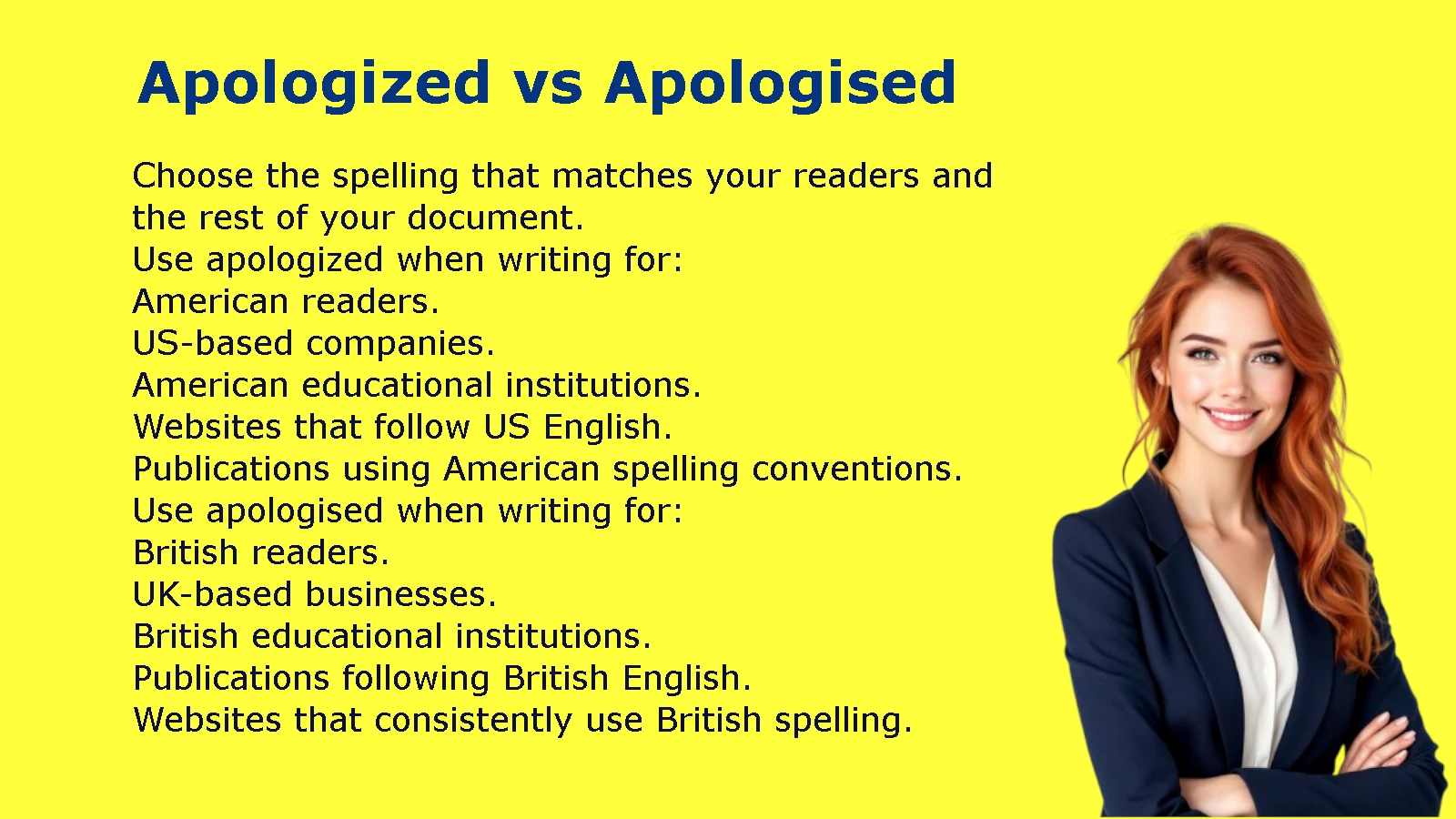
Apologized vs apologised is a comparison between the American and British English spellings of the same verb. Apologized is the standard American English spelling, while apologised is the standard British English spelling. Both mean to express regret for a mistake, offense, or inconvenience, and neither is incorrect.
The difference comes down to the spelling conventions used in different English-speaking regions. American English generally uses -ize, while British English often uses -ise. These differences also appear in related words such as apologize/apologise, apologizing/apologising, and apologizes/apologises.
Understanding these forms will help you choose the right spelling, use the correct past tense, distinguish the verb from its noun forms, and write professional expressions such as “We apologize for any inconvenience caused.”
Apologized vs Apologised: Quick Answer
| Question | Answer |
| Is it apologized or apologised? | Both are correct spellings. |
| Which is American English? | Apologized is the standard American spelling. |
| Which is British English? | Apologised is the standard British spelling. |
| Do apologized and apologised mean the same thing? | Yes. Both mean expressed regret or said sorry. |
| Is apologise spelled with an S or Z? | Both apologise and apologize are accepted regional spellings. |
Apologized vs Apologised: What Is the Difference?
Apologised and Apologized have the same meaning, grammatical function, and pronunciation. The only difference is their spelling. American English uses the letter Z in apologized, whereas British English commonly uses S in apologised.
Both forms are the simple past tense and past participle of the verb apologize or apologise. You can use either form when describing someone who expressed regret about something that happened.
The main difference depends on your intended audience and the English spelling convention you follow.
Apologized Is the American English Spelling
Apologized is the standard spelling in American English. Writers in the United States generally use the letter Z in verbs ending in -ize.
For example:
- She apologized for arriving late to the meeting.
- The company apologized after the service interruption.
- He apologized to his colleague for the misunderstanding.
- The manager apologized for the incorrect information.
- They apologized for the delay in processing the order.
American dictionaries, newspapers, educational materials, and business publications commonly follow this spelling.
The same Z convention appears in other related verbs:
- Organize, not organise.
- Realize, not realise.
- Recognize, not recognise.
- Apologize, not apologise.
- Specialize, not specialise.
Important: The Z spelling is not a sign that apologized has a different meaning or pronunciation. It simply follows American spelling conventions.
Apologised Is the British English Spelling
Apologised is the standard spelling in British English. British writers commonly use the -ise ending in everyday writing.
For example:
- She apologised for forgetting the appointment.
- The teacher apologised for the confusion.
- The airline apologised for the cancelled flight.
- He apologised to his friend after the argument.
- The organization apologised for its mistake.
British publications, schools, and many UK-based organizations use this spelling.
The same S convention appears in other verbs:
- Organise.
- Realise.
- Recognise.
- Apologise.
- Specialise.
However, British English also accepts some -ize spellings under particular dictionary and house-style conventions. Therefore, it is more accurate to say that -ise is a common British preference rather than an absolute rule for every British publication.
Apologized vs Apologised Examples
The easiest way to understand the difference is to compare both spellings in identical sentences.
| American English | British English |
| She apologized for the mistake. | She apologised for the mistake. |
| He apologized to his parents. | He apologised to his parents. |
| They apologized for the delay. | They apologised for the delay. |
| The company apologized to its customers. | The company apologised to its customers. |
| I apologized for my behavior. | I apologised for my behaviour. |
| The manager apologized for the inconvenience. | The manager apologised for the inconvenience. |
Notice that the meaning and sentence structure remain unchanged. Only the regional spelling convention differs.
Which Spelling Should You Use?
Choose the spelling that matches your readers and the rest of your document.
Use apologized when writing for:
- American readers.
- US-based companies.
- American educational institutions.
- Websites that follow US English.
- Publications using American spelling conventions.
Use apologised when writing for:
- British readers.
- UK-based businesses.
- British educational institutions.
- Publications following British English.
- Websites that consistently use British spelling.
For example, if you are writing an American customer-service email, use:
“We apologize for the inconvenience.”
For a British audience, write:
“We apologise for the inconvenience.”
Both sentences are grammatically correct. Consistency matters more than choosing one spelling over the other.
Is Apologise the UK Spelling of Apologize?
Yes. Apologise is the commonly preferred British English spelling of apologize. Both words have the same meaning and function as verbs. The distinction follows regional spelling conventions, with British English commonly using S and American English using Z.
This difference also applies to their related forms, including apologises, apologising, and apologised.
Apologize or Apologise: Which Is Correct?
Both spellings are correct, but they belong to different regional conventions.
| Spelling | English variety | Example |
| Apologize | American English | I apologize for the error. |
| Apologise | British English | I apologise for the error. |
Neither spelling is inherently more formal, professional, or grammatically accurate.
For example, an American company would normally write:
“We apologize for the inconvenience caused by the scheduled maintenance.”
A British company might write:
“We apologise for the inconvenience caused by the scheduled maintenance.”
The difference does not affect the message’s politeness or seriousness.
Do British People Use Apologise or Apologize?
British English commonly uses apologise, particularly in everyday writing and publications that follow traditional British spelling conventions.
However, British English has more than one accepted spelling system. Some British dictionaries and publishers use -ize forms, including apologize.
The Oxford spelling convention, for example, uses -ize in many words where other British styles prefer -ise.
This means you may encounter both spellings in British publications. When writing for a particular organization, follow its preferred style guide.
Is Apologise Correct in Australian and Canadian English?
Regional spelling conventions extend beyond the United States and the United Kingdom.
Australian English generally follows British-style spelling and commonly uses apologise.
Canadian English has a mixture of British and American spelling influences. Both -ise and -ize forms appear, depending on the word, publisher, and style guide.
Here is a quick comparison:
| Region | Common spelling |
| United States | Apologize |
| United Kingdom | Apologise |
| Australia | Apologise |
| Canada | Apologize or apologise, depending on style |
| New Zealand | Apologise |
If you write for an international audience, select one consistent spelling system rather than switching between regional forms.
Apologise Meaning: What Does It Mean?
Apologise means to express regret for something you have done or said, particularly when your actions have caused inconvenience, disappointment, offense, or harm to another person.
It is a verb used in personal conversations, workplace communication, customer service, and formal situations. The American spelling is apologize, but both forms carry exactly the same meaning.
An apology can acknowledge a mistake, show responsibility, or help repair a damaged relationship.
Definition of Apologise
The verb apologise means to say that you are sorry for an action, mistake, or situation.
It can describe a direct expression of regret or a formal acknowledgment of responsibility.
For example:
- I apologise for interrupting your presentation.
- The employee apologised for sending the wrong document.
- She apologised after realizing that her comment was offensive.
- The company apologised for the unexpected service disruption.
In each sentence, the speaker acknowledges something that went wrong and expresses regret.
An apology does not always mean that someone intentionally caused a problem. People also apologise for accidental mistakes, misunderstandings, and situations outside their control.
Apologise in Different Contexts
The meaning remains consistent, but the way people use the verb depends on the situation.
Personal relationships
People apologise to repair relationships and acknowledge emotional harm.
Example: “I apologised to my sister for not attending her graduation.”
Workplace communication
Employees and managers use apologies to acknowledge errors, missed deadlines, or misunderstandings.
Example: “I apologise for sending the incorrect report.”
Customer service
Businesses apologise when customers experience delays, service interruptions, or product-related problems.
Example: “We apologise for the inconvenience caused by the delivery delay.”
Formal communication
Writers use more polished expressions when addressing clients, customers, managers, or professional contacts.
Example: “Please accept my sincere apologies for the misunderstanding.”
Apologise Meaning in Example Sentences
Here are additional examples showing how the verb works in different situations.
| Example sentence | Context |
| I apologise for my careless remarks. | Personal responsibility |
| She apologised to her manager. | Workplace communication |
| The airline apologised for the cancellation. | Customer service |
| He apologised after realizing his mistake. | Acknowledging an error |
| We apologise for the delay in responding. | Professional communication |
| They apologised for disturbing the neighbors. | Social interaction |
| The teacher apologised for the confusion during class. | Educational setting |
Usage tip: The verb commonly takes the preposition for before the action or situation that caused the regret.
For example:
- Apologise for the mistake.
- Apologise for being late.
- Apologise for the misunderstanding.
You can also use to when identifying the person receiving the apology.
For example:
“She apologised to her colleague for the misunderstanding.”
How Do You Pronounce Apologise and Apologize?
Apologise and apologize have the same standard pronunciation in English. The S-versus-Z spelling difference does not change how speakers normally pronounce these words. Both contain four syllables, with the main stress on the third syllable.
Their pronunciation is generally represented as /əˈpɒl.ə.dʒaɪz/ in British English and /əˈpɑː.lə.dʒaɪz/ in many American English pronunciations.
Apologize Pronunciation
The American spelling apologize is pronounced with four syllables.
The stress falls on the third syllable.
A useful pronunciation breakdown is:
- First syllable: ə
- Second syllable: pɑː
- Third syllable: lə
- Fourth syllable: dʒaɪz
The exact vowel quality varies by accent.
Apologise Pronunciation
The British spelling apologise follows the same pronunciation pattern.
The final sound is a voiced Z sound, even though British spelling uses the letter S.
This is an important distinction because the spelling does not necessarily determine the sound of the final consonant.
Are Apologize and Apologise Pronounced Differently?
No. In standard English pronunciation, both forms sound the same within the same accent.
| Feature | Apologize | Apologise |
| Syllables | Four | Four |
| Main stress | Third syllable | Third syllable |
| Final sound | /z/ | /z/ |
| Meaning | Express regret | Express regret |
| Standard pronunciation | Same | Same |
The difference is primarily orthographic, not phonetic.
How to Spell the Past Tense of Apologize
The past tense of apologize is apologized in American English, while the past tense of apologise is apologised in British English.
Both forms describe an apology that someone made in the past. They also function as past participles, which means you can use them with auxiliary verbs such as has, have, and had.
Apologized or Apologised: Which Is the Past Tense?
Both words are correct past-tense forms.
For example:
- American: “He apologized for arriving late.”
- British: “He apologised for arriving late.”
The verb changes its ending from -ize or -ise to -ized or -ised.
This follows the normal spelling pattern for regular verbs ending in a silent E. The final E remains before the D.
Other examples include:
- Realize → Realized.
- Organize → Organized.
- Recognize → Recognized.
- Apologize → Apologized.
The same pattern applies to British S spellings:
- Realise → Realised.
- Organise → Organised.
- Recognise → Recognised.
- Apologise → Apologised.
Apologize Verb Forms
The following table shows the main verb forms in both spelling systems.
| Verb form | American English | British English |
| Base form | Apologize | Apologise |
| Third-person singular | Apologizes | Apologises |
| Present participle | Apologizing | Apologising |
| Simple past | Apologized | Apologised |
| Past participle | Apologized | Apologised |
These forms allow you to use the verb in different tenses.
Present tense:
“I apologize whenever I make a mistake.”
Present continuous:
“She is apologizing to the customer.”
Simple past:
“They apologized for the confusion.”
Present perfect:
“He has apologized for his behavior.”
Past perfect:
“She had apologized before the meeting started.”
The same grammatical structures work with British spellings.
Common Mistakes When Using Apologized and Apologised
Writers sometimes make mistakes when switching between American and British English.
Here are some common errors to avoid.
Mixing regional spellings
Incorrect or inconsistent: “She apologised for the error, but later apologized again.”
Consistent American English: “She apologized for the error, but later apologized again.”
Consistent British English: “She apologised for the error, but later apologised again.”
Using the wrong verb tense
Incorrect: “He apologize yesterday.”
Correct: “He apologized yesterday.”
The word yesterday identifies a completed past action, so the sentence needs the past tense.
Confusing the verb with the noun
Incorrect: “She gave an apologize.”
Correct: “She gave an apology.”
Apologize is a verb, whereas apology is a noun.
Using the wrong present participle
American English: “She is apologizing.”
British English: “She is apologising.”
Both are correct, but you should maintain regional consistency.
Is Apologise a Noun or a Verb?
Apologise is a verb, not a noun. It describes the action of expressing regret or saying sorry. Its corresponding noun is apology, while apologies is the plural form. Understanding this distinction helps you construct grammatically correct sentences and avoid confusing expressions such as “give an apologize.”
Is Apologise a Verb?
Yes. Apologise is a regular verb that describes the act of expressing regret.
You can use it in different sentence structures.
Apologise to someone:
“She apologised to her colleague.”
Apologise for something:
“He apologised for the misunderstanding.”
Apologise for doing something:
“I apologised for arriving late.”
Apologise that something happened:
“The company apologised that the service was unavailable.”
The verb can also appear in different tenses, depending on when the apology takes place.
What Is the Noun Form of Apologise?
The noun form is apology.
An apology is an expression of regret or acknowledgment of a mistake. It can be spoken, written, or communicated through a formal statement.
For example:
- She offered an apology for her behavior.
- His apology sounded sincere.
- The company issued a public apology.
- We received an apology from the delivery service.
The plural form is apologies.
For example:
- Please accept my apologies.
- The manager offered several apologies during the meeting.
- We received apologies from both departments.
Notice that apology and apologies do not follow the same spelling pattern as apologize and apologise.
The noun remains spelled the same in American and British English.
Apologize, Apology, and Apologies: What’s the Difference?
These words are related, but they perform different grammatical functions.
| Word | Part of speech | Meaning | Example |
| Apologize | Verb (US) | To express regret | I apologize for the delay. |
| Apologise | Verb (UK) | To express regret | I apologise for the delay. |
| Apology | Singular noun | An expression of regret | She offered an apology. |
| Apologies | Plural noun | More than one apology or a formal expression of regret | Please accept my apologies. |
A simple way to remember the difference is:
- Apologize/apologise: The action.
- Apology: One expression of regret.
- Apologies: Multiple expressions or a conventional plural-noun expression.
Apologize vs Apologies in Example Sentences
Compare these examples to understand how the words work.
Using apologize as a verb:
“I apologize for the inconvenience.”
Here, apologize describes the action of expressing regret.
Using apologies as a noun:
“Please accept my apologies for the inconvenience.”
In this sentence, apologies refers to the expression of regret itself.
Another verb example:
“We apologize for the delay in delivering your order.”
Another noun example:
“Our apologies for the delay in delivering your order.”
Both sentences communicate the same general message, but their grammatical structures differ.
Should You Say Apologize or Apologies for the Inconvenience?
Use apologize for the inconvenience when you need a verb to express regret. Use apologies for the inconvenience when you want to use a noun-based expression. Both are grammatically correct and widely used in professional communication, including customer-service emails, business notices, and service announcements.
Apologize for the Inconvenience
“Apologize for the inconvenience” is a common professional expression.
It uses apologize as a verb, followed by for and the noun phrase the inconvenience.
For example:
- We apologize for the inconvenience.
- I apologize for the inconvenience caused by the delay.
- Our team apologizes for the temporary service interruption.
- The company apologizes for any disruption to your account.
American businesses generally use apologize, while British businesses commonly use apologise.
This expression works well when a company wants to acknowledge a problem without making its message unnecessarily complicated.
Apologies for the Inconvenience
“Apologies for the inconvenience” uses apologies as a plural noun.
It is a shorter expression that communicates regret without using a complete subject-and-verb construction.
For example:
- Apologies for the inconvenience.
- Our apologies for the unexpected delay.
- Please accept our apologies for the disruption.
- Sincere apologies for the confusion.
This construction often sounds concise and natural in customer-service messages.
For a more complete formal sentence, you can write:
“Please accept our apologies for any inconvenience caused.”
Apologize or Apologies for the Inconvenience: Which Is Correct?
Both expressions are correct, but they have different grammatical structures.
| Expression | Grammar | Example |
| We apologize for the inconvenience. | Subject + verb | Complete sentence |
| We apologise for the inconvenience. | Subject + verb | Complete sentence |
| Our apologies for the inconvenience. | Noun phrase | Conventional apology |
| Please accept our apologies. | Verb + noun phrase | Complete sentence |
| I apologize for the delay. | Verb | Complete sentence |
Choose the expression that best fits the tone and structure of your message.
For example, a formal customer-service email might say:
“We sincerely apologize for the inconvenience caused by the unexpected system outage.”
A short notification might simply say:
“Our apologies for the temporary disruption.”
Both communicate regret clearly.
Common Professional Examples
Here are several expressions you can use in business communication.
For delayed services:
“We apologize for the delay and appreciate your patience.”
For technical problems:
“Please accept our apologies for the temporary interruption to our services.”
For incorrect information:
“We apologize for providing inaccurate information in our previous message.”
For missed appointments:
“Our apologies for the inconvenience caused by the scheduling change.”
For delivery problems:
“We sincerely apologize for the delay in delivering your order.”
Choose wording that accurately reflects the situation. A specific apology often sounds more sincere than a vague statement.
How to Say Apologise for Any Inconvenience Caused
“Apologise for any inconvenience caused” is a grammatically correct expression commonly used in British English to acknowledge problems that have affected other people.
American English uses apologize instead of apologise. The expression appears in business emails, customer-service notifications, delivery updates, maintenance announcements, and formal letters.
Is “We Apologise for Any Inconvenience Caused” Correct?
Yes. “We apologise for any inconvenience caused” is grammatically correct.
The sentence contains:
- We: The subject.
- Apologise: The main verb.
- For: The preposition introducing the reason for the apology.
- Any inconvenience caused: The noun phrase explaining the situation.
The expression is useful when a company wants to acknowledge that an action or unexpected event has affected customers.
For example:
“We apologise for any inconvenience caused by the scheduled maintenance. Our team is working to restore normal service as quickly as possible.”
This version does more than express regret. It also explains the situation and tells customers what the company is doing about it.
American vs British Versions
The main difference is the spelling of the verb.
| British English | American English |
| We apologise for any inconvenience caused. | We apologize for any inconvenience caused. |
| We apologise for the delay. | We apologize for the delay. |
| We sincerely apologise for the disruption. | We sincerely apologize for the disruption. |
| Please accept our apologies. | Please accept our apologies. |
The noun apologies remains unchanged in both varieties.
Therefore, you do not need to modify every word in an apology when switching between American and British English. Only the regionally different spellings need attention.
Alternative Professional Ways to Apologize for Inconvenience
Repeating the same apology in every email can make business communication sound impersonal.
You can use alternative expressions to make your message more natural while maintaining a professional tone.
| Alternative expression | Best situation |
| We sincerely apologize for the inconvenience. | General customer-service problems |
| We regret any inconvenience this may have caused. | Formal announcements |
| Please accept our apologies for the disruption. | Service interruptions |
| We are sorry for the inconvenience. | Friendly business communication |
| Thank you for your patience and understanding. | Delays and ongoing issues |
| We apologize for the unexpected delay. | Shipping and delivery problems |
| We appreciate your understanding during this time. | Temporary service changes |
| We regret the inconvenience caused by this issue. | Formal business correspondence |
Practical writing tip: Avoid using an apology as a substitute for explaining a problem. Customers usually appreciate knowing what happened, how it affects them, and what steps the company is taking to resolve it.
When to Use This Expression in Professional Communication
The expression works in several business situations.
Customer-service emails
Use it when responding to a complaint, addressing an order problem, or explaining a service issue.
Example:
“We apologize for any inconvenience caused and are reviewing your request.”
Service interruptions
Use it when a website, application, or business service becomes temporarily unavailable.
Example:
“We apologise for any inconvenience caused by the temporary interruption to our online services.”
Shipping and delivery delays
Use it when an order arrives late or a delivery schedule changes.
Example:
“We sincerely apologize for the delay in delivering your package.”
Appointment changes
Use it when a business needs to reschedule an appointment or meeting.
Example:
“We apologize for any inconvenience caused by the change to your appointment time.”
Technical problems and website maintenance
Use it when planned maintenance or unexpected technical issues affect customers.
Example:
“We apologise for any inconvenience caused while we complete the necessary system updates.”
Practical Case Study: Choosing the Right Apology in a Business Email
Imagine an online retailer experiences a two-day delivery delay because of an unexpected warehouse issue.
The company needs to notify customers and acknowledge the inconvenience.
A weak message might say:
“Sorry for the delay.”
Although understandable, this message provides little context and may sound dismissive.
A more effective American English version would be:
“We apologize for the delay in processing your order. An unexpected warehouse issue affected our delivery schedule, and our team is working to dispatch your package as soon as possible. We appreciate your patience and understanding.”
The British English version would be:
“We apologise for the delay in processing your order. An unexpected warehouse issue affected our delivery schedule, and our team is working to dispatch your package as soon as possible. We appreciate your patience and understanding.”
The improved message works because it:
- Acknowledges the specific problem.
- Takes responsibility for communicating the delay.
- Explains what caused the issue.
- Provides information about the next step.
- Maintains a respectful and professional tone.
The spelling changes, but the communication strategy stays the same.
Apologized vs Apologised: Quick Comparison Table
The following table summarizes the main differences between the two spelling systems and their related grammatical forms.
| Feature | American English | British English |
| Base verb | Apologize | Apologise |
| Past tense | Apologized | Apologised |
| Past participle | Apologized | Apologised |
| Present participle | Apologizing | Apologising |
| Third-person singular | Apologizes | Apologises |
| Singular noun | Apology | Apology |
| Plural noun | Apologies | Apologies |
| Meaning | Express regret | Express regret |
| Pronunciation | Same standard pronunciation | Same standard pronunciation |
Remember these three points:
- Apologized is the standard American past-tense spelling.
- Apologised is the common British past-tense spelling.
- Apology and apologies are spelled the same in both American and British English.
If you are writing for a specific country, follow its preferred spelling convention throughout the document.
Frequently Asked Questions
Is It Apologized or Apologised?
Both are correct. Apologized is the standard American English spelling, while apologised is the commonly preferred British English spelling. Both words represent the past tense of apologize or apologise and have the same meaning.
Is Apologise UK or US Spelling?
Apologise is commonly used in British English, while apologize is the standard American spelling. Both forms mean to express regret for an action, mistake, or inconvenience.
Is Apologise Spelled With an S or a Z?
Both spellings exist. British English commonly uses apologise with an S, while American English uses apologize with a Z. The spelling difference does not change the meaning or standard pronunciation.
How Do You Spell Apologize in the Past Tense?
The past tense is apologized in American English and apologised in British English. Both forms are also used as past participles, as in “She has apologized” or “She has apologised.”
Is Apologise a Noun?
No. Apologise is a verb that describes the act of expressing regret. Its noun form is apology, and the plural form is apologies. For example, you apologise to someone or offer an apology.
Should I Write Apologize or Apologies for the Inconvenience?
Use apologize when you need a verb, as in “We apologize for the inconvenience.” Use apologies when you need a noun, as in “Please accept our apologies for the inconvenience.” Both expressions are grammatically correct.
Conclusion: Apologized vs Apologised
The difference between apologized vs apologised is a matter of regional spelling, not meaning or grammar. Apologized is the standard American English form, while apologised is commonly preferred in British English. Both are correct ways to describe someone expressing regret for a mistake, offense, or inconvenience.
Remember these simple spelling rules:
- Use apologized when following American English.
- Use apologised when following common British English conventions.
- Use apologize or apologise for the present-tense verb.
- Use apology as the singular noun and apologies as the plural.
- Write apologize for the inconvenience when using the verb and apologies for the inconvenience when using the noun.
The best approach is to choose one English spelling convention and maintain it throughout your writing. Whether you are preparing a professional email, an academic assignment, or a website article, consistent spelling makes your communication clearer and more polished.













